KI-Beratung Beta

  • Produktbild: A Practitioner's Guide to State and Local Population Projections
  • Produktbild: A Practitioner's Guide to State and Local Population Projections
Band 37 - 11%

A Practitioner's Guide to State and Local Population Projections

11% sparen

125,99 € UVP 142,99 €

inkl. gesetzl. MwSt., Versandkostenfrei


Beschreibung

This book focuses on the methodology and analysis of state and local population projections. It describes the most commonly used data sources and application techniques for four types of projection methods: cohort-component, trend extrapolation, structural models, and microsimulation. It covers the components...

Beschreibung

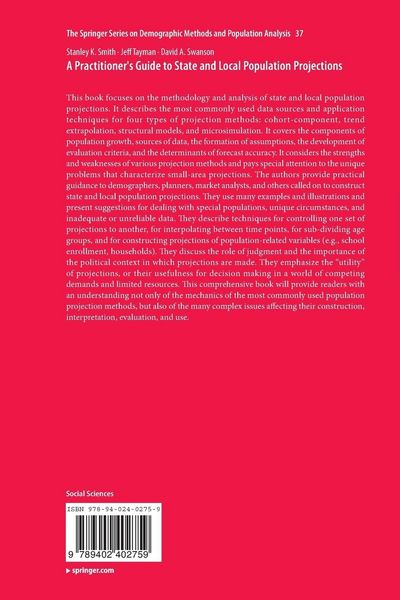
This book focuses on the methodology and analysis of state and local population projections. It describes the most commonly used data sources and application techniques for four types of projection methods: cohort-component, trend extrapolation, structural models, and microsimulation. It covers the components of population growth, sources of data, the formation of assumptions, the development of evaluation criteria, and the determinants of forecast accuracy. It considers the strengths and weaknesses of various projection methods and pays special attention to the unique problems that characterize small-area projections.    The authors provide practical guidance to demographers, planners, market analysts, and others called on to construct state and local population projections. They use many examples and illustrations and present suggestions for dealing with special populations, unique circumstances, and inadequate or unreliable data. They describe techniques for controlling one set of projections to another, for interpolating between time points, for sub-dividing age groups, and for constructing projections of population-related variables (e.g., school enrollment, households). They discuss the role of judgment and the importance of the political context in which projections are made. They emphasize the “utility” of projections, or their usefulness for decision making in a world of competing demands and limited resources.   This comprehensive book will provide readers with an understanding not only of the mechanics of the most commonly used population projection methods, but also of the many complex issues affecting their construction, interpretation, evaluation, and use.

Rezension

“In fourteen chapters it provides the
reader with the necessary tools for creating numerous population projection
methods. … both graduate and upper-level undergraduate students could use this
book as the sole textbook for a course, or as a supplement focusing on select
chapters. Similarly, those who need a refresher on specific projection
fundamentals will find this book full of helpful information. … Reading this
book is an eye-opening journey into the complex world of population
projections/forecasts.” (Alison Yacyshyn, Canadian Studies in population, Vol. 42
(3-4), 2015)

Produktdetails

Einband

Taschenbuch

Erscheinungsdatum

17.09.2016

Abbildungen

XV, 411 p. 26 illus.

Verlag Springer Netherland

Produktdetails

Einband

Taschenbuch

Erscheinungsdatum

17.09.2016

Abbildungen

XV, 411 p. 26 illus.

Verlag Springer Netherland
Seitenzahl

411

Maße (L/B/H)

23,5/15,5/2,4 cm

Gewicht

645 g

Auflage

Softcover reprint of the original 1st ed. 2013

Sprache

Englisch

ISBN

978-94-024-0275-9

Herstelleradresse

Springer-Verlag GmbH
Europaplatz 3
69115 Heidelberg
DE

Email: ProductSafety@springernature.com

Noch keine Bewertungen vorhanden

Verfassen Sie die erste Bewertung zu diesem Artikel

Helfen Sie anderen Kundinnen und Kunden durch Ihre Meinung.

Kundinnen und Kunden meinen

Bewertungen (0)

  • Produktbild: A Practitioner's Guide to State and Local Population Projections
  • Produktbild: A Practitioner's Guide to State and Local Population Projections
  • Chapter 1: Rationale, Terminology, Scope.- Chapter 2: Fundamental  of Population Analysis.- Chapter 3: Overview of the Cohort-Component Method.- Chapter 4: Mortality.- Chapter 5: fertility.- Chapter 6: Migration.- Chapter 7: Implementing the Cohort-Component Method.- Chapter 8: Extrapolation Methods.- Chapter 9: Structural and Microsimulation Models.- Chapter 10: Special Adjustments.- Chapter 11: Related Projections.- Chapter 12: Evaluating Projections.- Chapter 13 Forecast Accuracy and Bias.- Chapter 14: A Practical Guide to Small-Area Projections.- Epilogues: Some Final Thoughts.- Glossary.- Index.