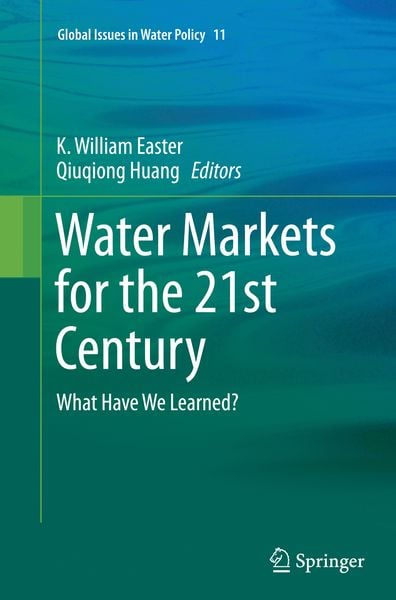
Water Markets for the 21st Century What Have We Learned?
-
- Hardcover
- Taschenbuch ausgewählt
- eBook
-
Sprache:Englisch
142,99 €
inkl. gesetzl. MwSt.,
Beschreibung
Produktdetails
Einband
Taschenbuch
Erscheinungsdatum
18.09.2016
Abbildungen
XVIII, 36 illus., 30 illus. in color., schwarz-weiss Illustrationen, farbige Illustrationen
Herausgeber
K. William Easter + weitereVerlag
Springer NetherlandSeitenzahl
341
Maße (L/B/H)
23,5/15,5/2 cm
Gewicht
546 g
Auflage
Softcover reprint of the original 1st edition 2014
Sprache
Englisch
ISBN
978-94-024-0794-5
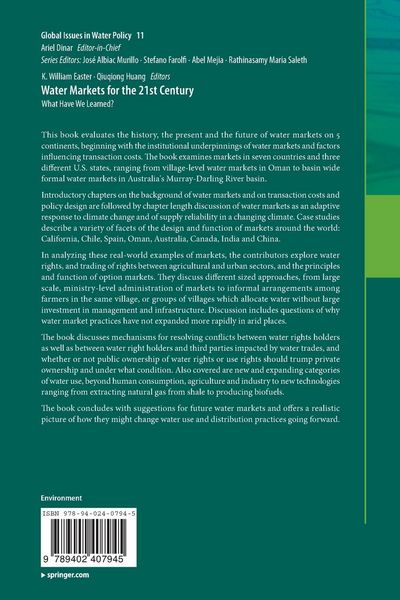
This book evaluates the history, the present and the future of water markets on 5 continents, beginning with the institutional underpinnings of water markets and factors influencing transaction costs. The book examines markets in seven countries and three different U.S. states, ranging from village-level water markets in Oman to basin wide formal water markets in Australia's Murray-Darling River basin.
Introductory chapters on the background of water markets and on transaction costs and policy design are followed by chapter length discussion of water markets as an adaptive response to climate change and of supply reliability in a changing climate. Case studies describe a variety of facets of the design and function of markets around the world: California, Chile, Spain, Oman, Australia, Canada, India and China.
In analyzing these real-world examples of markets, the contributors explore water rights and trading of rights between agricultural and urban sectors and the principles and function of option markets. They discuss different sized approaches, from large scale, ministry-level administration of markets to informal arrangements among farmers in the same village, or groups of villages which allocate water without large investment in management and infrastructure. Discussion includes questions of why water market practices have not expanded more rapidly in arid places.
The book discusses mechanisms for resolving conflicts between water rights holders as well as between water right holders and third parties impacted by water trades and whether or not public ownership of water rights or use rights should trump private ownership and under what condition. Also covered are new and expanding categories of water use, beyond human consumption, agriculture and industry to new technologies ranging from extracting natural gas from shale to producing biofuels.
The book concludes with suggestions for future water markets and offers a realistic picture of how they might change water use and distribution practices going forward.
Kundinnen und Kunden meinen
Verfassen Sie die erste Bewertung zu diesem Artikel
Helfen Sie anderen Kund*innen durch Ihre Meinung
Kurze Frage zu unserer Seite
Vielen Dank für Ihr Feedback
Wir nutzen Ihr Feedback, um unsere Produktseiten zu verbessern. Bitte haben Sie Verständnis, dass wir Ihnen keine Rückmeldung geben können. Falls Sie Kontakt mit uns aufnehmen möchten, können Sie sich aber gerne an unseren Kund*innenservice wenden.
zum Kundenservice