KI-Beratung Beta

Gutscheinbedingungen

**Gültig am 20.11.2026 ab einem Mindestbestellwert von 30€ auf Spielzeug, Schreibwaren, Filme, Geschenke & Trends, Musik, tolino eReader & Zubehör, Hörbücher und Hörbuch-Downloads, nicht preisgebundene Bücher und Kalender online auf thalia.at und in der Thalia App. Einzelne Artikel können ausgeschlossen sein. Aufgrund der Buchpreisbindung sind deutschsprachige Bücher und eBooks ausgenommen. Zusätzlich ausgenommen sind Abos & Flatrates, Games, Geschenkkarten/-boxen, Shelfies, Software, Zeitschriften sowie einzelne Artikel von tonies®. Pro Einkauf einmal einlösbar. Click & Collect nur bei Onlinevorabzahlung möglich. Keine Barauszahlung. Nicht kombinierbar mit anderen Aktionen und Gutscheinen. Gutschein wird auf max. 500€ Bestellwert angerechnet. Nicht gültig für Versandkosten und Services. Preisgebundene Artikel sind vom Mindestbestellwert ausgeschlossen.

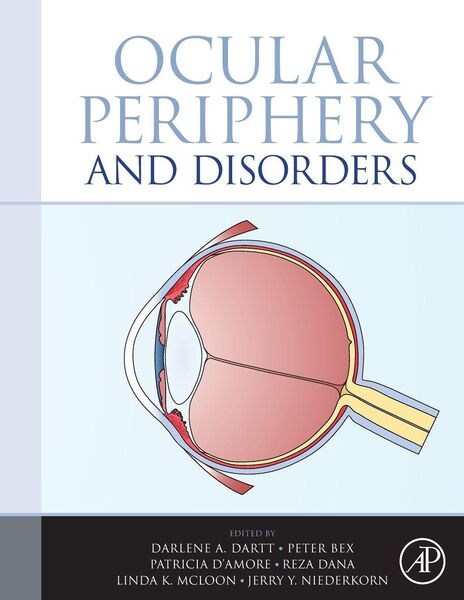
  • Produktbild: Ocular Periphery and Disorders
  • Produktbild: Ocular Periphery and Disorders

Ocular Periphery and Disorders

127,99 €

inkl. gesetzl. MwSt., Versandkostenfrei


Beschreibung

This selection of articles from the Encyclopedia of the Eye is the first single-volume overview presenting articles on the function, biology, physiology, and pathology of the structures of the ocular periphery, as well as the related disorders and their treatment. The peripheral structures are implicated...

Beschreibung

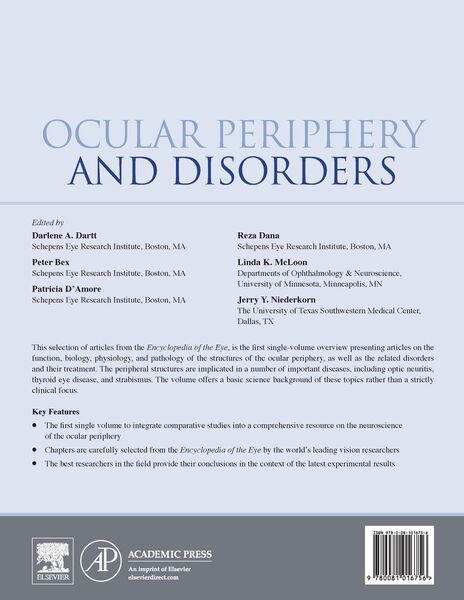
This selection of articles from the Encyclopedia of the Eye is the first single-volume overview presenting articles on the function, biology, physiology, and pathology of the structures of the ocular periphery, as well as the related disorders and their treatment. The peripheral structures are implicated in a number of important diseases, including optic neuritis, thyroid eye disease, and strabismus. The volume offers a basic science background of these topics rather than a strictly clinical focus.

Portrait

Dr. D'Amore earned her PhD in Biology from Boston University, was a postdoctoral fellow in Biological Chemistry and Ophthalmology at Johns Hopkins Medical School, then moved to Boston Children's Hospital as Assistant Professor where she remains Research Associate in Surgery. In 1998, she became Charles L. Schepens Professor of Ophthalmology and Professor of Pathology at Harvard Medical School and a Senior Scientist at Mass. Eye and Ear. She is the Associate Chief of Basic and Translational Research for Ophthalmology at Mass. Eye and Ear and the Vice Chair of Basic and Translational Research for the Department of Ophthalmology.
Dr. D'Amore is an international expert in vascular growth and development and has been at the forefront of angiogenesis research for over three decades. She has published more than 170 peer-reviewed papers, 75 reviews, and edited or co-edited two books.In addition to his role as Senior Scientist and Co-Director at the Schepens Eye Research Institute, Dr. Reza Dana holds the Claes H. Dohlman Chair in Ophthalmology at Harvard Medical School. He is Director of the Cornea & Refractive Surgery Service at the Massachusetts Eye & Ear, and serves as the Vice Chairman of the Harvard Department of Ophthalmology and Associate Chief of Ophthalmology for Academic Programs at Massachusetts Eye and Ear. After graduating Summa Cum Laude from St. Paul's School in New Hampshire, he completed his bachelor's (Phi Beta Kappa), graduate, and medical education at Johns Hopkins University. He performed his residency in Ophthalmology at the Illinois Eye and Ear Infirmary in Chicago, followed by a clinical fellowship in Cornea and External Diseases at the Wills Eye Hospital in Philadelphia. Reza then completed additional fellowship training in Immunology and Uveitis at the Massachusetts Eye and Ear Infirmary, and in Ocular and Transplantation Immunology at the Schepens Eye Research Institute. Dr. Dana also holds a Master of Science degree in Management from Harvard University. Reza has been a member of the full-time Harvard faculty since 1995. As a clinician-scientist, he has a particular interest in the molecular and cellular mechanisms of inflammation as they pertain to the ocular surface and anterior segment pathologies, including dry eye, allergy, wound healing responses, and transplant rejection.

Produktdetails

Einband

Taschenbuch

Erscheinungsdatum

02.09.2016

Herausgeber Darlene A. Dartt + weitere
Verlag Elsevier Science & Technology

Produktdetails

Einband

Taschenbuch

Erscheinungsdatum

02.09.2016

Herausgeber
Verlag Elsevier Science & Technology
Seitenzahl

568

Maße (L/B/H)

27,9/21,6/2,9 cm

Gewicht

1300 g

Sprache

Englisch

ISBN

978-0-08-101675-6

Noch keine Bewertungen vorhanden

Verfassen Sie die erste Bewertung zu diesem Artikel

Helfen Sie anderen Kundinnen und Kunden durch Ihre Meinung.

Kundinnen und Kunden meinen

Bewertungen (0)

  • Produktbild: Ocular Periphery and Disorders
  • Produktbild: Ocular Periphery and Disorders
  • I. Anatomy and Pathophysiology of Blinking and Eye Movements
    Eyelid anatomy and the pathophysiology of blinking
    Differentiation and morphogenesis of extraocular muscles
    Extraocular muscle anatomy
    Extracocular muscle metabolism
    Extraocular muscles: proprioception and proprioceptors
    Abnormal eye movements due to disease of the extraocular muscles and their innervation
    Extraocular muscles: functional assessment in the clinic

    II. Structure and Function of the Tear Film, Ocular Adnexa, Cornea, and Conjunctiva in Health and Pathogenesis in Disease
    Meibomian glands and lipid layer
    Lacrimal gland overview
    Lacrimal gland hormone regulation
    Lacrimal gland signaling-neural
    Lids: Anatomy, pathophysiology, and mucocutaneous junction
    Ocular surface-overview of electrolyte and fluid transport across the conjunctiva
    Conjunctival Goblet cells
    Ocular mucins
    Tear drainage
    Cornea overview
    Corneal epithelium-cell biology and basic science
    Corneal nerves-anatomy
    Corneal nerves-function
    Corneal epithelium-wound healing junctions, attachment to stroma receptors, matrix metalloproteinases, intercellular communications
    Corneal epithelium-transport and permeability
    Stem cells of the ocular surface
    The ocular surface-the surgical treatment for corneal epithelial stem cell deficiency, corneal epithelial defects, and periferal corneal ulcer
    Refractive surgery
    Refractive surgery and inlays
    Contact lenses
    Imaging of the cornea
    The corneal stroma
    Corneal dystrophies
    Corneal imaging-clinical
    Corneal scars
    Corneal endothelium-overview
    Regulation of corneal endothelial function
    Regulation of corneal endothelial cell proliferation
    Artificial cornea
    Drug delivery to cornea and conjunctiva-esterase- and protease-directed prodrug design
    Knock-out mice models: cornea, conjunctiva, eyelids, and lacrimal glands
    Gene therapy

    III. Immune Regulation of the Cornea and Conjunctiva and Its Dysregulation in Disease
    Adaptive Immune System and the Eye: Mucosal Immunity
    Adaptive immune system and the eye: T-cell mediated immunity
    Innate immune system and the eye
    Immunoregulatory processes that sustain immune privilege in the eye
    Immunosupressive and anti-inflammatory molecules that maintain immune previlege of the eye
    Antigen-presenting cells in the eye and ocular surface
    Dry eye: An immune-based inflammation
    Penetrating keratoplasty
    Immunopathogenesis of HSV Keratitis
    Immunopathogenesis of Onchocerciasis (River Blindness)
    Immunopathogenesis of pseudomonas keratitis
    Immunobiology of acanthomeba karatitis
    Molecular and cellular mechanisms in allergic conjunctivitis
    Pathogenesis of fungal keratitis
    Conjunctiva Immune surveillance
    Defense mechanisms of tears and ocular surface
    Corneal epithelium- response to infection
    Inflammation of the Conjunctiva
    Concept of Angiogenic Privilege
    Corneal angiogenesis
    Avascularity of the cornea

    IV. Visual Acuity Related to the Cornea and Its Disorders
    Visual optics: pupil
    Acuity
    Contrast sensitivity
    Astigmatism
    Vera-Diaz- Myopia
    Levi-Amblyopia
    Harb- Hyperopia