Gutscheinbedingungen

**Gültig bis 06.07.2026 auf fremdsprachige Bücher online auf thalia.at, in der Thalia App ab einem Mindestbestellwert von 30€ und in allen Thalia Buchhandlungen in Österreich. In den Buchhandlungen nur gültig auf lagernde Ware. Einzelne Artikel können ausgeschlossen sein. Ausgenommen sind preisgebundene Artikel & eBooks. Pro Einkauf einmal einlösbar. Nur gültig gegen Vorlage oder im Onlineshop hinterlegter Bonuscard. Infos zur Einlösung in der Buchhandlung sind auf der Bonuscard-Vorteilspreisseite zu finden. Click & Collect nur bei Onlinevorabzahlung möglich. Keine Einlösung bei Scan & Go-Bezahlung. Keine Barauszahlung. Nicht kombinierbar mit anderen Aktionen und Gutscheinen. Gutschein wird auf max. 500€ Bestellwert angerechnet. Nicht gültig für Versandkosten und Services.

  • Produktbild: Schooling for Sustainable Development in Europe
  • Produktbild: Schooling for Sustainable Development in Europe
Band 6

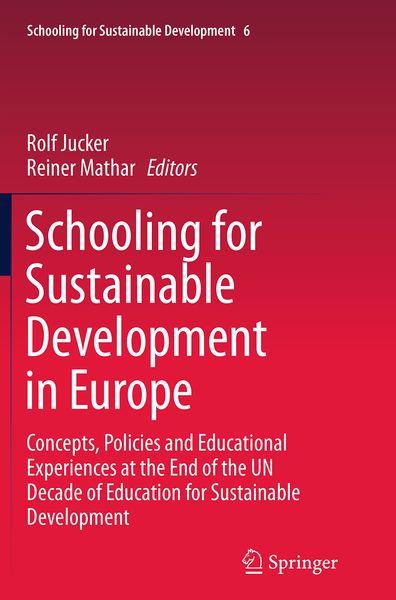
Schooling for Sustainable Development in Europe Concepts, Policies and Educational Experiences at the End of the UN Decade of Education for Sustainable Development

99,99 €

inkl. gesetzl. MwSt., Versandkostenfrei


Beschreibung

Produktdetails

Einband

Taschenbuch

Erscheinungsdatum

10.09.2016

Abbildungen

XXI, 17 illus., 14 illus. in color., farbige Illustrationen, schwarz-weiss Illustrationen

Herausgeber

Rolf Jucker + weitere

Verlag

Springer

Seitenzahl

380

Maße (L/B/H)

23,5/15,5/2,2 cm

Gewicht

610 g

Auflage

Softcover reprint of the original 1st edition 2015

Sprache

Englisch

ISBN

978-3-319-38113-8

Beschreibung

Portrait

Rolf Jucker is currently teamleader at Kaospilots Switzerland and a coach and consultant in organisational learning processes towards sustainability. Until the end of 2013 he ran the department of conceptual ESD development at the Swiss Foundation for ESD, éducation21. From 2008–2012 he was director of the Swiss Foundation for Environmental Education, an independent body tasked with the mainstreaming of Environmental Education and ESD in the Swiss school system. Having gained an MSc in Education for Sustainability, he has worked extensively as an international ESD advisor and has widely published on the subject, amongst others Our Common Illiteracy. Education as if the Earth and People mattered (2002).

Reiner Mathar is currently heading the coordination of ESD in the state of Hessen (Germany), is German representative of the KMK (Standing Conference of Ministers of Education in Germany) at the Steering Committee of UNECE (United Nations Economic Commission for Europe) and Member of the National Round Table for the UN-Decade on ESD in Germany. Since 1997 he has been involved in all nation-wide programmes on ESD in Germany, in particular in the process of developing the concept of "Gestaltungskompetenz", which is the leading concept of ESD in Germany. In the field of ESD with a focus on global development, he is one of the editors of the national curriculum framework. In 2010 he was co-opted as an expert on ESD onto the international ESD-EXPERT-net (India, Germany, Mexico and South-Africa).

Produktdetails

Einband

Taschenbuch

Erscheinungsdatum

10.09.2016

Abbildungen

XXI, 17 illus., 14 illus. in color., farbige Illustrationen, schwarz-weiss Illustrationen

Herausgeber

Verlag

Springer

Seitenzahl

380

Maße (L/B/H)

23,5/15,5/2,2 cm

Gewicht

610 g

Auflage

Softcover reprint of the original 1st edition 2015

Sprache

Englisch

ISBN

978-3-319-38113-8

Herstelleradresse

Springer-Verlag KG
Sachsenplatz 4-6
1201 Wien
AT

Email: GPSR Kontakt

Noch keine Bewertungen vorhanden

Verfassen Sie die erste Bewertung zu diesem Artikel

Helfen Sie anderen Kundinnen und Kunden durch Ihre Meinung.

Kundinnen und Kunden meinen

Bewertungen (0)

  • Produktbild: Schooling for Sustainable Development in Europe
  • Produktbild: Schooling for Sustainable Development in Europe
  • PART I: GENERAL AND CROSS-NATIONAL ISSUES.- Chapter 1: Introduction: From a Single Project to a Systemic Approach to Sustainability-An Overview of Developments in Europe; Rolf Jucker and Reiner Mathar.- Chapter 2: A Whole School Approach to Sustainable Development: Elements of Education for Sustainable Development and Student's Competencies for Sustainable Development; Reiner Mathar.- Chapter 3: Quality Criteria for ESD Schools: Engaging Whole Schools in Education for Sustainable Development; Michela Mayer and Søren Breiting.- Chapter 4: Education for Sustainable Development (ESD): A Critical Review of Concept, Potential and Risk; William Scott.- Chapter 5: Perspectives on ESD from a European Member of UNESCO's High-Level Panel, with Particular Reference to Sweden; Carl Lindberg.- Chapter 6: Social Learning-Oriented Capacity-Building for Critical Transitions towards Sustainability; Arjen Wals.- Chapter 7: Education for Sustainable Development in a Cultural Ecological Frame; Patrick Dillon.- PART II: CASE STUDIES FROM INDIVIDUAL COUNTRIES OR REGIONS.- Chapter 8: Project-Variety and Established Structures: Development and Actual Practice of ESD in Germany; Reiner Mathar.- Chapter 9: Education for Sustainable Development between Main-Streaming and Systemic Change: Switzerland as a Case Study; Rolf Jucker and Florence Nuoffer.- Chapter 10: Education for Sustainable Development in Austria: Networking for Innovation; Franz Rauch and Günther Pfaffenwimmer.- Chapter 11: Moving Schools towards ESD in Catalonia, Spain: The Tensions of a Change; Mariona Espinet, Mercè Junyent, Arnau Amat and Alba Castelltort.- Chapter 12: The Challenge of Mainstreaming ESD in Hungary; Mónika Réti, Dániel Horváth, Katalin Czippán and Attila Varga.- Chapter 13: Education for Sustainable Development in Finland; Mauri Åhlberg, Mervi Aineslahti, Annukka Alppi, LeaHoutsonen, Anna Maaria Nuutinen and Arto Salonen.- Chapter 14: Learning from ESD Projects during the UN Decade in Norway; Mari Ugland Andresen, Nina Høgmo and Astrid Sandås.- Chapter 15: Searching for a Sea Change, One Drip at a Time: Education for Sustainable Development in Denmark; Simon Rolls, Katrine Dahl Madsen, Torben Ingerslev Roug and Niels Larsen.- Chapter 16: Education for Sustainable Development in Flanders: the UN Decade and Beyond; Katrien Van Poeck, Jürgen Loones and Ingrid Claus.- Chapter 17: Education for Sustainable Development in France; Michel Ricard and Maryvonne Dussaux.- Chapter 18: Paving the Way to Education for Sustainable Development in Cyprus: Achievements, Findings and Challenges; Aravella Zachariou and Chrysanthi Kadji-Beltran.- Chapter 19: Reflections on ESD in UK Schools; Stephen Martin, James Dillon, Peter Higgins, Glenn Strachan and Paul Vare.- Chapter 20: Education for Sustainable Development in the Netherlands; Martin de Wolf and André de Hamer.