KI-Beratung Beta

Gutscheinbedingungen

**Gültig bis 30.11.2026 auf Spielzeug, Schreibwaren, Filme, Geschenke & Trends, Musik, tolino eReader & Zubehör, Hörbücher und Hörbuch-Downloads, nicht preisgebundene Bücher und Kalender online auf thalia.at und in der Thalia App. Einzelne Artikel können ausgeschlossen sein. Aufgrund der Buchpreisbindung sind deutschsprachige Bücher und eBooks ausgenommen. Zusätzlich ausgenommen sind Abos & Flatrates, Games, Geschenkkarten/-boxen, Shelfies, Software, Zeitschriften sowie einzelne Artikel von tonies®. Pro Einkauf einmal einlösbar. Nur gültig mit im Onlineshop hinterlegter Bonuscard. Click & Collect nur bei Onlinevorabzahlung möglich. Keine Barauszahlung. Nicht kombinierbar mit anderen Aktionen und Gutscheinen. Gutschein wird auf max. 500€ Bestellwert angerechnet. Nicht gültig für Versandkosten und Services.

  • Produktbild: Developmental Toxicology
  • Produktbild: Developmental Toxicology
Band 889

Developmental Toxicology Methods and Protocols

139,99 €

inkl. gesetzl. MwSt., Versandkostenfrei


Beschreibung

The discipline of developmental toxicology is an integration of concepts, models, and methodologies based heavily on the superimposition of toxicology principles upon the science of developmental biology.  The science of developmental toxicology also borrows from other research areas that are concerned...

Beschreibung

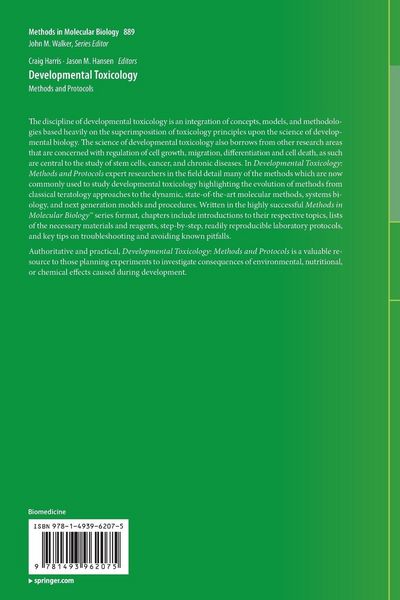
The discipline of developmental toxicology is an integration of concepts, models, and methodologies based heavily on the superimposition of toxicology principles upon the science of developmental biology.  The science of developmental toxicology also borrows from other research areas that are concerned with regulation of cell growth, migration, differentiation and cell death, as such are central to the study of stem cells, cancer, and chronic diseases. In
Developmental Toxicology: Methods and Protocols
expert researchers in the field detail many of the methods which are now commonly used to study developmental toxicology highlighting the evolution of methods from classical teratology approaches to the dynamic, state-of-the-art molecular methods, systems biology, and next generation models and procedures. Written in the highly successful
Methods in Molecular Biology™
series format, chapters include introductions to their respective topics, lists of the necessary materials and reagents, step-by-step, readily reproducible laboratory protocols, and key tips on troubleshooting and avoiding known pitfalls.


Authoritative and practical,
Developmental Toxicology: Methods and Protocols
is a valuable resource to those planning experiments to investigate consequences of environmental, nutritional, or chemical effects caused during development.

Produktdetails

Einband

Taschenbuch

Erscheinungsdatum

23.08.2016

Abbildungen

XII, 471 p.

Herausgeber Craig Harris + weitere

Produktdetails

Einband

Taschenbuch

Erscheinungsdatum

23.08.2016

Abbildungen

XII, 471 p.

Herausgeber
Verlag Humana Press
Seitenzahl

471

Maße (L/B/H)

25,4/17,8/2,7 cm

Gewicht

902 g

Auflage

Softcover reprint of the original 1st ed. 2012

Sprache

Englisch

ISBN

978-1-4939-6207-5

Herstelleradresse

Springer-Verlag GmbH
Tiergartenstr. 17
69121 Heidelberg
DE

Email: ProductSafety@springernature.com

Noch keine Bewertungen vorhanden

Verfassen Sie die erste Bewertung zu diesem Artikel

Helfen Sie anderen Kundinnen und Kunden durch Ihre Meinung.

Kundinnen und Kunden meinen

Bewertungen (0)

  • Produktbild: Developmental Toxicology
  • Produktbild: Developmental Toxicology

  • Volume Overview - Introduction.-
    In Vivo
    Models of Developmental Toxicology.-Caenorhabditis Elegans as a Model in Developmental Toxicology.-Zebrafish Embryo Developmental Toxicology Assay.-Gene Knockdown by Morpholino-modified Oligonucleotides in the Zebrafish (Danio rerio) Model: Applications for Developmental Toxicology.-An Amphibian Model for Studies of Developmental Reproductive Toxicity.-Avian Models in Teratology and Developmental Toxicology.-Overview of In Vitro Models in Developmental Toxicology.-Primary Cell and Micromass Culture in Assessing Developmental Toxicity.-Embryonic Stem Cell Test (EST): Stem cell Use in Predicting Developmental Cardiotoxicity and Osteotoxicity.-Mouse Embryonic Stem Cell Adherent Cell Differentiation and Cytotoxicity (ACDC) Assay.-The Murine Limb Bud in Culture as an In Vitro Teratogenicity Test System.-Rodent Whole Embryo Culture.-Rabbit Whole Embryo Culture.-Assessment of Xenobiotic Biotransformation Including Reactive Oxygen Species Generation in the Embryo using Benzene as an Example.-Methodological Approaches to Cytochrome P450 Profiling in Embryos.-Analysis of Nrf2-Mediated Transcriptional Induction of Antioxidant Response in Early Embryos.-Regulation and Control of AP-1 Binding Activity in Embryotoxicity.-Thioredoxin Redox Status Assessment During Embryonic Development:  The Redox Western.-Methods for the Determination of Plasma or Tissue Glutathione Levels.-Oxidative Stress, Thiols, and Redox Profiles.-A Review of Toxicogenomic Approaches in Developmental Toxicology.-Epigenetic Approaches and Methods in Developmental Toxicology: Role of HDAC Inhibition in Teratogenic Events.-DNA Methylation Screening and Analysis.-Assessment of Histiotrophic Nutrition using Fluorescent Probes.-Diabetic Embryopathy.-Gene Expression Analysis in Developing Embryos:
    In situ
    Hybridization.-Assessment of Gross Fetal Malformations:  The Modernized Wilson Technique and Skeletal Staining.