
Porous Materials for Carbon Dioxide Capture
-
- Hardcover
- Taschenbuch ausgewählt
- eBook
-
Sprache:Englisch
99,99 €
inkl. gesetzl. MwSt.,
Beschreibung
Produktdetails
Einband
Taschenbuch
Erscheinungsdatum
03.09.2016
Abbildungen
X, 245 p. 156 illus., 68 illus. in color.
Herausgeber
An-Hui Lu + weitereVerlag
Springer BerlinSeitenzahl
245
Maße (L/B/H)
23,5/15,5/1,5 cm
Gewicht
394 g
Auflage
Softcover reprint of the original 1st edition 2014
Sprache
Englisch
ISBN
978-3-662-51358-3
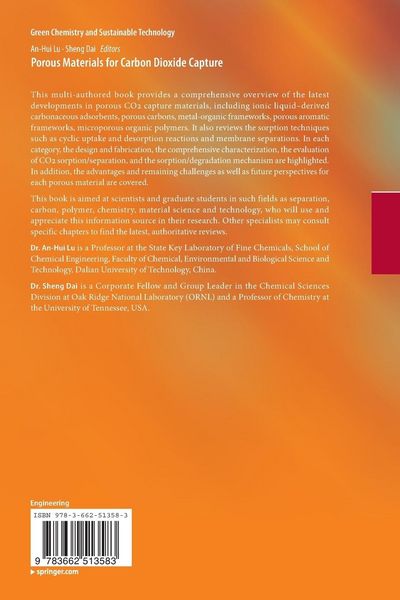
This multi-authored book provides a comprehensive overview of the latest developments in porous CO
2
capture materials, including ionic liquid–derived carbonaceous adsorbents, porous carbons, metal-organic frameworks, porous aromatic frameworks, micro porous organic polymers. It also reviews the sorption techniques such as cyclic uptake and desorption reactions and membrane separations. In each category, the design and fabrication, the comprehensive characterization, the evaluation of CO
2
sorption/separation and the sorption/degradation mechanism are highlighted. In addition, the advantages and remaining challenges as well as future perspectives for each porous material are covered.
This book is aimed at scientists and graduate students in such fields as separation, carbon, polymer, chemistry, material science and technology, who will use and appreciate this information source in their research. Other specialists may consult specific chapters to find the latest, authoritative reviews.
Dr. An-Hui Lu
is a Professor at the State Key Laboratory of Fine Chemicals, School of Chemical Engineering, Faculty of Chemical, Environmental and Biological Science and Technology, Dalian University of Technology, China.
Dr. Sheng Dai
is a Corporate Fellow and Group Leader in the Chemical Sciences Division at Oak Ridge National Laboratory (ORNL) and a Professor of Chemistry at the University of Tennessee, USA.
Noch keine Bewertungen vorhanden
Verfassen Sie die erste Bewertung zu diesem Artikel
Helfen Sie anderen Kundinnen und Kunden durch Ihre Meinung.
Kurze Frage zu unserer Seite
Vielen Dank für Ihr Feedback
Wir nutzen Ihr Feedback, um unsere Produktseiten zu verbessern. Bitte haben Sie Verständnis, dass wir Ihnen keine Rückmeldung geben können. Falls Sie Kontakt mit uns aufnehmen möchten, können Sie sich aber gerne an unseren Kund*innenservice wenden.
zum Kundenservice