Gutscheinbedingungen

**Gültig bis 25.06.2026 auf fremdsprachige Bücher online auf thalia.at und in der Thalia App. Einzelne Artikel können ausgeschlossen sein. Ausgenommen sind preisgebundene Artikel & eBooks. Pro Einkauf einmal einlösbar. Click & Collect nur bei Onlinevorabzahlung möglich. Keine Barauszahlung. Nicht kombinierbar mit anderen Aktionen und Gutscheinen. Gutschein wird auf max. 500€ Bestellwert angerechnet. Nicht gültig für Geschenkkarten, Versandkosten und Services.

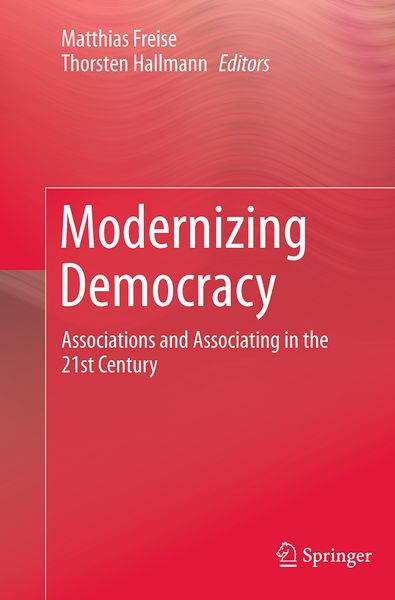
  • Produktbild: Modernizing Democracy
  • Produktbild: Modernizing Democracy
- 11%

Modernizing Democracy Associations and Associating in the 21st Century

11% sparen

96,99 € UVP 109,99 €

inkl. gesetzl. MwSt., Versandkostenfrei


Beschreibung

Produktdetails

Einband

Taschenbuch

Erscheinungsdatum

03.09.2016

Abbildungen

XIX, 13 illus., 4 illus. in color., schwarz-weiss Illustrationen, farbige Illustrationen

Herausgeber

Matthias Freise + weitere

Verlag

Springer Us

Seitenzahl

357

Maße (L/B/H)

23,5/15,5/2,1 cm

Gewicht

575 g

Auflage

Softcover reprint of the original 1st edition 2014

Sprache

Englisch

ISBN

978-1-4939-5530-5

Beschreibung

Portrait

Matthias Freise received his Ph.D. in Political Science from Münster University, Germany where Annette Zimmer was his doctoral advisor. Currently, he is Assistant Professor of Political Science and executive director of the Graduate School of Politics at the same place. Previously, he supervised a doctoral research group on “European Civil Society and Multilevel Governance” at Münster University together with Annette Zimmer. His research interests include civil society theory, third sector research, European multilevel governance and interest representation. He is co-editor of the series “European Civil Society” at Nomos Publishers. Recent publications include A Panacea for all seasons? Civil Society and Governance in Europe (Baden-Baden: Nomos, 2010) and several articles on civil society organisations in public private partnerships. In addition, Matthias Freise is a teacher in the advanced training course on Nonprofit Management and Governance at Münster University.

Thorsten Hallmann received his Ph.D. in Political Science from Münster University, Germany, in 2008. His dissertation dealt with the public discourse on drug policy and the "drug scene" in Münster. He is mainly working on third sector and local policy issues. From 2011 to 2013 he was a member of the WILCO research team, a EU-funded international project on welfare innovations on the local level. As a student, he joined the Johns Hopkins Comparative Nonprofit Sector Project team in Münster, headed by Annette Zimmer. Later they conducted further research on local associations together. Hallmann also worked as a volunteer and board member in a local refugee relief organisation and is an active member of further civic associations.

Produktdetails

Einband

Taschenbuch

Erscheinungsdatum

03.09.2016

Abbildungen

XIX, 13 illus., 4 illus. in color., schwarz-weiss Illustrationen, farbige Illustrationen

Herausgeber

Verlag

Springer Us

Seitenzahl

357

Maße (L/B/H)

23,5/15,5/2,1 cm

Gewicht

575 g

Auflage

Softcover reprint of the original 1st edition 2014

Sprache

Englisch

ISBN

978-1-4939-5530-5

Herstelleradresse

Springer-Verlag GmbH
Tiergartenstr. 17
69121 Heidelberg
DE

Email: ProductSafety@springernature.com

Kundinnen und Kunden meinen

0 Bewertungen

Informationen zu Bewertungen

Zur Abgabe einer Bewertung ist eine Anmeldung im Konto notwendig. Die Authentizität der Bewertungen wird von uns nicht überprüft. Wir behalten uns vor, Bewertungstexte, die unseren Richtlinien widersprechen, entsprechend zu kürzen oder zu löschen.

Die Bewertungen sind nach Format, Anzahl Sterne und Datum sortiert.

Verfassen Sie die erste Bewertung zu diesem Artikel

Helfen Sie anderen Kund*innen durch Ihre Meinung

Kundinnen und Kunden meinen

0 Bewertungen filtern

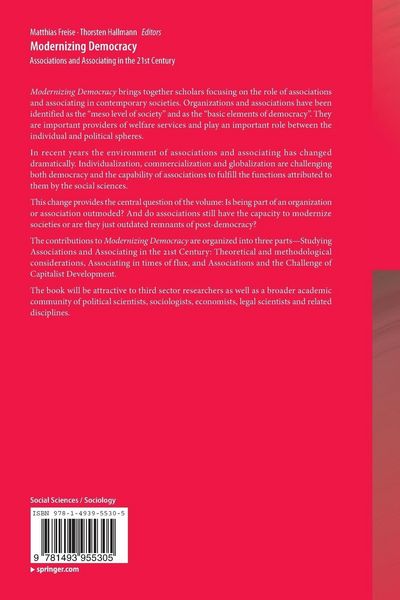
  • Produktbild: Modernizing Democracy
  • Produktbild: Modernizing Democracy
  • Preface.- Chapter 1. Modernizing Democracy? Associations and Associating in the 21st Century.- Chapter 2. Social Life and Politics in Voluntary Organizations :An Historical Perspective.- Chapter 3. Alexis de Tocqueville revisited: Between the Centralization of Political Power, Civil Associations and Gender Politics in the European Union.- Chapter 4. Tocqueville did not write about soccer clubs: Participation in voluntary associations and political involvement.- Chapter 5. Voluntary Associations and Social Capital: Inclusive and exclusive dimensions.- Chapter 6. Who Calls the Shots? The Real Normative Power of Civil Society.- Chapter 7. The Impact of Civil Society on Sustainable Development.- Chapter 8. Volunteering in a hybrid institutional and organizational environment: An emerging research agenda.- Chapter 9. Voluntary Involvement in German Welfare Organizations.- Chapter 10. Changes in work and human services: On the risks and chances they entail for volunteering.- Chapter 11. Residual and Emancipatory Value of Volunteering in the Czech Society.- Chapter 12. Two Decades of Participatory Democracy in Poland.- Chapter 13. The role of civil society organizations in the field of unemployment: for or by the unemployed?.- Chapter 14. Transnational mobility and associative life.- Chapter 15. Associating at the European level: Civil Society Networks in Brussels.- Chapter 16. Why Is There no Statute for a European Association?.- Chapter 17. Developments in the Third Sector – The Last Decade and a Cautious View into the Future.- Chapter 18. “Though we manage we are no corporation!” Patterns in volunteer management of German youth organisations.- Chapter 19. Governance logics in NGDO-Boards between political and economic challenges: Empirical results from Austria.- Chapter 20. Associating for Affordable Housing: Nonprofit Social Housing in Germany and the US.- Chapter 21. From Mainstreaming to Modernization? New Labour and the Third Sector in England.- Chapter 22. Towards a neoliberal Third sector? International lessons from recent developments in China.- Chapter 23. Social Investment: Franco-German Experiences.- Chapter 24. Opportunities and limits of cooperatives in times of socio-ecological transformation.- Chapter 25. Nonprofit Arts and Culture in the United States: Roles, Audiences and Participation.- Chapter 26. Major Giving in Germany: Facts and Opportunities.- Chapter 27. Aktive Bürgerschaft: Innovations for Civil Society in Germany.