KI-Beratung Beta

Produktbild: The Practice of Industrial Policy
- 10%

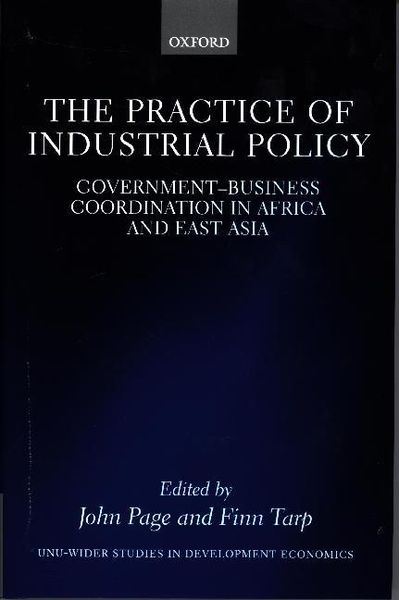
The Practice of Industrial Policy

10% sparen

131,99 € UVP 147,10 €

inkl. gesetzl. MwSt., Versandkostenfrei


Beschreibung

This is an open access title available under the terms of a CC BY-NC-SA 3.0 IGO licence. It is free to read at Oxford Scholarship Online and offered as a free PDF download from OUP and selected open access locations. Much of the information relevant to policy formulation for industrial development is...

Beschreibung

This is an open access title available under the terms of a CC BY-NC-SA 3.0 IGO licence. It is free to read at Oxford Scholarship Online and offered as a free PDF download from OUP and selected open access locations. Much of the information relevant to policy formulation for industrial development is held by the private sector, not by public officials. There is therefore fairly broad agreement in the development literature that some form of structured engagement - often referred to as close or strategic coordination - between the public and private sectors is needed, both to assist in the design of appropriate policies and to provide feedback on their implementation. There is less agreement on how that engagement should be structured, how its objectives should be defined, and how success should be measured. In fact, the academic literature on close coordination provides little practical guidance on how governments interested in developing a framework for government-business engagement should go about doing it.
The burden of this lack of guidance falls most heavily on Africa, where - despite 20 years of growth - lack of structural transformation has slowed job creation and the pace of poverty reduction. Increasingly, African governments are seeking to design and implement policies to encourage the more rapid growth of high productivity industries and in the process confronting the need to engage constructively with the private sector. These efforts have met with mixed results. For sustained success in structural transformation, new policies and new approaches to government-business coordination will be needed.
In 2014 the Korea International Cooperation Agency and UNU-WIDER launched a joint research project on 'The Practice of Industrial Policy'. The objective of the project was to help African policy-makers develop better coordination between the public and private sectors in order to identify the constraints to faster structural transformation and to design, implement, and monitor policies to remove them. This book, written by national researchers and international experts, presents the results of that research.

Produktdetails

Einband

Gebundene Ausgabe

Erscheinungsdatum

13.04.2017

Abbildungen

21 Figures, 12 Tables, 5 Boxes

Herausgeber John Page + weitere

Produktdetails

Einband

Gebundene Ausgabe

Erscheinungsdatum

13.04.2017

Abbildungen

21 Figures, 12 Tables, 5 Boxes

Herausgeber
Verlag Oxford University Press
Seitenzahl

332

Maße (L/B/H)

2,3/15,7/24 cm

Gewicht

619 g

Sprache

Englisch

ISBN

978-0-19-879695-4

EU-Ansprechpartner

Kolibri 360 GmbH
Ettore-Bugatti-Straße 6-14
51149 Köln
DE
produktsicherheit@kolibri360.de

Herstelleradresse

Oxford University Press
Great Clarendon Street
OX2 6DP Oxford
GB
EXPORTtradequeries@oup.com

Noch keine Bewertungen vorhanden

Verfassen Sie die erste Bewertung zu diesem Artikel

Helfen Sie anderen Kundinnen und Kunden durch Ihre Meinung.

Kundinnen und Kunden meinen

Bewertungen (0)

  • Produktbild: The Practice of Industrial Policy
    • 1: John Page and Finn Tarp: Overview and Insights

    • PART I: COORDINATION AND INDUSTRIAL POLICY

    • 2: Joseph E. Stiglitz: Industrial Policy, Learning, and Development

    • 3: Justin Yifu Lin and Khuong Minh Vu: Coordination through an Asian Lens

    • 4: Alberto Lemma and Dirk Willem te Velde: State-Business Relations as Drivers of Economic Performance

    • 5: Rachel M. Gisselquist: State Capability and Prospects for Close Coordination: Considerations for Industrial Policy in Africa

    • PART II: COORDINATION MECHANISMS IN ASIA

    • 6: Eun Mee Kim: Korea's Evolving Business-Government Relationship

    • 7: Rajah Rasiah: The Industrial Policy Experience of the Electronics Industry in Malaysia

    • 8: Hinh T. Dinh: Case Studies of Decentralized Coordination in China

    • 9: Tu-Anh Vu-Thanh: The Political Economy of Industrial Development in Viet Nam: Impact of State-Business Relationship on Industrial Performance, 1986-2013

    • PART III: BUILDING COORDINATION IN AFRICA

    • 10: Mulu Gebreeyesus: A Natural Experiment of Industrial Policy: Floriculture and the Metal and Engineering Industries in Ethiopia

    • 11: Haroon Bhorat, Aalia Cassim, and Alan Hirsch: Policy Coordination and Growth Traps in a Middle-Income Country Setting: The Case of South Africa

    • 12: Thomas Farole and Lotta Moberg: Special Economic Zones in Africa: Political Economy Challenges and Solutions

    • 13: Ernest Aryeetey and Nkechi S. Owoo: Ghana's Experiments with Business-Government Coordination

    • 14: John Page: Importing coordination: Africa's Presidential Investors' Advisory Councils