Gutscheinbedingungen

**Gültig nur für Bestellungen an die Wunsch-Poststation bis 10.06.2026 auf Spielzeug, Schreibwaren, Filme, Geschenke & Trends, Musik, tolino eReader & Zubehör, Hörbücher und Hörbuch-Downloads (außer Abo), nicht preisgebundene Bücher und Kalender online auf thalia.at und in der Thalia App. Einzelne Artikel können ausgeschlossen sein. Aufgrund der Buchpreisbindung sind deutschsprachige Bücher und eBooks ausgenommen. Zusätzlich ausgenommen sind preisgebundene Artikel, Abos & Flatrates, eBooks, Games, Geschenkkarten/-boxen, Shelfies, Software, Zeitschriften sowie einzelne Artikel von tonies®. Pro Einkauf einmal einlösbar. Kein Click & Collect möglich. Keine Barauszahlung. Nicht kombinierbar mit anderen Aktionen und Gutscheinen. Gutschein wird auf max. 500€ Bestellwert angerechnet. Nicht gültig für Versandkosten und Services.

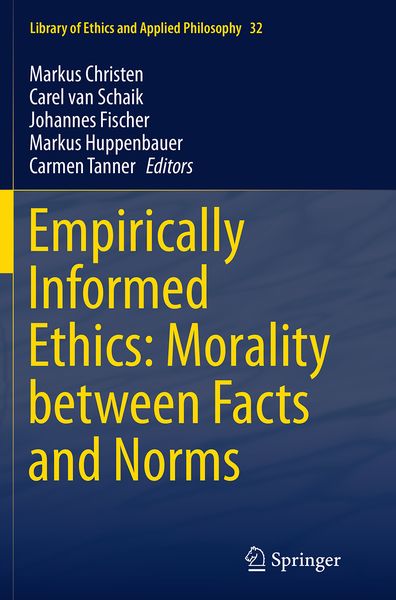
Produktbild: Empirically Informed Ethics: Morality between Facts and Norms
Band 32

Empirically Informed Ethics: Morality between Facts and Norms

99,99 €

inkl. gesetzl. MwSt., Versandkostenfrei


Beschreibung

Produktdetails

Einband

Taschenbuch

Erscheinungsdatum

23.08.2016

Abbildungen

X, 13 illus., schwarz-weiss Illustrationen

Herausgeber

Markus Christen + weitere

Verlag

Springer

Seitenzahl

349

Maße (L/B/H)

23,5/15,5/2 cm

Gewicht

546 g

Auflage

Softcover reprint of the original 1st edition 2014

Sprache

Englisch

ISBN

978-3-319-34848-3

Beschreibung

Portrait

Mark Alfano (philosophy) is at the Center of Human Values of Princeton University, Princeton, USA.


Sarah F. Brosnan (primatology) is at the Department of Psychology, Georgia State University, Georgia, USA.


Judith Burkart (anthropology) is at the Anthropological Institute and Museum of the University of Zurich, Switzerland.


Markus Christen (neuroethics) is at the Institute of Biomedical Ethics of the University of Zurich, Switzerland.


Johannes Fischer (theological ethics) is at the Institute of Social Ethics of the University of Zurich.


Tobias Gollan (social psychology) is at the Psychology Department of the University of Hamburg, Germany.


Hauke Heekeren (affective neuroscience) is at the Cluster of Excellence “Languages of Emotion”of the Free University of Berlin, Germany.


Markus Huppenbauer (ethics) is at the University Priority Program Ethics of the University of Zurich.


Adrian Jaeggi (anthropology) is at the Department of Anthropology of the University of California Santa Barbara, California, USA.


Antti Kauppinen (philosophy) is at the Department of Philosophy of the Trinity College Dublin, Ireland.


Tanja Krones (medical ethics and sociology) is at the University Hospital Zurich and the Institute of Biomedical Ethics of the University of Zurich, Switzerland.


DanielLapsley (moral psychology) is at the Psychology Department of the University of Notre Dame, Indiana, USA.


Theresa Lopez (moral philosophy) is at the Department of Philosophy of the University of Arizona, Arizona, USA.


Bert Musschenga (moral philosophy) is at the Philosophy Department of the University of Amsterdam, Netherlands.


Darcia Narvaez (moral psychology) is at the Department of Psychology, University of Notre Dame, Indiana, USA.


Adriano Naves de Brito (moral philosophy) is at the Center of Human Sciences, Unisinos University, Brasil.


Shaun Nichols (experimental philosophy) is at the Department of Philosophy, University of Arizona, Arizona, USA.


Kristin Prehn (cognitive neuroscience) is at the Cluster of Excellence “Languages of Emotion”, Free University of Berlin, Germany.


Jesse J. Prinz (moral philosophy) is at the Philosophy Program at the Graduate Center, City University of New York, New York, USA.


Claudia Rudolf von Rohr (anthropology) is at the Anthropological Institute & Museum of the University of Zurich, Switzerland.


Carmen Tanner (social psychology) is at the Center for Ethics and Finance at the Institute of Banking and Finance, at the University of Zurich, Switzerland.


Mark Timmons (moral philosophy) is at the Department of Philosophy, University of Arizona, Arizona, USA.


JohannesJ.M. van Delden (medical ethics) is at the Medical school of Utrecht University, Netherlands.


Carel P. van Schaik (anthropology) is at the Anthropological Institute & Museum of the University of Zurich, Switzerland.


Ghislaine J.M.W. van Thiel (medical ethics) is at the Medical school of Utrecht University, Netherlands.


Erich H. Witte (social psychology) is at the Psychology Department of the University of Hamburg, Germany
Produktdetails

Einband

Taschenbuch

Erscheinungsdatum

23.08.2016

Abbildungen

X, 13 illus., schwarz-weiss Illustrationen

Herausgeber

Verlag

Springer

Seitenzahl

349

Maße (L/B/H)

23,5/15,5/2 cm

Gewicht

546 g

Auflage

Softcover reprint of the original 1st edition 2014

Sprache

Englisch

ISBN

978-3-319-34848-3

Herstelleradresse

Springer-Verlag KG
Sachsenplatz 4-6
1201 Wien
AT

Email: ProductSafety@springernature.com

Kundinnen und Kunden meinen

0 Bewertungen

Informationen zu Bewertungen

Zur Abgabe einer Bewertung ist eine Anmeldung im Konto notwendig. Die Authentizität der Bewertungen wird von uns nicht überprüft. Wir behalten uns vor, Bewertungstexte, die unseren Richtlinien widersprechen, entsprechend zu kürzen oder zu löschen.

Die Bewertungen sind nach Format, Anzahl Sterne und Datum sortiert.

Verfassen Sie die erste Bewertung zu diesem Artikel

Helfen Sie anderen Kund*innen durch Ihre Meinung

Kundinnen und Kunden meinen

0 Bewertungen filtern

  • Produktbild: Empirically Informed Ethics: Morality between Facts and Norms
  • Introduction; Bridging the Is-Ought-Dichotomy.- Part I: What is Empirically Informed Ethics?.- Markus Christen, Mark Alfano’ Outlining the Field – A Research Program for Empirically Informed Ethics.- Johannes Fischer; What Kind of Ethics? – How the Understanding of the Fields Affects the Role of Empirical Research on Morality for Ethics.-

    Adriano Naves de Brito; Moral Behavior and Moral Sentiments – On the Natural Basis for Moral Values.- Part II: Investigating Origins of Morality.- Carel P. van Schaik, Judith Burkart, Adrian Jaeggi, Claudia Rudolf von Rohr; Morality as a Biological Adaptation – an Evolutionary Model based on the Lifestyle of Human Foragers.- Sarah F. Brosnan; Precursors of Morality – Evidence for Moral Behaviors in Non-Human Primates.- Jesse J. Prinz; Where Do Morals Come From? – A Plea for a Cultural Approach.- Part III: Assessing the Moral Agent.- Carmen Tanner, Markus Christen; Moral Intelligence – A Framework for Understanding Moral Competences.- Kristin Prehn, Hauke Heekeren; Moral Brains – Possibilities and Limits of the Neuroscience of Ethics.- Shaun Nichols, Mark Timmons, Theresa Lopez; Using Experiments in Ethics – Ethical Conservatism and the Psychology of Moral Luck.- Part IV: Justifications between Rational Reflections and Intuitions.- Ghislaine J.M.W. van Thiel, Johannes J.M. van Delden; Intuitions in Moral Reasoning – Normative Empirical Reflective Equilibrium as a Model for Substantial Justification of Moral Claims.- Bert Musschenga; Moral Expertise – The Role of Expert Judgments and Expert Intuitions in the Constitution of (Local) Ethical Theories.- Erich H. Witte &, Tobias Gollan; Social Variability in Moral Judgments – Analyzing the Justification of Actions using the Prescriptive Attribution Concept.- Part V: Practicing Morality and Ethics in the Real World; Darcia Narvaez, Daniel Lapsley.- Becoming a Moral Person – Moral Development and Moral Character Education as a Result of Social Interactions.- Markus Huppenbauer, Carmen Tanner; Ethical Leadership – How to Integrate Empirical and Ethical Aspects for Promoting Moral Decision Making in Business Practice.- Tanja Krones; The Empirical Turn in Bioethics – From Boundary Work to a Context-Sensitive, Transdisciplinary Field of Inquiry.- Critical Postscript.- Antti Kauppinen; Ethics and Empirical Psychology – Critical Remarks to Empirically Informed Ethics.- References.- Index.- Authors