KI-Beratung Beta

Gutscheinbedingungen

**Gültig bis 11.11.2026 auf Spielzeug, Schreibwaren, Filme, Geschenke & Trends, Musik, tolino eReader & Zubehör, Hörbücher und Hörbuch-Downloads, nicht preisgebundene Bücher und Kalender online auf thalia.at und in der Thalia App. Einzelne Artikel können ausgeschlossen sein. Aufgrund der Buchpreisbindung sind deutschsprachige Bücher und eBooks ausgenommen. Zusätzlich ausgenommen sind Abos & Flatrates, Games, Geschenkkarten/-boxen, Shelfies, Software, Zeitschriften sowie einzelne Artikel von tonies®. Pro Einkauf einmal einlösbar. Click & Collect nur bei Onlinevorabzahlung möglich. Keine Barauszahlung. Nicht kombinierbar mit anderen Aktionen und Gutscheinen. Gutschein wird auf max. 500€ Bestellwert angerechnet. Nicht gültig für Versandkosten und Services.

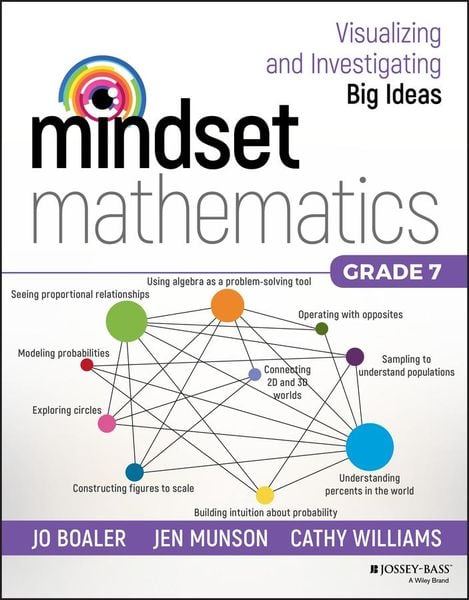
Produktbild: Mindset Mathematics - Visualizing and Investigating Big Ideas, Grade 7

Mindset Mathematics - Visualizing and Investigating Big Ideas, Grade 7

Aus der Reihe Mindset Mathematics

25,99 €

inkl. gesetzl. MwSt., zzgl. Versandkosten


  • Kostenlose Lieferung ab 30 € Einkaufswert
  • Versandkostenfrei für Bonuscard-Kund*innen

Beschreibung

Engage students in mathematics using growth mindset techniques

The most challenging parts of teaching mathematics are engaging students and helping them understand the connections between mathematics concepts. In this volume, you'll find a collection of low floor, high ceiling tasks that will help you...

Beschreibung

Engage students in mathematics using growth mindset techniques

The most challenging parts of teaching mathematics are engaging students and helping them understand the connections between mathematics concepts. In this volume, you'll find a collection of low floor, high ceiling tasks that will help you do just that, by looking at the big ideas at the seventh-grade level through visualization, play, and investigation.

During their work with tens of thousands of teachers, authors Jo Boaler, Jen Munson, and Cathy Williams heard the same message-that they want to incorporate more brain science into their math instruction, but they need guidance in the techniques that work best to get across the concepts they needed to teach. So the authors designed Mindset Mathematics around the principle of active student engagement, with tasks that reflect the latest brain science on learning. Open, creative, and visual math tasks have been shown to improve student test scores, and more importantly change their relationship with mathematics and start believing in their own potential. The tasks in Mindset Mathematics reflect the lessons from brain science that:

  • There is no such thing as a math person - anyone can learn mathematics to high levels.
  • Mistakes, struggle and challenge are the most important times for brain growth.
  • Speed is unimportant in mathematics.
  • Mathematics is a visual and beautiful subject, and our brains want to think visually about mathematics.

With engaging questions, open-ended tasks, and four-color visuals that will help kids get excited about mathematics, Mindset Mathematics is organized around nine big ideas which emphasize the connections within the Common Core State Standards (CCSS) and can be used with any current curriculum.

Produktdetails

Einband

Taschenbuch

Erscheinungsdatum

27.08.2019

Verlag Wiley
Seitenzahl

304

Produktdetails

Einband

Taschenbuch

Erscheinungsdatum

27.08.2019

Verlag Wiley
Seitenzahl

304

Maße (L/B/H)

26,9/21,5/1,7 cm

Gewicht

844 g

Sprache

Englisch

ISBN

978-1-119-35791-9

Herstelleradresse

Libri GmbH
Europaallee 1
36244 Bad Hersfeld
DE

Email: gpsr@libri.de

Noch keine Bewertungen vorhanden

Verfassen Sie die erste Bewertung zu diesem Artikel

Helfen Sie anderen Kundinnen und Kunden durch Ihre Meinung.

Kundinnen und Kunden meinen

Bewertungen (0)

Die Leseprobe wird geladen.
  • Produktbild: Mindset Mathematics - Visualizing and Investigating Big Ideas, Grade 7
  • Introduction 1

    Low-Floor, High-Ceiling Tasks 2

    Youcubed Summer Camp 3

    Memorization versus Conceptual Engagement 4

    Mathematical Thinking, Reasoning, and Convincing 5

    Big Ideas 9

    Structure of the Book 9

    Note on Materials 17

    Manipulatives and Materials Used in This Book 18

    Activities for Building Norms 21

    Encouraging Good Group Work 21

    Paper Folding: Learning to Reason, Convince, and Be a Skeptic 22

    Big Idea 1: Connecting 2D and 3D Worlds 27

    Visualize: Seeing Slices 29

    Play: Playing with Clay 34

    Investigate: The Area of Slices 40

    Big Idea 2: Constructing Figures to Scale 47

    Visualize: What is Scale? 50

    Play: A Fishy Image 55

    Investigate: Magnifying Solids 61

    Big Idea 3: Seeing Proportional Relationships 69

    Visualize: Growing Dough 72

    Play: is It Proportional? 80

    Investigate: Sizing Up Proportions 86

    Big Idea 4: Understanding Percents in the World 93

    Visualize: Painting Percents 95

    Play: Building Benchmarks 103

    Investigate: What's It Going to Cost? 109

    Big Idea 5: Building Intuition about Probability 119

    Visualize: is It Fair? 121

    Play: Fair Sums? 131

    Investigate: What's in the Bag? 136

    Big Idea 6: Modeling Probabilities 145

    Visualize: What's the Chance of That? 147

    Play: Probability Carnival 155

    Investigate: Go, Go Galton Board! 163

    Big Idea 7: Sampling to Understand Populations 171

    Visualize: Sampling Dots and Beads 173

    Play: Catch and Release 180

    Investigate: Wildlife Populations 186

    Big Idea 8: Operating with Opposites 197

    Visualize: Line Dancing 199

    Play: Integer Tic-Tac-Toe 207

    Investigate: Coordinating Multiplication 216

    Big Idea 9: Using Algebra as a Problem-Solving Tool 225

    Visualize: Case by Case 228

    Play: (Non) Linear Pattern Puzzles 237

    Investigate: Linear Letters 245

    Big Idea 10: Exploring Circles 251

    Visualize: Building Hunches about Circumference 253

    Play: Dissecting Circle Area 260

    Investigate: Unraveling Circles 267

    Appendix 273

    Centimeter Grid Paper 274

    1" Grid Paper 275

    Snap Cube Grid Paper 276

    Isometric Dot Paper 277

    Dot Paper 278

    About the Authors 279

    Acknowledgments 281

    Index 283