
The Physiology of Exercise in Spinal Cord Injury
-
- Hardcover ausgewählt
- Taschenbuch
- eBook
-
Sprache:Englisch
192,99 €
UVP
219,99 €
inkl. gesetzl. MwSt.,
Beschreibung
Produktdetails
Einband
Gebundene Ausgabe
Erscheinungsdatum
22.12.2016
Abbildungen
VI, 286 p. 42 illus., 12 illus. in color.
Herausgeber
J. Andrew TaylorVerlag
Springer UsSeitenzahl
286
Maße (L/B/H)
24,1/16/2,2 cm
Gewicht
606 g
Auflage
1st edition 2016
Sprache
Englisch
ISBN
978-1-4939-6662-2
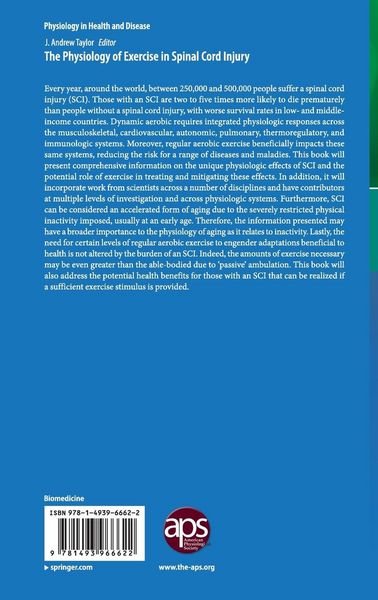
Every year, around the world, between 250,000 and 500,000 people suffer a spinal cord injury (SCI). Those with an SCI are two to five times more likely to die prematurely than people without a spinal cord injury, with worse survival rates in low- and middle-income countries. Dynamic aerobic requires integrated physiologic responses across the musculoskeletal, cardiovascular, autonomic, pulmonary, thermoregulatory, and immunologic systems. Moreover, regular aerobic exercise beneficially impacts these same systems, reducing the risk for a range of diseases and maladies. This book will present comprehensive information on the unique physiologic effects of SCI and the potential role of exercise in treating and mitigating these effects. In addition, it will incorporate work from scientists across a number of disciplines and have contributors at multiple levels of investigation and across physiologic systems. Furthermore, SCI can be considered an accelerated form of aging due to the severely restricted physical inactivity imposed, usually at an early age. Therefore, the information presented may have a broader importance to the physiology of aging as it relates to inactivity. Lastly, the need for certain levels of regular aerobic exercise to engender adaptations beneficial to health is not altered by the burden of an SCI. Indeed, the amounts of exercise necessary may be even greater than the able-bodied due to ‘passive’ ambulation. This book will also address the potential health benefits for those with an SCI that can be realized if a sufficient exercise stimulus is provided.
Noch keine Bewertungen vorhanden
Verfassen Sie die erste Bewertung zu diesem Artikel
Helfen Sie anderen Kundinnen und Kunden durch Ihre Meinung.
Kurze Frage zu unserer Seite
Vielen Dank für Ihr Feedback
Wir nutzen Ihr Feedback, um unsere Produktseiten zu verbessern. Bitte haben Sie Verständnis, dass wir Ihnen keine Rückmeldung geben können. Falls Sie Kontakt mit uns aufnehmen möchten, können Sie sich aber gerne an unseren Kund*innenservice wenden.
zum Kundenservice