
Enabling Things to Talk Designing IoT solutions with the IoT Architectural Reference Model
-
- Hardcover
- Taschenbuch ausgewählt
-
Sprache:Englisch
49,99 €
inkl. gesetzl. MwSt.,
Beschreibung
Produktdetails
Einband
Taschenbuch
Erscheinungsdatum
23.08.2016
Herausgeber
Alessandro Bassi + weitereVerlag
Springer BerlinSeitenzahl
349
Maße (L/B/H)
23,5/15,5/2 cm
Gewicht
546 g
Auflage
Softcover reprint of the original 1st edition 2013
Sprache
Englisch
ISBN
978-3-662-52494-7
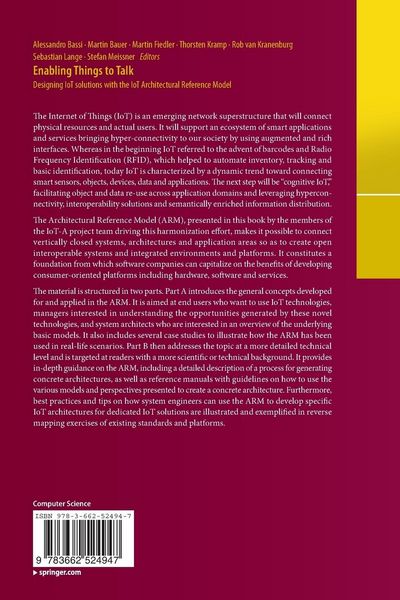
The Internet of Things (IoT) is an emerging network superstructure that will connect physical resources and actual users. It will support an ecosystem of smart applications and services bringing hyper-connectivity to our society by using augmented and rich interfaces. Whereas in the beginning IoT referred to the advent of barcodes and Radio Frequency Identification (RFID), which helped to automate inventory, tracking and basic identification, today IoT is characterized by a dynamic trend toward connecting smart sensors, objects, devices, data and applications. The next step will be “cognitive IoT,” facilitating object and data re-use across application domains and leveraging hyper-connectivity, interoperability solutions and semantically enriched information distribution.
The Architectural Reference Model (ARM), presented in this book by the members of the IoT-A project team driving this harmonization effort, makes it possible to connect vertically closed systems, architectures and application areas so as to create open interoperable systems and integrated environments and platforms. It constitutes a foundation from which software companies can capitalize on the benefits of developing consumer-oriented platforms including hardware, software and services.
The material is structured in two parts. Part A introduces the general concepts developed for and applied in the ARM. It is aimed at end users who want to use IoT technologies, managers interested in understanding the opportunities generated by these novel technologies, and system architects who are interested in an overview of the underlying basic models. It also includes several case studies to illustrate how the ARM has been used in real-life scenarios. Part B then addresses the topic at a more detailed technical level and is targeted at readers with a more scientific or technical background. It provides in-depth guidance on the ARM, including a detailed description of a process for generating concrete architectures, as well as reference manuals with guidelines on how to use the various models and perspectives presented to create a concrete architecture. Furthermore, best practices and tips on how system engineers can use the ARM to develop specific IoT architectures for dedicated IoT solutions are illustrated and exemplified in reverse mapping exercises of existing standards and platforms.
Noch keine Bewertungen vorhanden
Verfassen Sie die erste Bewertung zu diesem Artikel
Helfen Sie anderen Kundinnen und Kunden durch Ihre Meinung.
Kurze Frage zu unserer Seite
Vielen Dank für Ihr Feedback
Wir nutzen Ihr Feedback, um unsere Produktseiten zu verbessern. Bitte haben Sie Verständnis, dass wir Ihnen keine Rückmeldung geben können. Falls Sie Kontakt mit uns aufnehmen möchten, können Sie sich aber gerne an unseren Kund*innenservice wenden.
zum Kundenservice