
KI-Beratung Beta

Gutscheinbedingungen

**Gültig bis 30.11.2026 auf Spielzeug, Schreibwaren, Filme, Geschenke & Trends, Musik, tolino eReader & Zubehör, Hörbücher und Hörbuch-Downloads, nicht preisgebundene Bücher und Kalender online auf thalia.at und in der Thalia App. Einzelne Artikel können ausgeschlossen sein. Aufgrund der Buchpreisbindung sind deutschsprachige Bücher und eBooks ausgenommen. Zusätzlich ausgenommen sind Abos & Flatrates, Games, Geschenkkarten/-boxen, Shelfies, Software, Zeitschriften sowie einzelne Artikel von tonies®. Pro Einkauf einmal einlösbar. Nur gültig mit im Onlineshop hinterlegter Bonuscard. Click & Collect nur bei Onlinevorabzahlung möglich. Keine Barauszahlung. Nicht kombinierbar mit anderen Aktionen und Gutscheinen. Gutschein wird auf max. 500€ Bestellwert angerechnet. Nicht gültig für Versandkosten und Services.

  • Produktbild: Advances in Computational Social Science
  • Produktbild: Advances in Computational Social Science
Band 11 - 12%

Advances in Computational Social Science The Fourth World Congress

12% sparen

144,99 € UVP 164,99 €

inkl. gesetzl. MwSt., Versandkostenfrei


Beschreibung

This volume is a post-conference publication of the 4th World Congress on Social Simulation (WCSS), with contents selected from among the 80 papers originally presented at the conference. WCSS is a biennial event, jointly organized by three scientific communities in computational social science, namely,...

Beschreibung

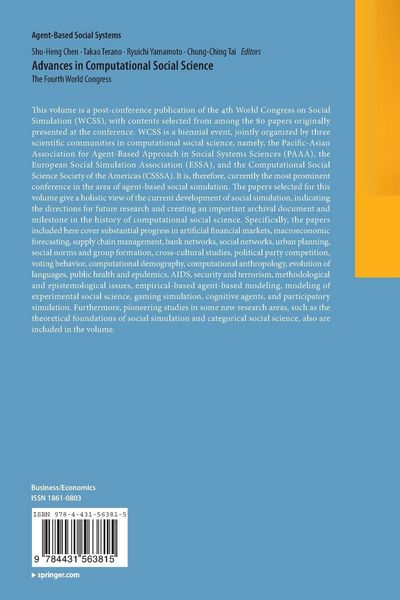
This volume is a post-conference publication of the 4th World Congress on Social Simulation (WCSS), with contents selected from among the 80 papers originally presented at the conference. WCSS is a biennial event, jointly organized by three scientific communities in computational social science, namely, the Pacific-Asian Association for Agent-Based Approach in Social Systems Sciences (PAAA), the European Social Simulation Association (ESSA), and the Computational Social Science Society of the Americas (CSSSA). It is, therefore, currently the most prominent conference in the area of agent-based social simulation. The papers selected for this volume give a holistic view of the current development of social simulation, indicating the directions for future research and creating an important archival document and milestone in the history of computational social science. Specifically, the papers included here cover substantial progress in artificial financial markets, macroeconomic forecasting, supply chain management, bank networks, social networks, urban planning, social norms and group formation, cross-cultural studies, political party competition, voting behavior, computational demography, computational anthropology, evolution of languages, public health and epidemics, AIDS, security and terrorism, methodological and epistemological issues, empirical-based agent-based modeling, modeling of experimental social science, gaming simulation, cognitive agents, and participatory simulation. Furthermore, pioneering studies in some new research areas, such as the theoretical foundations of social simulation and categorical social science, also are included in the volume.

Produktdetails

Einband

Taschenbuch

Erscheinungsdatum

23.08.2016

Abbildungen

XXXIII, 349 p. 134 illus., 49 illus. in color.

Herausgeber Shu-Heng Chen + weitere

Produktdetails

Einband

Taschenbuch

Erscheinungsdatum

23.08.2016

Abbildungen

XXXIII, 349 p. 134 illus., 49 illus. in color.

Herausgeber
Verlag Springer Tokyo
Seitenzahl

349

Maße (L/B/H)

23,5/15,5/2,1 cm

Gewicht

581 g

Auflage

Softcover reprint of the original 1st ed. 2014

Sprache

Englisch

ISBN

978-4-431-56381-5

Herstelleradresse

Springer-Verlag KG
Sachsenplatz 4-6
1201 Wien
AT

Email: ProductSafety@springernature.com

Noch keine Bewertungen vorhanden

Verfassen Sie die erste Bewertung zu diesem Artikel

Helfen Sie anderen Kundinnen und Kunden durch Ihre Meinung.

Kundinnen und Kunden meinen

Bewertungen (0)

  • Produktbild: Advances in Computational Social Science
  • Produktbild: Advances in Computational Social Science

  • Online Communities and Social Media
    .
    -
    Stock BBS Factor Model Using Principal Component Score.
    -
    How Consumer-Generated Advertising Works: An Empirical Agent-Based Simulation.
    -
    Understanding Citizens’ Channel Choice of Public Service Delivery: An Agent-Based Simulation Approach.
    -
    Cyclical Pattern of the Rise and Fall of an Online Community Due to a Troll.
    - Economic and Social Networks
    .
    -
    On the Indeterminacy of the Clearing Payment Vectors in Numerical Simulations on Financial Networks.
    -
    Three-State Opinion Formation Model on Adaptive Networks and Time to Consensus.
    -
    Achieving Consensus with Segregation in Multiple Social Contexts.
    - Behavioral Finance and Macroeconomics
    .
    -
    How Does Overconfidence Affect Asset Pricing, Volatility, and Volume?.
    -
    Analyzing the Validity of Passive Investment Strategies Under Financial Constraints.
    -
    Macroeconomic Forecasting with Agent-Based Models: Prediction and Simulation of the Impact of Public Policies on SMEs.
    -
    Influence of the Corporation Tax Rate on GDP in an Agent-Based Artificial Economic System.
    - Demographics, Health Care, Linguistics, and Sociology
    .
    -
    Semi-Artificial Models of Populations: Connecting Demography with Agent-Based Modelling.
    -
    An Agent-Based Approach for Patient Satisfaction and Collateral Health Effects.
    -
    Complex Evolutionary Pathways in Interacting Linguistic Communities.
    -
    Socio-Cognitive Influences on Social Stratification.
    - Participatory Modeling
    .
    -
    A Computational Study of Rule Learning in “Do-It-Yourself Lottery” with Aggregate Information.
    -
    Agent-Based Social Simulation as an Aid to Communication Between Stakeholders.
    -
    Hybrid Approach of Agent-Based and Gaming Simulations for Stakeholder Accreditation
    .- Methodology
    .
    -
    When Does Simulated Data Match Real Data?.
    -
    Towards Validating a Model of Households and Societies in East Africa.
    -
    Social Simulation Comparison in Arbitrary Problem Domains: First Steps Towards a More Principled Approach
    .