Gutscheinbedingungen

**Gültig bis 25.06.2026 auf fremdsprachige Bücher online auf thalia.at und in der Thalia App. Einzelne Artikel können ausgeschlossen sein. Ausgenommen sind preisgebundene Artikel & eBooks. Pro Einkauf einmal einlösbar. Click & Collect nur bei Onlinevorabzahlung möglich. Keine Barauszahlung. Nicht kombinierbar mit anderen Aktionen und Gutscheinen. Gutschein wird auf max. 500€ Bestellwert angerechnet. Nicht gültig für Geschenkkarten, Versandkosten und Services.

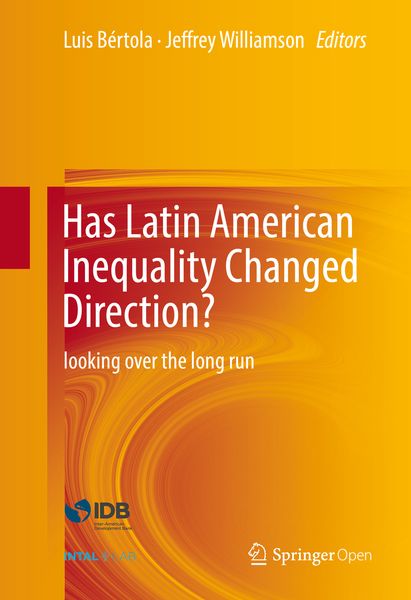
Produktbild: Has Latin American Inequality Changed Direction?

Has Latin American Inequality Changed Direction? Looking Over the Long Run

51,99 €

inkl. gesetzl. MwSt., Versandkostenfrei


Beschreibung

Produktdetails

Einband

Gebundene Ausgabe

Erscheinungsdatum

03.02.2017

Herausgeber

Luis Bértola + weitere

Verlag

Springer

Seitenzahl

419

Maße (L/B/H)

24,1/16/2,7 cm

Gewicht

805 g

Auflage

1st ed. 2017

Sprache

Englisch

ISBN

978-3-319-44620-2

Beschreibung

Portrait

Luis Bértola (Universidad de la República, Uruguay)

Professor at the Economic and Social History Program, director of the Ph.D. and Master Programme, since 2005; Visiting Professor at the University of Gothenburg since 2010; Member of the Bureau of the International Economic History Association 2009-2015; CEPR Associate; member of the Figuerola Institute, Universidad Carlos III, Madrid; Director of the Montevideo-Oxford Latin American Economic History Data Base. Was editor of the Journal of Iberian and Latin American Economic History Review. Co-author of The Economic Development of Latin America since Independence (Oxford University Press, 2012) and of several articles and book chapters of international publications during the last years. Has been advisor for ECLAC, IADB, ILO, NU and several national institutions in Uruguay and Latin America.

Jeffrey G. Williamson (Harvard University and University of Wisconsin-Madison)

The Laird Bell Professor of Economics, emeritus, Harvard University and Honorary Fellow, Department of Economics, University of Wisconsin-Madison, Williamson is past President of the Economic History Association (1994-1995), Chairman of the Harvard Economics Department (1997-2000), and Master of Harvard’s Mather House (1986-1993).

Produktdetails

Einband

Gebundene Ausgabe

Erscheinungsdatum

03.02.2017

Herausgeber

Verlag

Springer

Seitenzahl

419

Maße (L/B/H)

24,1/16/2,7 cm

Gewicht

805 g

Auflage

1st ed. 2017

Sprache

Englisch

ISBN

978-3-319-44620-2

Herstelleradresse

Springer-Verlag GmbH
Tiergartenstr. 17
69121 Heidelberg
DE

Email: ProductSafety@springernature.com

Kundinnen und Kunden meinen

0 Bewertungen

Informationen zu Bewertungen

Zur Abgabe einer Bewertung ist eine Anmeldung im Konto notwendig. Die Authentizität der Bewertungen wird von uns nicht überprüft. Wir behalten uns vor, Bewertungstexte, die unseren Richtlinien widersprechen, entsprechend zu kürzen oder zu löschen.

Die Bewertungen sind nach Format, Anzahl Sterne und Datum sortiert.

Verfassen Sie die erste Bewertung zu diesem Artikel

Helfen Sie anderen Kund*innen durch Ihre Meinung

Kundinnen und Kunden meinen

0 Bewertungen filtern

  • Produktbild: Has Latin American Inequality Changed Direction?
  • INTRODUCTION.- Chapter1. Long-run inequality trends and cycles and the recent inequality downturn in Latin America.- PART I. LONG-RUN TRENDS.- Chapter 2. Functional Inequality in Latin America: News from the Twentieth Century.- Chapter 3. The Political Economy of Income Inequality in Chile since 1850.- Chapter 4. What Human Heights Can Explain about the Evolution of Living Standards and Inequality in Latin America: the Case of Mexican Females and Males, 1850-1992.- Chapter 5. Long-run Human Development in Mexico: 1895-2010.- Chapter 6. Inequality, Institutions, and Long-Term Development: A Perspective from Brazilian Regions.- Chapter 7. Historical perspectives on regional income inequality in Brazil, 1872-2000.- Chapter 9. Racial Inequality in Brazil from Independence to Present.- Chapter 10. The lingering face of gender inequality in Latin America.- Chapter 11. Fiscal Redistribution in Latin America since the Nineteenth Century.- PART II. THE RECENT INEQUALITY DOWNTURN.- Chapter 12. Inequality in Latin America.- Chapter 13. The Inequality Story in Latin America and the Caribbean: Searching for an Explanation.- Chapter 14. The Political Economy of Inequality at the Top in Contemporary Chile. .- Chapter 15. Structural change and the fall of income inequality in Latin America - Agricultural development, inter-sectoral duality and the Kuznets curve.- Chapter 16. Fiscal policy and inequality in Latin America 1960-2012.- Chapter 17. Challenges for Social Policy in a Less Favorable Macroeconomic Context. INTRODUCTION.- Chapter1. Long-run inequality trends and cycles and the recent inequality downturn in Latin America.- PART I. LONG-RUN TRENDS.- Chapter 2. Functional Inequality in Latin America: News from the Twentieth Century.- Chapter 3. The Political Economy of Income Inequality in Chile since 1850.- Chapter 4. What Human Heights Can Explain about the Evolution of Living Standards and Inequality in Latin America: the Case of Mexican Females and Males, 1850-1992.- Chapter 5. Long-run Human Development in Mexico: 1895-2010.- Chapter 6. Inequality, Institutions, and Long-Term Development: A Perspective from Brazilian Regions.- Chapter 7. Historical perspectives on regional income inequality in Brazil, 1872-2000.- Chapter 9. Racial Inequality in Brazil from Independence to Present.- Chapter 10. The lingering face of gender inequality in Latin America.- Chapter 11. Fiscal Redistribution in Latin America since the Nineteenth Century.- PART II. THE RECENT INEQUALITY DOWNTURN.- Chapter 12. Inequality in Latin America.- Chapter 13. The Inequality Story in Latin America and the Caribbean: Searching for an Explanation.- Chapter 14. The Political Economy of Inequality at the Top in Contemporary Chile.- Chapter 15. Structural change and the fall of income inequality in Latin America - Agricultural development, inter-sectoral duality and the Kuznets curve.- Chapter 16. Fiscal policy and inequality in Latin America 1960-2012.- Chapter 17. Challenges for Social Policy in a Less Favorable Macroeconomic Context.