
Hall of Mirrors The Great Depression, the Great Recession, and the Uses-And Misuses-Of History
-
- Englisch ausgewählt
29,99 €
inkl. gesetzl. MwSt.,
- Kostenlose Lieferung ab 30 € Einkaufswert
- Versandkostenfrei für Bonuscard-Kund*innen
Beschreibung
Produktdetails
Einband
Taschenbuch
Erscheinungsdatum
01.10.2016
Verlag
KNV BesorgungSeitenzahl
520
Maße (L/B/H)
23,4/15,6/3,1 cm
Gewicht
876 g
Sprache
Englisch
ISBN
978-0-19-062107-0
catastrophic depression like that of the 1930s, unemployment in the U.S. and Europe still rose to excruciating high levels. Pain and suffering were widespread.
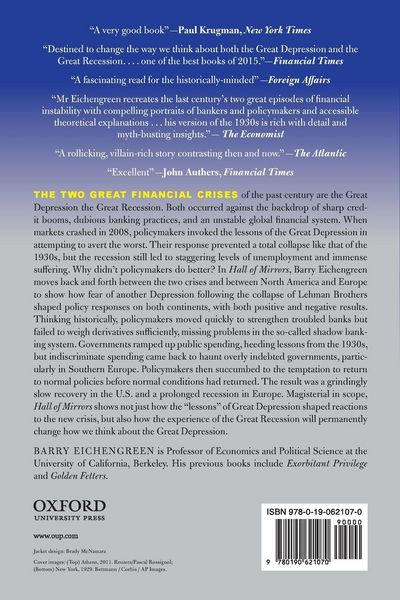
The question, given this, is why didn't policymakers do better? Hall of Mirrors, Barry Eichengreen's monumental twinned history of the two crises, provides the farthest-reaching answer to this question to date. Alternating back and forth between the two crises and between North America and Europe, Eichengreen shows how fear of another Depression following the collapse of Lehman Brothers shaped policy responses on both continents, with both positive and negative results. Since bank
failures were a prominent feature of the Great Depression, policymakers moved quickly to strengthen troubled banks. But because derivatives markets were not important in the 1930s, they missed problems in the so-called shadow banking system. Having done too little to support spending in the 1930s, governments
also ramped up public spending this time around. But the response was indiscriminate and quickly came back to haunt overly indebted governments, particularly in Southern Europe. Moreover, because politicians overpromised, and because their measures failed to stave off a major recession, a backlash quickly developed against activist governments and central banks. Policymakers then prematurely succumbed to the temptation to return to normal policies before normal conditions had returned. The
result has been a grindingly slow recovery in the United States and endless recession in Europe.
Hall of Mirrors is both a major work of economic history and an essential exploration of how we avoided making only some of the same mistakes twice. It shows not just how the "lessons" of Great Depression history continue to shape society's response to contemporary economic problems, but also how the experience of the Great Recession will permanently change how we think about the Great Depression.
Noch keine Bewertungen vorhanden
Verfassen Sie die erste Bewertung zu diesem Artikel
Helfen Sie anderen Kundinnen und Kunden durch Ihre Meinung.
Kurze Frage zu unserer Seite
Vielen Dank für Ihr Feedback
Wir nutzen Ihr Feedback, um unsere Produktseiten zu verbessern. Bitte haben Sie Verständnis, dass wir Ihnen keine Rückmeldung geben können. Falls Sie Kontakt mit uns aufnehmen möchten, können Sie sich aber gerne an unseren Kund*innenservice wenden.
zum Kundenservice