KI-Beratung Beta

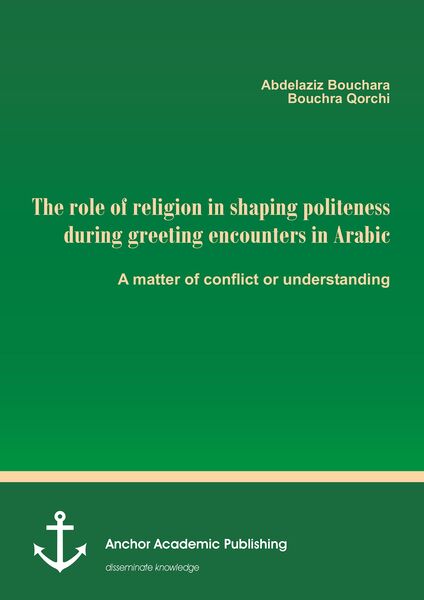
Produktbild: The role of religion in shaping politeness during greeting encounters in Arabic. A matter of conflict or understanding

The role of religion in shaping politeness during greeting encounters in Arabic. A matter of conflict or understanding

  • Form:Einzelkauf Download
  • Sprache:Englisch

29,99 €

inkl. gesetzl. MwSt.

Beschreibung

Politeness is one of the very important issues in the field of sociolinguistics and pragmatics, as it can be seen in almost every type of our interactions. Since the evolving of the politeness theory (Brown and Levinson 1978), cross-cultural pragmatics has gained the attention of many researchers in...

Beschreibung

Politeness is one of the very important issues in the field of sociolinguistics and pragmatics, as it can be seen in almost every type of our interactions. Since the evolving of the politeness theory (Brown and Levinson 1978), cross-cultural pragmatics has gained the attention of many researchers in this field. However, the Arab society has been far less investigated. Therefore, this book widens the scope of cross-cultural pragmatics by investigating politeness in (Moroccan) Arabic and contrasting the behavior of Arab and German speakers with regard to one type of politeness, namely the speech act of greeting. Furthermore, the implications of this study for foreign language teaching and cross-cultural training indicate that politeness and face concerns in different cultures should be part of any learning process. Hopefully, besides being informative, especially to scholars from other fields of intercultural communication research, this study should contribute to raise the awareness of sociolinguists in particular with respect to the role of religion in shaping politeness in Arabic and to serious confusion and misunderstandings that may come into being, when communicators from different cultural backgrounds cannot identify the pragmatic (implicit or indirect) meaning of their interlocutor's utterance.

Produktdetails

Format

PDF

Kopierschutz

Nein

Family Sharing

Nein

Text-to-Speech

Nein

Produktdetails

Format

PDF

Format

eBooks im PDF-Format haben eine festgelegte Seitengröße und eignen sich daher nur bedingt zum Lesen auf einem tolino eReader oder Smartphone. Für den vollen Lesegenuss empfehlen wir Ihnen bei PDF-eBooks die Verwendung eines Tablets oder Computers.

Kopierschutz

Nein

Kopierschutz

Dieses eBook können Sie uneingeschränkt auf allen Geräten der tolino Familie, allen sonstigen eReadern und am PC lesen. Das eBook ist nicht kopiergeschützt und kann ein personalisiertes Wasserzeichen enthalten. Weitere Hinweise zum Lesen von eBooks mit einem personalisierten Wasserzeichen finden Sie unter Hilfe/Downloads.

Family Sharing

Nein

Family Sharing

Mit Family Sharing können Sie eBooks innerhalb Ihrer Familie (max. sechs Mitglieder im gleichen Haushalt) teilen. Sie entscheiden selbst, welches Buch Sie mit welchem Familienmitglied teilen möchten. Auch das parallele Lesen durch verschiedene Familienmitglieder ist durch Family Sharing möglich. Um eBooks zu teilen oder geteilt zu bekommen, muss jedes Familienmitglied ein Konto bei Thalia oder einem anderen tolino-Buchhändler haben. Weitere Informationen finden Sie unter Hilfe/Family-Sharing.

Text-to-Speech

Nein

Text-to-Speech

Bedeutet Ihnen Stimme mehr als Text? Mit der Funktion Text-to-Speech können Sie sich im tolino webReader und in der aktuellen Thalia – Lesen & Hören App das eBook vorlesen lassen. Weitere Informationen finden Sie unter Hilfe/Text-to-Speech.

Erscheinungsdatum

07.07.2016

Verlag Anchor Academic Publishing
Seitenzahl

84 (Printausgabe)

Dateigröße

2307 KB

Auflage

1. Auflage

Sprache

Englisch

EAN

9783960675556

Barrierefreiheit
  • keine Information zur Barrierefreiheit bekannt

Noch keine Bewertungen vorhanden

Verfassen Sie die erste Bewertung zu diesem Artikel

Helfen Sie anderen Kundinnen und Kunden durch Ihre Meinung.

Kundinnen und Kunden meinen

Bewertungen (0)

Weitere Artikel finden Sie in

Die Leseprobe wird geladen.
  • Produktbild: The role of religion in shaping politeness during greeting encounters in Arabic. A matter of conflict or understanding