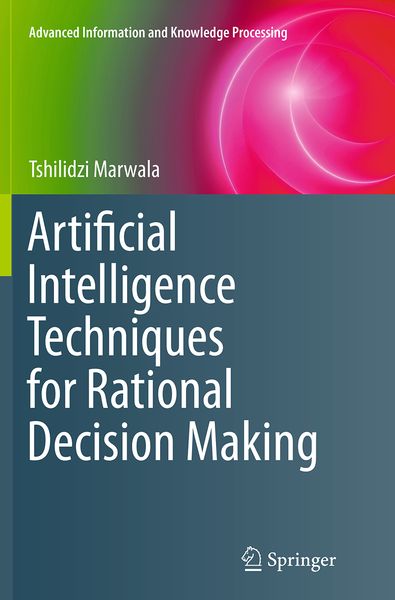
Artificial Intelligence Techniques for Rational Decision Making
-
- Hardcover
- Taschenbuch ausgewählt
- eBook
-
Sprache:Englisch
51,99 €
inkl. gesetzl. MwSt.,
Beschreibung
Produktdetails
Einband
Taschenbuch
Erscheinungsdatum
22.09.2016
Abbildungen
XV, 35 illus., schwarz-weiss Illustrationen
Verlag
SpringerSeitenzahl
168
Maße (L/B/H)
23,5/15,5/1,1 cm
Gewicht
289 g
Auflage
Softcover reprint of the original 1st edition 2014
Sprache
Englisch
ISBN
978-3-319-38298-2
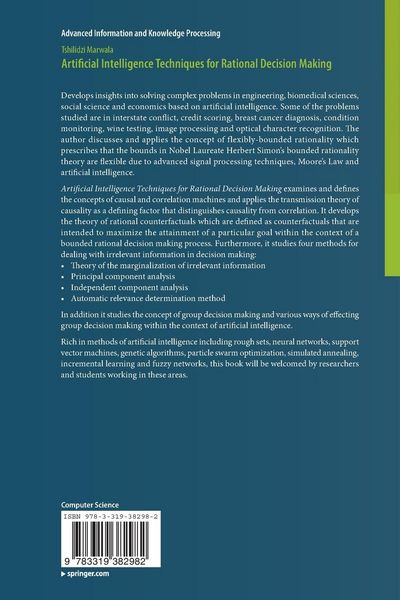
Develops insights into solving complex problems in engineering, biomedical sciences, social science and economics based on artificial intelligence. Some of the problems studied are in interstate conflict, credit scoring, breast cancer diagnosis, condition monitoring, wine testing, image processing and optical character recognition. The author discusses and applies the concept of flexibly-bounded rationality which prescribes that the bounds in Nobel Laureate Herbert Simon’s bounded rationality theory are flexible due to advanced signal processing techniques, Moore’s Law and artificial intelligence.
Artificial Intelligence Techniques for Rational Decision Making examines and defines the concepts of causal and correlation machines and applies the transmission theory of causality as a defining factor that distinguishes causality from correlation. It develops the theory of rational counterfactuals which are defined as counterfactuals that are intended to maximize theattainment of a particular goal within the context of a bounded rational decision making process. Furthermore, it studies four methods for dealing with irrelevant information in decision making:
- Theory of the marginalization of irrelevant information
- Principal component analysis
- Independent component analysis
- Automatic relevance determination method
In addition it studies the concept of group decision making and various ways of effecting group decision making within the context of artificial intelligence.
Rich in methods of artificial intelligence including rough sets, neural networks, support vector machines, genetic algorithms, particle swarm optimization, simulated annealing, incremental learning and fuzzy networks, this book will be welcomed by researchers and students working in these areas.
Kundinnen und Kunden meinen
Verfassen Sie die erste Bewertung zu diesem Artikel
Helfen Sie anderen Kund*innen durch Ihre Meinung
Kurze Frage zu unserer Seite
Vielen Dank für Ihr Feedback
Wir nutzen Ihr Feedback, um unsere Produktseiten zu verbessern. Bitte haben Sie Verständnis, dass wir Ihnen keine Rückmeldung geben können. Falls Sie Kontakt mit uns aufnehmen möchten, können Sie sich aber gerne an unseren Kund*innenservice wenden.
zum Kundenservice