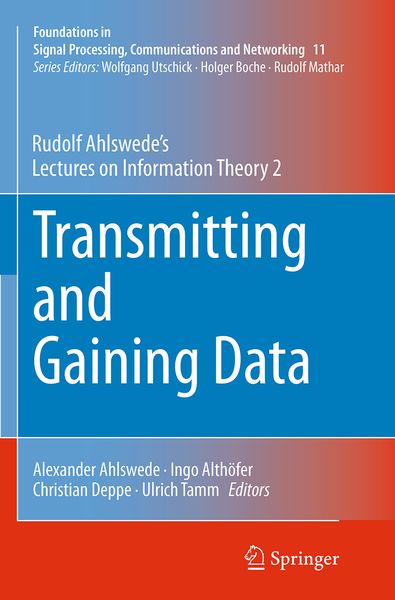
Transmitting and Gaining Data Rudolf Ahlswede’s Lectures on Information Theory 2
-
- Hardcover
- Taschenbuch ausgewählt
- eBook
-
Sprache:Englisch
49,99 €
inkl. gesetzl. MwSt.,
Beschreibung
Produktdetails
Einband
Taschenbuch
Erscheinungsdatum
22.09.2016
Abbildungen
XVII, 461 p. 4 illus.
Herausgeber
Alexander Ahlswede + weitereVerlag
SpringerSeitenzahl
461
Maße (L/B/H)
23,5/15,5/2,6 cm
Gewicht
721 g
Auflage
Softcover reprint of the original 1st ed. 2015
Sprache
Englisch
ISBN
978-3-319-35656-3
The calculation of channel capacities was one of Rudolf Ahlswede's specialties and is the main topic of this second volume of his Lectures on Information Theory. Here we find a detailed account of some very classical material from the early days of Information Theory, including developments from the USA, Russia, Hungary and (which Ahlswede was probably in a unique position to describe) the German school centered around his supervisor Konrad Jacobs. These lectures made an approach to a rigorous justification of the foundations of Information Theory. This is the second of several volumes documenting Rudolf Ahlswede's lectures on Information Theory. Each volume includes comments from an invited well-known expert. In the supplement to the present volume, Gerhard Kramer contributes his insights.
Classical information processing concerns the main tasks of gaining knowledge and the storage, transmission and hiding of data. The first task is the prime goal of Statistics. For transmission and hiding data, Shannon developed an impressive mathematical theory called Information Theory, which he based on probabilistic models. The theory largely involves the concept of codes with small error probabilities in spite of noise in the transmission, which is modeled by channels. The lectures presented in this work are suitable for graduate students in Mathematics, and also for those working in Theoretical Computer Science, Physics, and Electrical Engineering with a background in basic Mathematics. The lectures can be used as the basis for courses or to supplement courses in many ways. Ph.D. students will also find research problems, often with conjectures, that offer potential subjects for a thesis. More advanced researchers may find questions which form the basis of entire research programs.
Noch keine Bewertungen vorhanden
Verfassen Sie die erste Bewertung zu diesem Artikel
Helfen Sie anderen Kundinnen und Kunden durch Ihre Meinung.
Kurze Frage zu unserer Seite
Vielen Dank für Ihr Feedback
Wir nutzen Ihr Feedback, um unsere Produktseiten zu verbessern. Bitte haben Sie Verständnis, dass wir Ihnen keine Rückmeldung geben können. Falls Sie Kontakt mit uns aufnehmen möchten, können Sie sich aber gerne an unseren Kund*innenservice wenden.
zum Kundenservice