
KI-Beratung Beta

Gutscheinbedingungen

**Gültig bis 09.11.2026 auf tolino shine color (4016621130473), tolino vision color (4016621130183) und tolino vision color weiß (4016621131456) online auf thalia.at, in der Thalia App und in allen Thalia Buchhandlungen in Österreich. In den Buchhandlungen nur gültig auf lagernde Ware. Pro Einkauf einmal einlösbar. Nur gültig gegen Vorlage oder im Onlineshop hinterlegter Bonuscard. Infos zur Einlösung in der Buchhandlung sind auf der Bonuscard-Vorteilspreisseite zu finden. Click & Collect nur bei Onlinevorabzahlung möglich. Keine Einlösung bei Scan & Go-Bezahlung. Keine Barauszahlung. Nicht kombinierbar mit anderen Aktionen und Gutscheinen. Nicht gültig für Geschenkkarten, Versandkosten und Services. Nur solange der Vorrat reicht.

  • Produktbild: Methods for Social Theory
  • Produktbild: Methods for Social Theory

Methods for Social Theory Analytical tools for theorizing and writing

69,99 €

inkl. gesetzl. MwSt., Versandkostenfrei


Beschreibung

Produktdetails

Einband

Taschenbuch

Erscheinungsdatum

15.12.2016

Abbildungen

53 SW-Abb., 53 SW-Zeichn., 52 Tabellen

Verlag

Taylor & Francis

Seitenzahl

186

Maße (L/B/H)

23,4/15,6/1 cm

Gewicht

292 g

Sprache

Englisch

ISBN

978-1-4724-7284-7

Beschreibung

Rezension

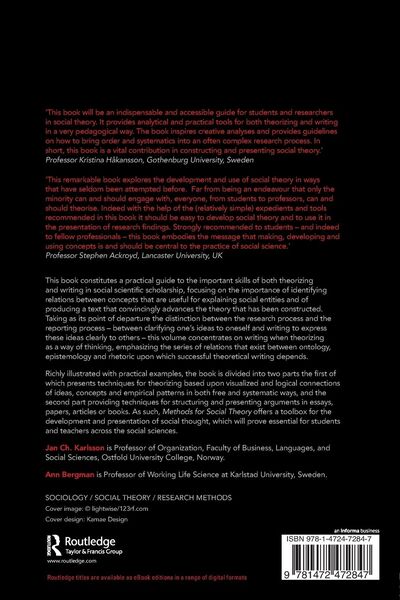
'This book will be an indispensable and accessible guide for students and researchers in social theory. It provides analytical and practical tools for both theorizing and writing in a very pedagogical way. The book inspires to creative analyses and provides guidelines on how to bring order and systematics into an often complex research process. In short, this book is a vital contribution in constructing and presenting social theory.' - Professor Kristina Håkansson, Gothenburg University, Sweden

'This remarkable book explores the development and use of social theory in ways that have seldom been attempted before. Far from being an endeavour that only the minority can and should engage with, everyone, from students to professors can and should theorise. Indeed with the help of the (relatively simple) expedients and tools recommended in this book it should be easy to develop social theory and to use it in the presentation of research findings. Strongly recommended to students - and indeed to fellow professionals - this book embodies the message that making, developing and using concepts is and should be central to the practice of social science.' - Professor Stephen Ackroyd, Lancaster University, U.K

Produktdetails

Einband

Taschenbuch

Erscheinungsdatum

15.12.2016

Abbildungen

53 SW-Abb., 53 SW-Zeichn., 52 Tabellen

Verlag

Taylor & Francis

Seitenzahl

186

Maße (L/B/H)

23,4/15,6/1 cm

Gewicht

292 g

Sprache

Englisch

ISBN

978-1-4724-7284-7

Herstelleradresse

Produktsicherheitsverantwortliche/r
Europaallee 1
36244 Bad Hersfeld
DE

Email: gpsr@libri.de

Noch keine Bewertungen vorhanden

Verfassen Sie die erste Bewertung zu diesem Artikel

Helfen Sie anderen Kundinnen und Kunden durch Ihre Meinung.

Kundinnen und Kunden meinen

Bewertungen (0)

Die Leseprobe wird geladen.
  • Produktbild: Methods for Social Theory
  • Produktbild: Methods for Social Theory
  • List of figures

    List of tables

    Preface

    Acknowledgements

    Chapter 1 Theorizing and writing social theory

    Social theory

    Theorizing

    Writing

    Writing in the research process

    Writing in the reporting process

    Outline of the book

    References

    PART I Tools for theorizing in social science

    Graphic representations

    Displays and property spaces as preliminary endpoints

    References

    Chapter 2 Basics of displays

    What is a display?

    Building blocks of displays

    Putting a display together

    Summary

    References

    Chapter 3 The use of displays in theorizing

    Theorizing by extending

    Theorizing by mapping interaction

    Stepwise theorizing

    Summary

    References

    Chapter 4 Basics of property spaces

    Constructing a property space

    Hidden property spaces

    Housekeeping

    Labelling the types: terms

    Developing existing terminology

    Summary

    References

    Chapter 5 Reduction of property spaces in theorizing

    Rescaling

    Indexing

    Logic reduction

    Empirical reduction

    Theoretical reduction

    Pragmatic reduction

    Summary

    References

    Chapter 6 Expansion of property spaces in theorizing

    Substruction

    More properties of existing dimensions

    More dimensions

    Combining property spaces

    Inserting process arrows

    Creating scales

    Summary

    References

    PART II Tools for writing social science

    References

    Chapter 7 The Model of Argumentation: chain of reasoning, chains of argument and arguments

    The rhetorical situation

    Purpose

    Persona

    Audience

    Tone

    The subject matter

    The model

    Summary

    References

    Chapter 8 Examples of using the Model of Argumentation

    The process of writing a social science text: an example

    The (preliminarily) finished structure of a text: an example

    The structure of Chapter 4, 'Basics of property spaces'

    Constructing a property space

    Housekeeping

    Moving the model down one level

    Summary

    References

    Chapter 9 Theorizing and writing

    Research process and reporting process

    Displays

    Property spaces

    Writing

    Summary

    References

    Appendix: from Bergman, Ann, Jan Ch. Karlsson and Jonas Axelsson (2010) 'Truth Claims and Explanatory Claims - an Ontological Typology of Futures Studies', Futures, 42(8): 857-65

    Index