
Argumentation Analysis and Evaluation
-
- Hardcover
- Taschenbuch ausgewählt
- eBook
-
Sprache:Englisch
75,99 €
inkl. gesetzl. MwSt.,
Beschreibung
Produktdetails
Einband
Taschenbuch
Erscheinungsdatum
15.11.2016
Verlag
Taylor & FrancisSeitenzahl
186
Maße (L/B/H)
22,9/15,2/1 cm
Gewicht
279 g
Auflage
2. Auflage
Sprache
Englisch
ISBN
978-1-138-22508-4
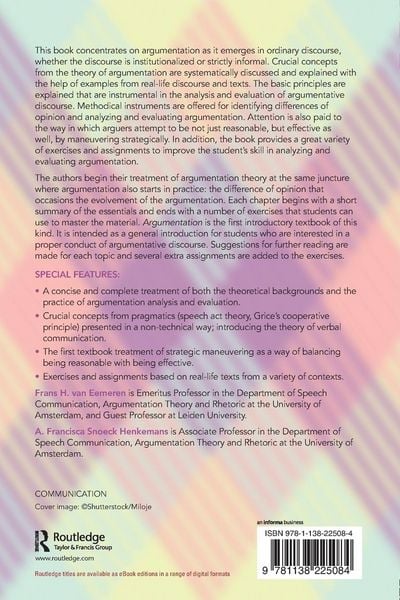
This book concentrates on argumentation as it emerges in ordinary discourse, whether the discourse is institutionalized or strictly informal. Crucial concepts from the theory of argumentation are systematically discussed and explained with the help of examples from real-life discourse and texts. The basic principles are explained that are instrumental in the analysis and evaluation of argumentative discourse. Methodical instruments are offered for identifying differences of opinion, analyzing and evaluating argumentation and presenting arguments in oral and written discourse. Attention is also paid to the way in which arguers attempt to be not just reasonable, but effective as well, by maneuvering strategically. In addition, the book provides a great variety of exercises and assignments to improve the student's skill in presenting argumentation.
The authors begin their treatment of argumentation theory at the same juncture where argumentation also starts in practice: The difference of opinion that occasions the evolvement of the argumentation. Each chapter begins with a short summary of the essentials and ends with a number of exercises that students can use to master the material. Argumentation is the first introductory textbook of this kind. It is intended as a general introduction for students who are interested in a proper conduct of argumentative discourse. Suggestions for further reading are made for each topic and several extra assignments are added to the exercises.
Special features:
- A concise and complete treatment of both the theoretical backgrounds and the practice of argumentation analysis and evaluation.
- Crucial concepts from pragmatics (speech act theory, Grice's cooperative principle) presented in a non-technical way; introducing the theory of verbal communication.
- The first textbook treatment of strategic maneuvering as a way of balancing being reasonable with being effective
- Exercises and assignments based on real-life texts from a variety of contexts.
Noch keine Bewertungen vorhanden
Verfassen Sie die erste Bewertung zu diesem Artikel
Helfen Sie anderen Kundinnen und Kunden durch Ihre Meinung.
Kurze Frage zu unserer Seite
Vielen Dank für Ihr Feedback
Wir nutzen Ihr Feedback, um unsere Produktseiten zu verbessern. Bitte haben Sie Verständnis, dass wir Ihnen keine Rückmeldung geben können. Falls Sie Kontakt mit uns aufnehmen möchten, können Sie sich aber gerne an unseren Kund*innenservice wenden.
zum Kundenservice