KI-Beratung Beta

Gutscheinbedingungen

**Gültig bis 18.11.2026 auf englischsprachige Klassiker (klassiker-32728) online auf thalia.at und in der Thalia App. Einzelne Artikel können ausgeschlossen sein. Ausgenommen sind preisgebundene Artikel & eBooks. Pro Einkauf einmal einlösbar. Click & Collect nur bei Onlinevorabzahlung möglich. Keine Barauszahlung. Nicht kombinierbar mit anderen Aktionen und Gutscheinen. Gutschein wird auf max. 500€ Bestellwert angerechnet. Nicht gültig für Geschenkkarten, Versandkosten und Services.

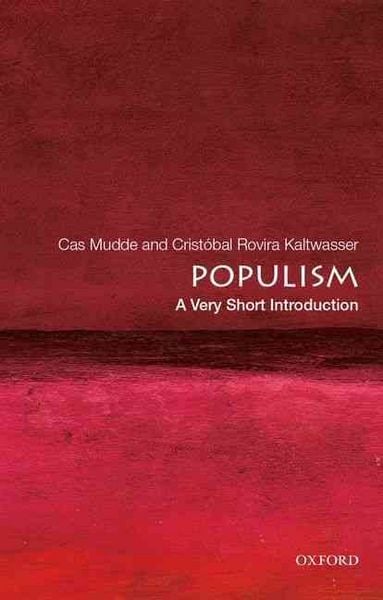
Produktbild: Populism: A Very Short Introduction
- 14%

Populism: A Very Short Introduction

Aus der Reihe Very Short Introductions
14% sparen

10,89 € UVP 12,80 €

inkl. gesetzl. MwSt., zzgl. Versandkosten


  • Kostenlose Lieferung ab 30 € Einkaufswert
  • Versandkostenfrei für Bonuscard-Kund*innen

Beschreibung

Populism is a central concept in the current media debates about politics and elections. However, like most political buzzwords, the term often floats from one meaning to another, and both social scientists and journalists use it to denote diverse phenomena. What is populism really? Who are the populist...

Beschreibung

Populism is a central concept in the current media debates about politics and elections. However, like most political buzzwords, the term often floats from one meaning to another, and both social scientists and journalists use it to denote diverse phenomena. What is populism really? Who are the populist leaders? And what is the relationship between populism and democracy? This book answers these questions in a simple and persuasive way, offering a swift guide to populism in theory and practice.
Cas Mudde and Cristóbal Rovera Kaltwasser present populism as an ideology that divides society into two antagonistic camps, the "pure people" versus the "corrupt elite," and that privileges the general will of the people above all else. They illustrate the practical power of this ideology through a survey of representative populist movements of the modern era: European right-wing parties, left-wing presidents in Latin America, and the Tea Party movement in the United States. The authors delve into the ambivalent personalities of charismatic populist leaders such as Juan Domingo Péron, H. Ross Perot, Jean-Marie le Pen, Silvio Berlusconi, and Hugo Chávez. If the strong male leader embodies the mainstream form of populism, many resolute women, such as Eva Péron, Pauline Hanson, and Sarah Palin, have also succeeded in building a populist status, often by exploiting gendered notions of society.
Although populism is ultimately part of democracy, populist movements constitute an increasing challenge to democratic politics. Comparing political trends across different countries, this compelling book debates what the long-term consequences of this challenge could be, as it turns the spotlight on the bewildering effect of populism on today's political and social life.

Rezension

Mudde and Rovira speak coherently and with nuance about a broad range of global phenomena and grapple nimbly with contextual differences, process, and transition. George Ciccariello-Maher, Latin American Research Review

Produktdetails

Verkaufsrang

4710

Einband

Taschenbuch

Erscheinungsdatum

09.02.2017

Abbildungen

10

Produktdetails

Verkaufsrang

4710

Einband

Taschenbuch

Erscheinungsdatum

09.02.2017

Abbildungen

10

Verlag Oxford University Press
Seitenzahl

131

Maße (L/B/H)

17,2/10,8/1,5 cm

Gewicht

137 g

Farbe

Rost

Sprache

Englisch

ISBN

978-0-19-023487-4

Herstelleradresse

Libri GmbH
Europaallee 1
36244 Bad Hersfeld
DE

Email: gpsr@libri.de

Noch keine Bewertungen vorhanden

Verfassen Sie die erste Bewertung zu diesem Artikel

Helfen Sie anderen Kundinnen und Kunden durch Ihre Meinung.

Kundinnen und Kunden meinen

Bewertungen (0)

Weitere Artikel finden Sie in

Die Leseprobe wird geladen.
  • Produktbild: Populism: A Very Short Introduction
    • Chapter 1: What populism is
    • Chapter 2: Populism around the world
    • Chapter 3: Populism and mobilization
    • Chapter 4: The populist leader
    • Chapter 5: Populism and democracy
    • Chapter 6: Causes and responses
    • References
    • Further Reading
    • Index