Gutscheinbedingungen

**Gültig bis 12.08.2026 auf fremdsprachige Bücher online auf thalia.at und in der Thalia App. Einzelne Artikel können ausgeschlossen sein. Ausgenommen sind preisgebundene Artikel & eBooks. Pro Einkauf einmal einlösbar. Click & Collect nur bei Onlinevorabzahlung möglich. Keine Barauszahlung. Nicht kombinierbar mit anderen Aktionen und Gutscheinen. Gutschein wird auf max. 500€ Bestellwert angerechnet. Nicht gültig für Geschenkkarten, Versandkosten und Services.

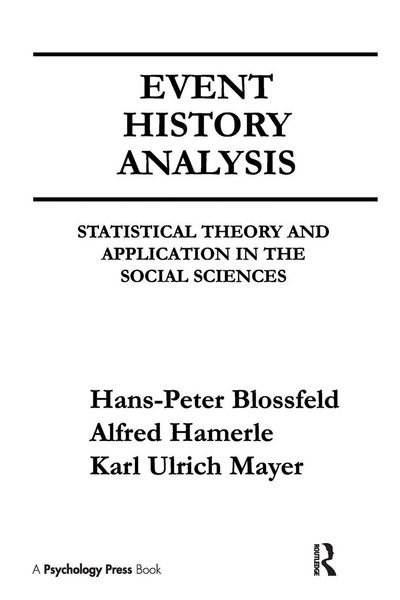
Produktbild: Event History Analysis

Event History Analysis Statistical theory and Application in the Social Sciences

57,99 €

inkl. gesetzl. MwSt., Versandkostenfrei


Produktdetails

Einband

Taschenbuch

Erscheinungsdatum

21.07.2016

Verlag

Taylor & Francis

Seitenzahl

298

Maße (L/B/H)

22,9/15,2/1,6 cm

Gewicht

403 g

Sprache

Englisch

ISBN

978-1-138-96917-9

Produktdetails

Einband

Taschenbuch

Erscheinungsdatum

21.07.2016

Verlag

Taylor & Francis

Seitenzahl

298

Maße (L/B/H)

22,9/15,2/1,6 cm

Gewicht

403 g

Sprache

Englisch

ISBN

978-1-138-96917-9

Herstelleradresse

Libri GmbH
Europaallee 1
36244 Bad Hersfeld
DE

Email: GPSR Kontakt

Noch keine Bewertungen vorhanden

Verfassen Sie die erste Bewertung zu diesem Artikel

Helfen Sie anderen Kundinnen und Kunden durch Ihre Meinung.

Kundinnen und Kunden meinen

Bewertungen (0)

  • Produktbild: Event History Analysis
  • Contents: Foreword. Aim and Structure of the Book. Domains and Rationale for the Application of Event History Analysis. The Statistical Theory of Event History Analysis. Data Organization and Descriptive Methods. Semi-Parametric Regression Models: The Cox Proportional Hazards Model. Parametric Regression Models. Appendices: List of Variable Names Used in Examples. Listing of the FORTRAN Program PR3FUN Written by Trond Petersen. Listing of the FORTRAN Program for Episode Splitting Given Discrete Time-Dependent Covariates. Listing of the FORTRAN Program for Episode Splitting Given Continuous Time-Dependent Covariates. Listing of the GLIM Macros to Estimate the Weibull and Log-Logistic Models of Roger and Peacock.