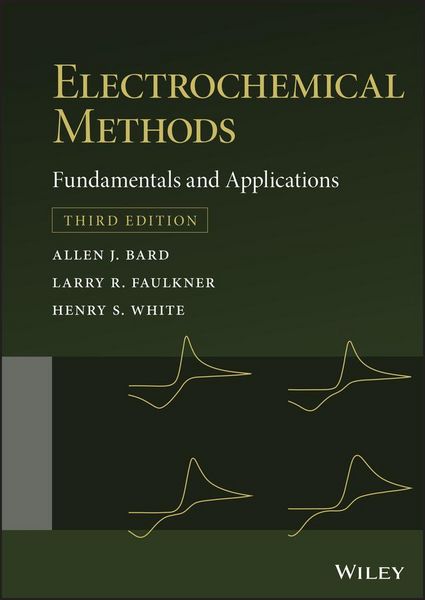
Electrochemical Methods Fundamentals and Applications
-
- Hardcover ausgewählt
- Taschenbuch
-
Sprache:Englisch
145,99 €
inkl. gesetzl. MwSt.,
Beschreibung
Produktdetails
Einband
Gebundene Ausgabe
Erscheinungsdatum
26.05.2022
Verlag
John Wiley & SonsSeitenzahl
1044
Maße (L/B/H)
25,5/18,5/6,4 cm
Gewicht
2216 g
Farbe
Dunkelgrün
Auflage
3. Auflage
Sprache
Englisch
ISBN
978-1-119-33406-4
The third edition of Electrochemical Methods has been extensively revised to reflect the evolution of electrochemistry over the past two decades, highlighting significant developments in the understanding of electrochemical phenomena and emerging experimental tools, while extending the book's value as a general introduction to electrochemical methods.
This authoritative resource for new students and practitioners provides must-have information crucial to a successful career in research. The authors focus on methods that are extensively practiced and on phenomenological questions of current concern.
This latest edition of Electrochemical Methods contains numerous problems and chemical examples, with illustrations that serve to illuminate the concepts contained within in a way that will assist both student and mid-career practitioner.
Significant updates and new content in this third edition include:
* An extensively revised introductory chapter on electrode processes, designed for new readers coming into electrochemistry from diverse backgrounds
* New chapters on steady-state voltammetry at ultramicroelectrodes, inner-sphere electrode reactions and electrocatalysis, and single-particle electrochemistry
* Extensive treatment of Marcus kinetics as applied to electrode reactions, a more detailed introduction to migration, and expanded coverage of electrochemical impedance spectroscopy
* The inclusion of Lab Notes in many chapters to help newcomers with the transition from concept to practice in the laboratory
The new edition has been revised to address a broader audience of scientists and engineers, designed to be accessible to readers with a basic foundation in university chemistry, physics and mathematics. It is a self-contained volume, developing all key ideas from the fundamental principles of chemistry and physics.
Perfect for senior undergraduate and graduate students taking courses in electrochemistry, physical and analytical chemistry, this is also an indispensable resource for researchers and practitioners working in fields including electrochemistry and electrochemical engineering, energy storage and conversion, analytical chemistry and sensors.
Noch keine Bewertungen vorhanden
Verfassen Sie die erste Bewertung zu diesem Artikel
Helfen Sie anderen Kundinnen und Kunden durch Ihre Meinung.
Kurze Frage zu unserer Seite
Vielen Dank für Ihr Feedback
Wir nutzen Ihr Feedback, um unsere Produktseiten zu verbessern. Bitte haben Sie Verständnis, dass wir Ihnen keine Rückmeldung geben können. Falls Sie Kontakt mit uns aufnehmen möchten, können Sie sich aber gerne an unseren Kund*innenservice wenden.
zum Kundenservice