Gutscheinbedingungen

**Gültig bis 22.07.2026 ab einem Mindestbestellwert von 40€ auf Spielzeug, Schreibwaren, Filme, Geschenke & Trends, Musik, tolino eReader & Zubehör, Hörbücher und Hörbuch-Downloads (außer Abo), nicht preisgebundene Bücher und Kalender online auf thalia.at und in der Thalia App. Einzelne Artikel können ausgeschlossen sein. Aufgrund der Buchpreisbindung sind deutschsprachige Bücher und eBooks ausgenommen. Zusätzlich ausgenommen sind preisgebundene Artikel, Abos & Flatrates, eBooks, Games, Geschenkkarten/-boxen, Shelfies, Software, Zeitschriften sowie einzelne Artikel von tonies®. Pro Einkauf einmal einlösbar. Click & Collect nur bei Onlinevorabzahlung möglich. Keine Barauszahlung. Nicht kombinierbar mit anderen Aktionen und Gutscheinen. Gutschein wird auf max. 500€ Bestellwert angerechnet. Nicht gültig für Versandkosten und Services. Preisgebundene Artikel sind vom Mindestbestellwert ausgeschlossen.

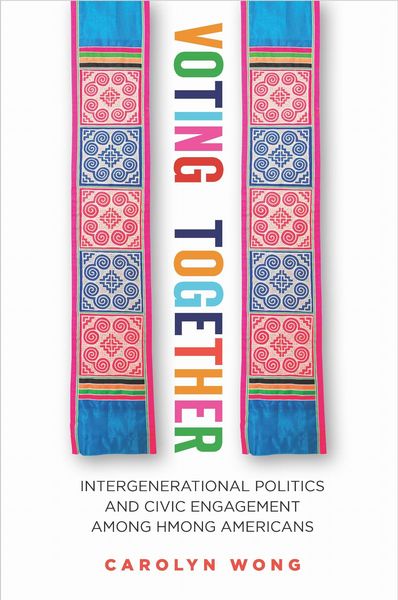
Produktbild: Voting Together

Voting Together Intergenerational Politics and Civic Engagement Among Hmong Americans

72,99 €

inkl. gesetzl. MwSt., Versandkostenfrei


Beschreibung

Produktdetails

Einband

Gebundene Ausgabe

Erscheinungsdatum

06.06.2017

Verlag

Stanford University Press

Seitenzahl

304

Maße (L/B/H)

23,1/15,7/2 cm

Gewicht

499 g

Sprache

Englisch

ISBN

978-0-8047-8223-4

Beschreibung

Rezension

"This book is an important contribution to scholarship in Asian American studies and immigrant politics. To date, there has been no in-depth study of the civic engagement of Hmong Americans. This is a notable gap, given that this group has defied expectations of low participation among groups with low socioeconomic resources. Voting Together skillfully shows how Hmong Americans have beaten the odds, drawing critical attention to factors like geographic context, clan structures, gender, and intergenerational dynamics. The book also provides valuable insights to better understand the future trajectory of this important, yet often overlooked, group."-Karthick Ramakrishnan, University of California, Riverside "This is a pioneering work that provides coast-to-coast coverage of the political engagements of 1.5 generation Hmong Americans. Wong legitimates young Hmong trailblazers by placing these newly elected individuals into the context of American history while also highlighting their role as emerging transnational leaders who affect global changes by demanding human and citizenship rights for their fellow co-ethnics in Southeast Asia. This highly readable book is an excellent addition to the field of Hmong studies."-Mai Na M. Lee, University of Minnesota "In this lively and illuminating account of Hmong American participation in political life, Carolyn Wong provides a deeper understanding of the interplay between newcomers and the political system. Drawing on interviews of community leaders and everyday people situated in different parts of the country, Voting Together forces readers to reconsider traditional theories of community empowerment and identity formation. This theoretically rich and nuanced account of diversity in America is a must-read for those interested in ethnic politics."-Janelle Wong, University of Maryland

Produktdetails

Einband

Gebundene Ausgabe

Erscheinungsdatum

06.06.2017

Verlag

Stanford University Press

Seitenzahl

304

Maße (L/B/H)

23,1/15,7/2 cm

Gewicht

499 g

Sprache

Englisch

ISBN

978-0-8047-8223-4

Herstelleradresse

Libri GmbH
Europaallee 1
36244 Bad Hersfeld
DE

Email: gpsr@libri.de

Noch keine Bewertungen vorhanden

Verfassen Sie die erste Bewertung zu diesem Artikel

Helfen Sie anderen Kundinnen und Kunden durch Ihre Meinung.

Kundinnen und Kunden meinen

Bewertungen (0)

Die Leseprobe wird geladen.
  • Produktbild: Voting Together


  • Contents and Abstracts


    1
    Citizenship and Participation


    chapter abstract

    Chapter One introduces the general argument developed in subsequent chapters. In Hmong American communities, political participation arises and deepens through inter-generational social mechanisms of voting. The process is aided by local institutions that educate newcomers in participatory skills and aid reconstruction of identity narratives. Present-day notions about citizenship rights and a desire for political inclusion are influenced by the Vietnam War experience of the Hmong Americans and their status as stateless refugees after the war. The relatively low levels of social-economic attainment of the Hmong Americans compared to other Asian Americans helps explain the motivation to participate in politics to press for public policy that would address poverty and educational reform


    2
    Reconstructing Identity Narratives


    chapter abstract

    Chapter Two examines the cultural and political meaning of identity stories as articulated by Hmong Americans, including examples of how freedom and parity are expressed in these narratives. These stories have formed through an amalgam of lived experience and values. The process of construction and telling of the narratives is participatory. The engagement of ordinary people in conversations and creation of interpretive stories and performing art productions is what animates the identity narratives in civic and political life.


    3
    Participation in Local Contexts


    chapter abstract

    Chapter Three compares local contexts of political and civic participation in several cities – principally, Fresno, California; Saint Paul-Minneapolis, Minnesota; Eau Claire, Wisconsin; and Hickory, North Carolina. The analysis uses a conceptual framework delineating the nature of parity of participation in society, including the realm of economic distribution and cultural recognition, as articulated by Fraser. The analysis emphasizes the importance of public educational institutions and community based organizations in promoting citizen education. . Interviews of high school students illustrate the importance of cultural recognition in the process of citizen education.


    4
    Views on Politics: From Leadership and the Grassroots


    chapter abstract

    Chapter Four uses interviews of Hmong American leaders and grassroots community members to examine views on a wide range of questions: the nature and extent of participants' political and civic engagement; sources of political information; attitudes about leadership; relationships to political parties; views about the main problems in the community; concepts of ethnic identity; and views of national policy issues.


    5
    Human Rights Advocacy Across Borders


    chapter abstract

    Chapter Five presents a case study of the politics of recognition and dignity as expressed in the testimony of Hmong refugees about human rights violations in Thailand, where their relatives' graves were desecrated. A collaborative project led by human rights researchers at the University of Minnesota and Hmong American political leaders explored how the rights claims can be usefully framed in terms of indigenous religious rights. From the work of a newly emerging generation of college-educated Hmong Americans, parts of this story began to find moving expression in a nascent literary and performing arts.


    6
    Deepening Intergenerational Participation


    chapter abstract

    Chapter Six concludes with a discussion of future prospects for wider and deeper political participation of the Hmong Americans. The desire to engage in elections is rooted in a belief in the role of government in assisting people poverty to become self-sufficient. Experiencing racial prejudice and economic disadvantage opens opportunities for education about commonality of interest with other racial-ethnic minorities and socially marginalized people. From this ground there is potential to better appreciate the power of collective action in politics and to gain the skills needed in a truly participatory citizenship which extends beyond voting alone. To realize this potential requires imagining collaborative and inter-generational projects of community-based political education.