KI-Beratung Beta

  • Produktbild: Measuring Poverty and Wellbeing in Developing Countries
  • Produktbild: Measuring Poverty and Wellbeing in Developing Countries

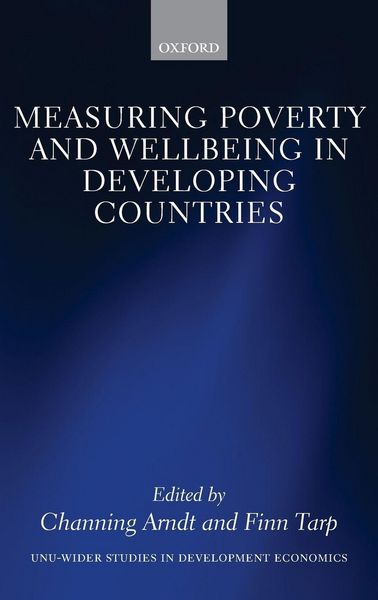
Measuring Poverty and Wellbeing in Developing Countries

159,99 €

inkl. gesetzl. MwSt., Versandkostenfrei


Beschreibung

Detailed analyses of poverty and wellbeing in developing countries, based on household surveys, have been ongoing for more than three decades. The large majority of developing countries now regularly conduct a variety of household surveys, and the information base in developing countries with respect...

Beschreibung

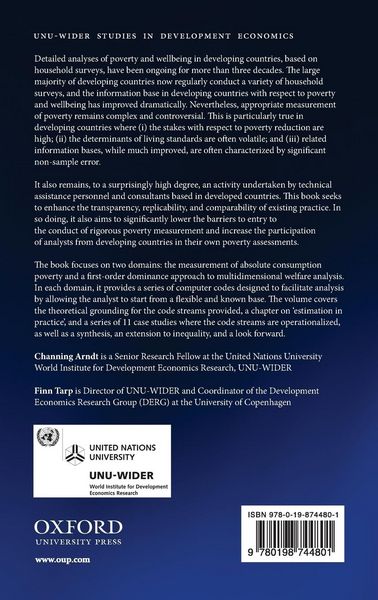
Detailed analyses of poverty and wellbeing in developing countries, based on household surveys, have been ongoing for more than three decades. The large majority of developing countries now regularly conduct a variety of household surveys, and the information base in developing countries with respect to poverty and wellbeing has improved dramatically. Nevertheless, appropriate measurement of poverty remains complex and controversial. This is particularly true in developing countries where (i) the stakes with respect to poverty reduction are high; (ii) the determinants of living standards are often volatile; and (iii) related information bases, while much improved, are often characterized by significant non-sample error. It also remains, to a surprisingly high degree, an activity undertaken by technical assistance personnel and consultants based in developed countries. This book seeks to enhance the transparency, replicability, and comparability of existing practice. In so doing, it also aims to significantly lower the barriers to entry to the conduct of rigorous poverty measurement and increase the participation of analysts from developing countries in their own poverty assessments. The book focuses on two domains: the measurement of absolute consumption poverty and a first order dominance approach to multidimensional welfare analysis. In each domain, it provides a series of flexible computer codes designed to facilitate analysis by allowing the analyst to start from a flexible and known base. The book volume covers the theoretical grounding for the code streams provided, a chapter on 'estimation in practice', a series of 11 case studies where the code streams are operationalized, as well as a synthesis, an extension to inequality, and a look forward.

Produktdetails

Einband

Gebundene Ausgabe

Erscheinungsdatum

22.12.2016

Abbildungen

23 Figures, 104 Tables, 3 Boxes

Herausgeber Arndt Channing + weitere

Produktdetails

Einband

Gebundene Ausgabe

Erscheinungsdatum

22.12.2016

Abbildungen

23 Figures, 104 Tables, 3 Boxes

Herausgeber
Verlag Oxford University Press
Seitenzahl

372

Maße (L/B/H)

24/16,1/2,5 cm

Gewicht

672 g

Sprache

Englisch

ISBN

978-0-19-874480-1

Herstelleradresse

Libri GmbH
Europaallee 1
36244 Bad Hersfeld
DE

Email: gpsr@libri.de

Noch keine Bewertungen vorhanden

Verfassen Sie die erste Bewertung zu diesem Artikel

Helfen Sie anderen Kundinnen und Kunden durch Ihre Meinung.

Kundinnen und Kunden meinen

Bewertungen (0)

Die Leseprobe wird geladen.
  • Produktbild: Measuring Poverty and Wellbeing in Developing Countries
  • Produktbild: Measuring Poverty and Wellbeing in Developing Countries
    • PART I: PRINCIPLES AND CHOICES

    • 1: Channing Arndt and Finn Tarp: Measuring poverty and wellbeing in developing countries: motivation and overview

    • 2: Channing Arndt, Kristi Mahrt, and Finn Tarp: Absolute poverty lines

    • 3: Channing Arndt, Nikolaj Siersbÿk, and Lars Peter Østerdal: Multidimensional first-order dominance comparisons of population wellbeing

    • 4: Channing Arndt and Kristi Mahrt: Estimation in practice

    • PART II: COUNTRY APPLICATIONS

    • 5: David Stifel and Tassew Woldehanna: Estimating utility-consistent poverty in Ethiopia, 2000-11

    • 6: David Stifel, Tiaray Razafimanantena, and Faly Rakotomanana: Estimating utility-consistent poverty in Madagascar, 2001-10

    • 7: Ulrik Beck, Richard Mussa, and Karl Pauw: Methods matter: the sensitivity of Malawian poverty estimates to definitions, data, and assumptions

    • 8: Channing Arndt, Sam Jones, Kristi Mahrt, Vincenzo Salvucci, and Finn Tarp: A review of consumption poverty estimation for Mozambique

    • 9: Hina Nazli, Edward Whitney, and Kristi Mahrt: Poverty trends in Pakistan

    • 10: Bjorn Van Campenhout, Haruna Sekabira, and Fiona Nattembo: Uganda: a new set of utility-consistent poverty lines

    • 11: Kristi Mahrt and Malokele Nanivazo: Estimating multidimensional childhood poverty in the Democratic Republic of Congo: 2007-2013

    • 12: Raymond Elikplim Kofinti, and Samuel Kobina Annim: Child deprivation and income poverty in Ghana

    • 13: Olu Ajakaiye, Afeikhena T. Jerome, Olanrewaju Olaniyan, Olufunke A. Alaba, and Kristi Mahrt: Spatial and temporal multidimensional poverty in Nigeria

    • 14: Channing Arndt, Vincent Leyaro, Kristi Mahrt, and Finn Tarp: Multidimensional assessment of child welfare for Tanzania

    • 15: Kristi Mahrt and Gibson Masumbu: Estimating multidimensional poverty in Zambia

    • PART III: SUMMING-UP AND LESSONS LEARNT

    • 16: Channing Arndt, Kristi Mahrt, and Finn Tarp: Synthesis

    • 17: Ulrik Richardt Beck: Keep it real: measuring real inequality using survey data from developing countries

    • 18: Channing Arndt and Finn Tarp: Conclusions and looking forward

    • APPENDIX A: User guide to Poverty Line Estimation Analytical Software-PLEASe

    • APPENDIX B: User guide to Estimating First-Order Dominance software (EFOD)