KI-Beratung Beta

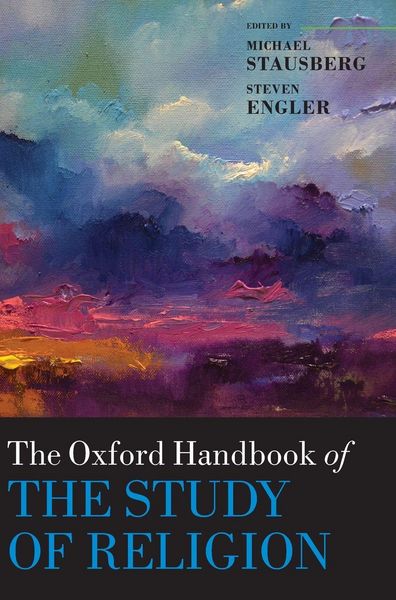
  • Produktbild: OHB STUDY OF RELIGION OHBK C
  • Produktbild: OHB STUDY OF RELIGION OHBK C

OHB STUDY OF RELIGION OHBK C

Aus der Reihe Oxford Handbooks

135,99 €

inkl. gesetzl. MwSt., Versandkostenfrei


Beschreibung

Produktdetails

Einband

Gebundene Ausgabe

Erscheinungsdatum

24.11.2016

Herausgeber

Stausberg Michael + weitere

Verlag

Oxford University Press

Seitenzahl

882

Maße (L/B/H)

25/17,5/5,1 cm

Gewicht

1670 g

Sprache

Englisch

ISBN

978-0-19-872957-0

Beschreibung

Rezension

The Oxford Handbook of the Study of Religion is an impressively thorough treatment, and it's difficult to imagine a single volume that could accomplish a more complete survey of the field of religious studies. C. Travis Webb, Reading Religion

Produktdetails

Einband

Gebundene Ausgabe

Erscheinungsdatum

24.11.2016

Herausgeber

Verlag

Oxford University Press

Seitenzahl

882

Maße (L/B/H)

25/17,5/5,1 cm

Gewicht

1670 g

Sprache

Englisch

ISBN

978-0-19-872957-0

Herstelleradresse

Libri GmbH
Europaallee 1
36244 Bad Hersfeld
DE

Email: gpsr@libri.de

Noch keine Bewertungen vorhanden

Verfassen Sie die erste Bewertung zu diesem Artikel

Helfen Sie anderen Kundinnen und Kunden durch Ihre Meinung.

Kundinnen und Kunden meinen

Bewertungen (0)

Die Leseprobe wird geladen.
  • Produktbild: OHB STUDY OF RELIGION OHBK C
  • Produktbild: OHB STUDY OF RELIGION OHBK C
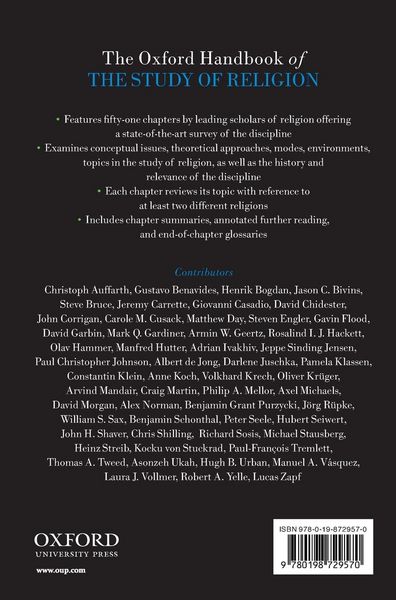
    • List of Figures and Tables
    • List of Contributors
    • Introduction: Aims, Scope, and Organization
    • Part I. Religion
    • 1: Michael Stausberg and Mark Q. Gardiner: Definition
    • 2: Giovanni Casadio: Historicizing and Translating Religion
    • 3: Michael Stausberg and Steven Engler: Theories of Religion
    • 4: Heinz Streib and Constantin Klein: Religion and Spirituality
    • 5: Lois Lee: Non-religion
    • Part II. Theoretical Approaches
    • 6: Armin W. Geertz: Cognitive Science
    • 7: Peter Seele and Lucas Zapf: Economics
    • 8: John H. Shaver, Benjamin Grant Purzycki, and Richard Sosis: Evolutionary Theory
    • 9: Darlene Juschka: Feminism and Gender Theory
    • 10: Gavin Flood: Hermeneutics
    • 11: Matthew Day: Marxism
    • 12: Arvind Mandair: Postcolonialism
    • 13: Mark Q. Gardiner and Steven Engler: Semantics
    • 14: Robert A. Yelle: Semiotics
    • 15: Paul-François Tremlett: (Post)-structuralism
    • 16: Philip A. Mellor and Chris Shilling: Social Theory
    • Part III. Modes
    • 17: Volkhard Krech: Communication
    • 18: David Morgan: Materiality
    • 19: Jeppe Sinding Jensen: Narrative
    • 20: Axel Michaels and William S. Sax: Performance
    • 21: Rosalind I. J. Hackett: Sound
    • 22: David Chidester: Space
    • 23: David Chidester: Time
    • Part IV. Environments
    • 24: Anne Koch: Economy
    • 25: Benjamin Schonthal: Law
    • 26: Oliver Krüger: Media
    • 27: Adrian Ivakhiv: Nature
    • 28: Pamela Klassen: Medicine
    • 29: Hubert Seiwert: Politics
    • 30: Laura J. Vollmer and Kocku von Stuckrad: Science
    • Sports
    • Tourism
    • Part V. Topics
    • 33: Jason C. Bivins: Belief
    • 34: John Corrigan: Emotion
    • 35: Craig Martin: Experience
    • 36: Christoph Auffarth: Gift and Sacrifice
    • 37: Gustavo Benavides: Gods
    • 38: Henrik Bogdan: Initiation and Transitions
    • 39: Manfred Hutter: Priests, Prophets, Sorcerers
    • 40: Hugh B. Urban: Purity
    • 41: Gavin Flood: Salvation
    • Part VI. Processes
    • 42: Steve Bruce: Differentiation
    • 43: Albert de Jong: The Disintegration and Death of Religions
    • 44: Asonzeh Ukah: Expansion
    • 45: Manuel A. Vásquez and David Garbin: Globalization
    • 46: Jörg Rüpke: Individualization and Privatization
    • 47: Olav Hammer: Tradition and Innovation
    • 48: Jeremy Carrette: Objectification and Commodification
    • 49: Paul Christopher Johnson: Syncretism and Hybridization
    • Part VII. The Discipline
    • 50: Michael Stausberg: History
    • 51: Thomas A. Tweed: Relevance