• Produktbild: Oxford Handbook of the History of English
  • Produktbild: Oxford Handbook of the History of English

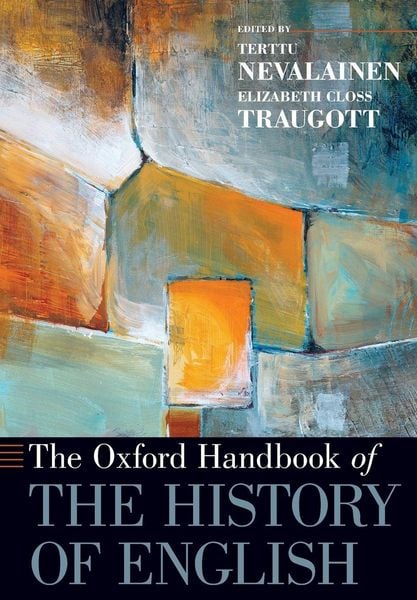
Oxford Handbook of the History of English

119,99 €

inkl. gesetzl. MwSt., Versandkostenfrei


Beschreibung

Produktdetails

Einband

Taschenbuch

Erscheinungsdatum

01.08.2016

Herausgeber

Nevalainen Terttu + weitere

Verlag

Oxford University Press

Seitenzahl

984

Maße (L/B/H)

24,4/17/5,2 cm

Gewicht

1588 g

Sprache

Englisch

ISBN

978-0-19-062788-1

Beschreibung

Produktdetails

Einband

Taschenbuch

Erscheinungsdatum

01.08.2016

Herausgeber

Verlag

Oxford University Press

Seitenzahl

984

Maße (L/B/H)

24,4/17/5,2 cm

Gewicht

1588 g

Sprache

Englisch

ISBN

978-0-19-062788-1

Herstelleradresse

Libri GmbH
Europaallee 1
36244 Bad Hersfeld
DE

Email: gpsr@libri.de

Noch keine Bewertungen vorhanden

Verfassen Sie die erste Bewertung zu diesem Artikel

Helfen Sie anderen Kundinnen und Kunden durch Ihre Meinung.

Kundinnen und Kunden meinen

Bewertungen (0)

  • Produktbild: Oxford Handbook of the History of English
  • Produktbild: Oxford Handbook of the History of English
    • Preface

    • Contents

    • Contributors

    • Abbreviations

    • Introduction: Rethinking and extending approaches to the history of the English language. (Terttu Nevalainen and Elizabeth Closs Traugott)

    • --PART I. RETHINKING EVIDENCE

    • --Guide to Part I.

    • --Evidence

    • 1. Lead Chapter: Evidence for the history of English: Introduction. (Susan Fitzmaurice and Jeremy Smith)

    • 2. Evidence from sources prior to 1500. (Carole Hough)

    • 3. Coins as evidence. (Philip Shaw)

    • 4. Editing early English texts. (Simon Horobin)

    • 5. Evidence from sources after 1500. (Joan C. Beal)

    • 6. Examples of evidence from phonology

    • 6.1 Middle English phonology in the digital age: What written corpora can tell us about sound change. (Nikolaus Ritt)

    • 6.2 Evidence for sound-change from Scottish corpora. (Wendy Anderson)

    • 6.3 GOAT vowel variants in the Diachronic Electronic Corpus of Tyneside English (DECTE). (Karen P. Corrigan)

    • 6.4 Analyzing the ONZE data as evidence for sound change. (Jennifer Hay)

    • 7. Using dictionaries and thesauruses as evidence. (Julie Coleman)

    • 8. Evidence from surveys and atlases in the history of the English language. (William A. Kretzschmar Jr. and Merja Stenroos)

    • 9. Evidence from historical corpora up to the twentieth century. (Merja Kytö and Päivi Pahta)

    • 10. Variability-based Neighbor Clustering: A bottom-up approach to periodization in historical linguistics. (Stefan Th. Gries and Martin Hilpert)

    • 11. Data retrieval in a diachronic context: The case of the historical English courtroom (Dawn Archer)

    • --Observing recent change through electronic corpora

    • 12. Lead Chapter: Some methodological issues related to corpus-based investigations of recent syntactic changes in English. (Mark Davies)

    • 13. "Small is beautiful " - On the value of standard reference corpora for observing recent grammatical change. (Marianne Hundt and Geoffrey Leech)

    • 14. Exploring variation and change in New Englishes: Looking into the International Corpus of English (ICE) and beyond. (Joybrato Mukherjee and Marco Schilk)

    • 15. Change in the English infinitival perfect construction. (Jill Bowie and Bas Aarts)

    • 16. Revisiting the reduplicative copula with corpus-based evidence. (Anne Curzan)

    • 17. Exploring aspects of the Great Complement Shift, with evidence from the TIME Corpus and COCA. (Juhani Rudanko)

    • 18. Diachronic collostructional analysis meets the noun phrase: Studying many a noun in COHA. (Martin Hilpert)

    • 19. From opportunistic to systematic use of the Web as corpus: do-support with got (to) in contemporary American English. (Christian Mair)

    • --PART II. ISSUES IN CULTURE AND SOCIETY

    • --Guide to Part II.

    • --Mass communication and technologies

    • 20. Lead Chapter: Technologies of communication. (Thomas Kohnen and Christian Mair)

    • 21. Oral practices in the history of English. (Ursula Schaefer)

    • 22. Forms of early mass communication: The religious domain. (Tanja Rütten)

    • 23. From manuscript to printing: Transformations of genres in the history of English. (Claudia Claridge)

    • 24. The competing demands of popularization vs. economy: Written language in the age of mass literacy. (Douglas Biber and Bethany Gray)

    • 25. The impact of electronically-mediated communication on language standards and style. (Naomi S. Baron)

    • 26. Old news: Rethinking language change through Australian broadcast speech. (Jenny Price)

    • 27. The commodification of language: English as a global commodity. (Deborah Cameron)

    • --Socio-cultural processes

    • 28. Lead Chapter: Socio-cultural processes and the history of English. (Jonathan Culpeper and Minna Nevala)

    • 29. Democratisation. (Michael Farrelly and Elena Seoane)

    • 30. Changing attitudes and political correctness. (Geoffrey Hughes)

    • 31. Social roles, identities, and networks. (Minna Palander-Collin)

    • 32. Changes in politeness cultures. (Andreas H. Jucker)

    • 33. The history of English seen as the history of ideas: Cultural change reflected in different translations of the New Testament. (Anna Wierzbicka)

    • 34. Attitudes, prescriptivism, and standardisation. (Carol Percy)

    • 35. Perceptions of dialects: Changing attitudes and ideologies. (Chris Montgomery)

    • 36. English in Ireland: A complex case study. (Tony Crowley)

    • --PART III. APPROACHES FROM CONTACT AND TYPOLOGY

    • --Guide to Part III.

    • --Language contact

    • 37. Lead Chapter: Assessing the role of contact in the history of English. (Raymond Hickey)

    • 38. Early English and the Celtic hypothesis. (Raymond Hickey)

    • 39. Language contact in the Scandinavian period. (Angelika Lutz)

    • 40. Language contact and linguistic attitudes in the Later Middle Ages. (Tim William Machan)

    • 41. Code-switching in English of the Middle Ages. (Päivi Pahta)

    • 42. Ethnic dialects in North American English. (Charles Boberg)

    • 43. Contact in the African area - A Southern African perspective. (Ana Deumert and Rajend Mesthrie)

    • 44. Contact in the Asian arena. (Lisa Lim and Umberto Ansaldo)

    • 45. Contact-induced change in English world-wide. (Edgar W. Schneider)

    • 46. Second language varieties of English. (Devyani Sharma)

    • 47. Pidgins and creoles in the history of English. (Donald Winford)

    • --Typology and typological change

    • 48. Lead Chapter: Typology and typological change in English historical linguistics. (Bernd Kortmann)

    • 49. The drift of English towards invariable word order from a typological and Germanic perspective. (John A. Hawkins)

    • 50. Typological hierarchies and frequency drifts in the history of English. (Mikko Laitinen)

    • 51. Lexical typology and typological changes in the English lexicon. (Alexander Haselow)

    • 52. Analyticity and syntheticity in the history of English. (Benedikt Szmrecsanyi)

    • 53. Grammaticalization in non-standard varieties of English and English-based pidgins and creoles. (Agnes Schneider)

    • 54. Towards an automated classification of Englishes. (Søren Wichmann and Matthias Urban)

    • --PART IV. RETHINKING CATEGORIES AND MODULES

    • --Guide to Part IV.

    • --Cycles and continua

    • 55. Lead Chapter: Cycles and continua: On unidirectionality and gradualness in language change. (Ricardo Bermúdez-Otero and Graeme Trousdale)

    • 56. Quantitative evidence for a feature-based account of grammaticalisation in English: Jespersen's Cycle. (Phillip Wallage)

    • 57. The syntax-lexicon continuum. (Cristiano Broccias)

    • 58. Toward a unified theory of chain shifting. (Aaron J. Dinkin)

    • 59. (Non)-rhoticity - Lessons from New Zealand English. (Jennifer Hay and Alhana Clendon)

    • 60. Lenition in English. (Patrick Honeybone)

    • 61. Continua and clines in the development of New Englishes. (Devyani Sharma and Caroline R. Wiltshire)

    • --Interfaces with information structure

    • 62. Lead Chapter: The interaction between syntax, information structure, and prosody in word order change. (Roland Hinterhölzl and Ans van Kemenade)

    • 63. Rethinking the loss of Verb Second. (Ans van Kemenade)

    • 64. Rethinking the OV/VO alternation in Old English: The effect of complexity, grammatical weight, and information status. (Ann Taylor and Susan Pintzuk)

    • 65. The impact of focusing and defocusing on word order in OE and OHG, and on changes at the right periphery in the middle periods. (Svetlana Petrova)

    • 66. The loss of local anchoring: From adverbial local anchors to permissive subjects. (Bettelou Los and Gea Dreschler)

    • 67. Stress clash and word order changes in the left periphery in Old English and Middle English. (Augustin Speyer)

    • 68. Clefts as resolution strategies after the loss of a multifunctional first position. (Bettelou Los and Erwin Komen)

    • Glossary

    • List of corpora and databases

    • Index of languages and language varieties

    • Name index

    • Subject index