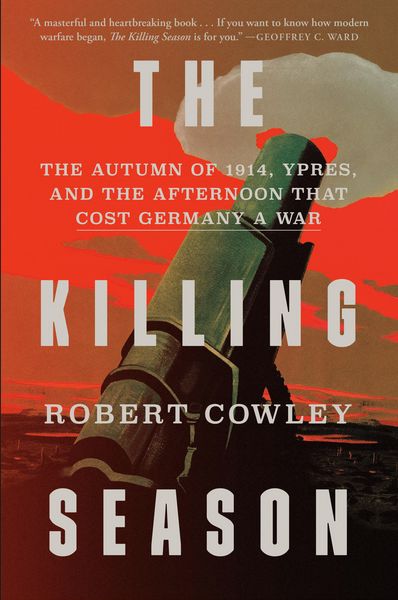
The Killing Season The Autumn of 1914, Ypres, and the Afternoon That Cost Germany a War
-
Sprache:Englisch
-
Verlag:Random House N.Y.
36,99 €
inkl. gesetzl. MwSt.,
Beschreibung
Produktdetails
Einband
Gebundene Ausgabe
Erscheinungsdatum
02.09.2025
Abbildungen
BLACK&WHITE PHOTOS THROUGHOUT
Verlag
Random House N.Y.Seitenzahl
752
Maße (L/B/H)
23,8/15,7/4 cm
Gewicht
1080 g
Sprache
Englisch
ISBN
978-1-4000-6852-4
“A masterful and heartbreaking book . . . If you want to know how modern warfare began, The Killing Season is for you.”—Geoffrey C. Ward, co-author of The Civil War, The War, and The Vietnam War
The Marne may have saved Paris and prevented a devastating setback for the Allies, but it did not spell eventual defeat for Germany. Ypres did.
The final months of 1914 were the bloodiest interval in a famously bloody war, a killing season. They ended with the First Battle of Ypres, a struggle in West Flanders, Belgium, whose importance has been too long overlooked—until now. Robert Cowley’s fresh, novelistic account of this crucial period describes how German armies in France were poised to sweep north to capture the Channel ports and knock England out of the war—and were only held back by a brilliant improvisation from a cobbled-together handful of desperate British, French, and Belgian troops.
In a re-examination of events that have too long seemed set in stone, Cowley combines a wide array of source materials with sharp portrayals both of military leaders and of the men they led. We follow Albert of Belgium, the world’s last warrior king; French General Ferdinand Foch, a former professor of military science; and Hendrik Geeraert, an alcoholic barge keeper, who pulled off Albert’s literal last-ditch effort. Many other memorable characters emerge, including Sir John French, a British commander, who displayed his greatest talent for maneuver in the bedroom; along with both a young Adolf Hitler and Winston Churchill.
The vast brawl of four armies in Flanders was a turning point that irrevocably changed the nature of modern warfare. In this visceral account, based on thirty years of research and picking up where Barbara Tuchman’s
The Guns of August left off, Cowley details the crucial decisions that determined the outcome of the Great War—which may have been decided by a single, extraordinary afternoon.
Noch keine Bewertungen vorhanden
Verfassen Sie die erste Bewertung zu diesem Artikel
Helfen Sie anderen Kundinnen und Kunden durch Ihre Meinung.
Kurze Frage zu unserer Seite
Vielen Dank für Ihr Feedback
Wir nutzen Ihr Feedback, um unsere Produktseiten zu verbessern. Bitte haben Sie Verständnis, dass wir Ihnen keine Rückmeldung geben können. Falls Sie Kontakt mit uns aufnehmen möchten, können Sie sich aber gerne an unseren Kund*innenservice wenden.
zum Kundenservice