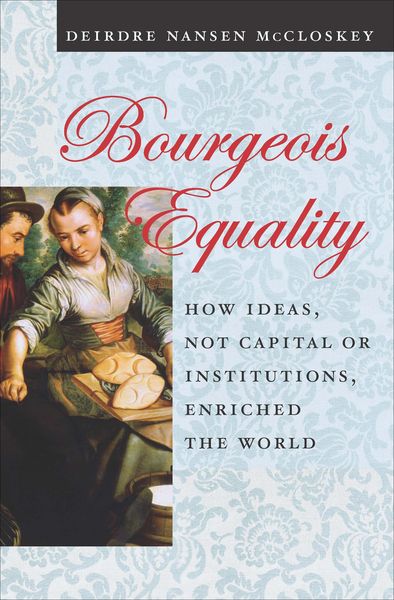
Bourgeois Equality How Ideas, Not Capital or Institutions, Enriched the World
-
- Taschenbuch
- eBook ausgewählt
-
Form:Einzelkauf Download
-
Sprache:Englisch
18,69 €
inkl. gesetzl. MwSt.Beschreibung
Produktdetails
Format
ePUB
Kopierschutz
Nein
Family Sharing
Nein
Text-to-Speech
Ja
Erscheinungsdatum
04.03.2020
Verlag
The University of Chicago PressSeitenzahl
768 (Printausgabe)
Dateigröße
1929 KB
Sprache
Englisch
EAN
9780226334042
How standards of living have skyrocketed since 1800, and the political philosophy that made it possible: "Persuasive...richly detailed and erudite."-
Financial Times
There's little doubt that most humans today are better off than their forebears. Stunningly so, the economist and historian Deirdre McCloskey argues in this concluding volume of her trilogy celebrating the oft-derided virtues of the bourgeoisie. The poorest of humanity, McCloskey shows, will soon be joining the comparative riches of Japan and Sweden and Botswana.
Why? Most economists-from Adam Smith and Karl Marx to Thomas Piketty-say the Great Enrichment since 1800 came from accumulated capital. McCloskey disagrees, fiercely. Our riches, she argues, were made not by piling brick on brick, bank balance on bank balance, but by piling idea on idea. Capital was necessary, but in the same way that oxygen is necessary for a fire. Nor were institutions the drivers: the World Bank orthodoxy of "add institutions and stir" hasn't worked. McCloskey builds a powerful case for the initiating role of ideas-ideas for electric motors and free elections, of course, but more deeply the bizarre and liberal ideas of equal liberty and dignity for ordinary folk. Liberalism arose from theological and political revolutions in northwest Europe, yielding a unique respect for betterment and its practitioners, and upending ancient hierarchies. Commoners were encouraged to have a go, and the bourgeoisie took up the Bourgeois Deal, and we were all enriched.
Few economists or historians write like McCloskey-her ability to invest the facts of economic history with the urgency of a novel, or of a leading case at law, is unmatched. She summarizes modern economics and modern economic history with verve and lucidity, yet sees through to the really big scientific conclusion. Not matter, but ideas. Big books don't come any more ambitious, or captivating, than
Bourgeois Equality.
Financial Times
There's little doubt that most humans today are better off than their forebears. Stunningly so, the economist and historian Deirdre McCloskey argues in this concluding volume of her trilogy celebrating the oft-derided virtues of the bourgeoisie. The poorest of humanity, McCloskey shows, will soon be joining the comparative riches of Japan and Sweden and Botswana.
Why? Most economists-from Adam Smith and Karl Marx to Thomas Piketty-say the Great Enrichment since 1800 came from accumulated capital. McCloskey disagrees, fiercely. Our riches, she argues, were made not by piling brick on brick, bank balance on bank balance, but by piling idea on idea. Capital was necessary, but in the same way that oxygen is necessary for a fire. Nor were institutions the drivers: the World Bank orthodoxy of "add institutions and stir" hasn't worked. McCloskey builds a powerful case for the initiating role of ideas-ideas for electric motors and free elections, of course, but more deeply the bizarre and liberal ideas of equal liberty and dignity for ordinary folk. Liberalism arose from theological and political revolutions in northwest Europe, yielding a unique respect for betterment and its practitioners, and upending ancient hierarchies. Commoners were encouraged to have a go, and the bourgeoisie took up the Bourgeois Deal, and we were all enriched.
Few economists or historians write like McCloskey-her ability to invest the facts of economic history with the urgency of a novel, or of a leading case at law, is unmatched. She summarizes modern economics and modern economic history with verve and lucidity, yet sees through to the really big scientific conclusion. Not matter, but ideas. Big books don't come any more ambitious, or captivating, than
Bourgeois Equality.
Noch keine Bewertungen vorhanden
Verfassen Sie die erste Bewertung zu diesem Artikel
Helfen Sie anderen Kundinnen und Kunden durch Ihre Meinung.
Kurze Frage zu unserer Seite
Vielen Dank für Ihr Feedback
Wir nutzen Ihr Feedback, um unsere Produktseiten zu verbessern. Bitte haben Sie Verständnis, dass wir Ihnen keine Rückmeldung geben können. Falls Sie Kontakt mit uns aufnehmen möchten, können Sie sich aber gerne an unseren Kund*innenservice wenden.
zum Kundenservice