KI-Beratung Beta

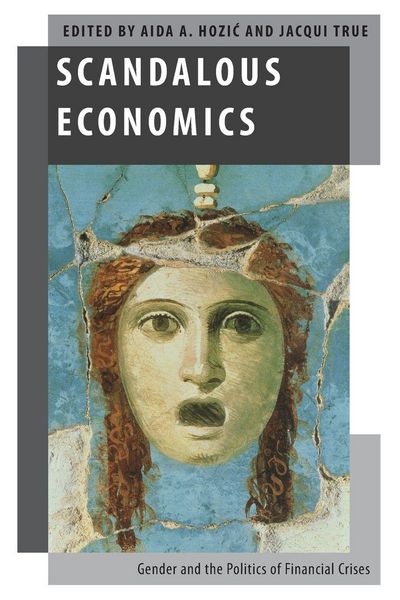
Produktbild: SCANDALOUS ECONOMICS OSGIR P

SCANDALOUS ECONOMICS OSGIR P

86,99 €

inkl. gesetzl. MwSt., Versandkostenfrei


Beschreibung

Of all of the lies, fragile alliances, and predatory financial dealings that have been revealed in the wake of the Global Financial Crisis of 2008, we have yet to come to terms with the ways in which structural inequalities around gender and race factor into (and indeed make possible) the current economic...

Beschreibung

Of all of the lies, fragile alliances, and predatory financial dealings that have been revealed in the wake of the Global Financial Crisis of 2008, we have yet to come to terms with the ways in which structural inequalities around gender and race factor into (and indeed make possible) the current economic order. Scandalous Economics is about "silences" - the astonishing neglect of gender and race in explanations of the Global Financial Crisis. But, it is also about "noises" - the sexual scandals and gendered austerity policies that have relegated public debate, and the crisis itself, into political oblivion. While feminist economists and movements such as Occupy Wall Street have pointed to the distributional inequalities that are an effect of financial deregulation, scholars haven't really grappled with the representational inequalities inherent in the way we view the politics of the market. For example, capitalism won't be made more equitable simply by appointing women to leadership positions within financial firms or corporations. And the next crisis will not be averted if our understandings of gendered inequalities are framed by sexual scandals in media and popular culture. We need to look at the activities and the privileges of the advantaged - the "TED women" of the crisis -- as much as the victimization of the disadvantaged - to fully grasp the interplay between gender and economy in this fragile age of restoration. Scandalous Economics breaks new ground by doing precisely this. It argues that normalization of the post-GFC economic order in the face of its obvious breakdown(s) has been facilitated by co-optation of feminist and queer perspectives into national and international responses to the crisis. Scandalous Economics builds upon the Occupy movement and other critical analysis of the GFC to comprehensively examine gendered material, ideational and representational dimensions that have served to make the crisis and its effects, 'the new normal' in Europe and America as well as Latin America and Asia.

Produktdetails

Einband

Taschenbuch

Erscheinungsdatum

11.05.2016

Herausgeber Aida A. Hozić + weitere
Verlag Oxford University Press

Produktdetails

Einband

Taschenbuch

Erscheinungsdatum

11.05.2016

Herausgeber
Verlag Oxford University Press
Seitenzahl

354

Maße (L/B/H)

23,4/15,6/1,9 cm

Gewicht

538 g

Sprache

Englisch

ISBN

978-0-19-020424-2

Herstelleradresse

Libri GmbH
Europaallee 1
36244 Bad Hersfeld
DE

Email: gpsr@libri.de

Noch keine Bewertungen vorhanden

Verfassen Sie die erste Bewertung zu diesem Artikel

Helfen Sie anderen Kundinnen und Kunden durch Ihre Meinung.

Kundinnen und Kunden meinen

Bewertungen (0)

Die Leseprobe wird geladen.
  • Produktbild: SCANDALOUS ECONOMICS OSGIR P
    • Acknowledgments
    • About the Contributors
    • I. Scandalous Gendering
    • Chapter 1: Making Feminist Sense of the Global Financial Crisis
    • Aida Hozi¿ and Jacqui True
    • Chapter 2: Lehman Brothers and Sisters: Revisiting Gender and After the Financial Crisis
    • Elisabeth Prugl
    • Chapter 3: The Global Financial Crisis' Silver Bullet: Women Leaders and Leaning-In
    • Jacqui True
    • Chapter 4: Finance, Financialization and the Production of Gender
    • Adrienne Roberts
    • II. Scandalous Obfuscations
    • Chapter 5: Broken Britain: Post-Crisis Austerity and the Trouble with the Troubled Families Program
    • Daniela Tepe-Belfrage and Johnna Montgomerie
    • Chapter 6: Constitutionalizing Austerity, Disciplining the Household - Masculine Norms of Competitiveness and the Crisis of Social Reproduction in the Eurozone
    • Ian Bruff and Stefanie Wohl
    • Chapter 7: Whose Crisis? Whose Recovery? Lessons Learnt (and Not) from the Asian Crisis
    • Juanita Elias
    • Chapter 8: "To double oppression, double rebellion": Women, Capital and Crisis in 'Post-neoliberal' Latin America
    • Guillermina Seri
    • III. Scandalous Sex
    • Chapter 9: Exploits and Exploitations: A Micro and Macro Analysis of the 'DSK Affair'
    • Celeste Montoya
    • Chapter 10: We, Neoliberals
    • Aida Hozi¿
    • Chapter 11: Gender, Finance and Embodiments of Crisis
    • Penny Griffin
    • IV. Scandalizing Reimaginings
    • Chapter 12: Global Raciality of Capitalism and 'Primitive' Accumulation: (Un) Making the Death Limit
    • Anna Aganthangelou
    • Chapter 13: Towards a Queer Political Economy of Crisis
    • Nicola Smith
    • Chapter 14: Self-Reproducing Movements and the Enduring Challenge of Materialist Feminism
    • Wanda Vrasti
    • Afterword: Gendering the Crisis
    • Marieke De Goede
    • References
    • Index