KI-Beratung Beta

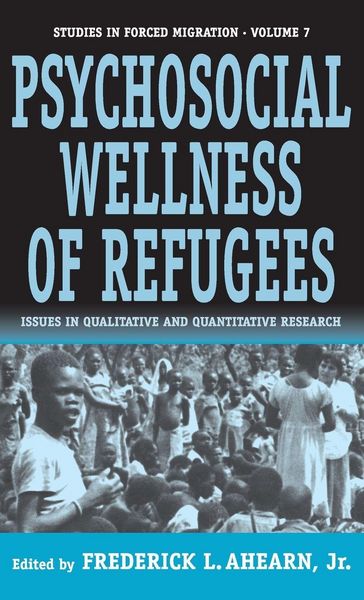
Produktbild: The Psychosocial Wellness of Refugees
Band 7

The Psychosocial Wellness of Refugees Issues in Qualitative and Quantitative Research

Aus der Reihe Forced Migration

179,99 €

inkl. gesetzl. MwSt., Versandkostenfrei


Beschreibung

In recent years, scholars in the fields of refugee studies and forced migration have extended their areas of interest and research into the phenomenon of displacement, human response to it, and ways to intervene to assist those affected, increasingly focusing on the emotional and social impact of displacement...

Beschreibung

In recent years, scholars in the fields of refugee studies and forced migration have extended their areas of interest and research into the phenomenon of displacement, human response to it, and ways to intervene to assist those affected, increasingly focusing on the emotional and social impact of displacement on refugees and their adjustment to the traumatic experiences. In the process, the positive concept of "psychosocial wellness" was developed as discussed in this volume. In it noted scholars address the strengths and limitations of their investigations, citing examples from their work with refugees from Afghanistan, Cambodia, Vietnam, Palestine, Cuba, Nicaragua, Haiti, Eastern Europe, Bosnia, and Chile. The authors discuss how they define "psychosocial wellness," as well as the issues of sample selection, measurement, reliability and validity, refugee narratives and "voices," and the ability to generalize findings and apply these to other populations. The key question that has guided many of these investigations and underlies the premise of this book is "what happens to an ordinary person who has experienced an extraordinary event?" This volume also highlights the fact that those involved in such research must also deal with their own emotional responses as they hear victims tell of killing, torture, humiliation, and dispossesion. The volume will therefore appeal to practitioners of psychology, psychiatry, social work, nursing, and anthropology. However, its breadth and the evaluation of the strengths and disadvantages of both qualitative and quantitative methods also make it an excellent text for students.

Portrait

Frederick L. Ahearn, Jr. was Dean and is now Ordinary Professor at the School of Social Service at the Catholic University of America and also has an appointment as Tutor at the Refugee Studies Programme, University of Oxford.

Produktdetails

Einband

Gebundene Ausgabe

Erscheinungsdatum

01.04.2000

Herausgeber Frederick L. Ahearn Jr.
Verlag Ingram Publishers Services

Produktdetails

Einband

Gebundene Ausgabe

Erscheinungsdatum

01.04.2000

Herausgeber Frederick L. Ahearn Jr.
Verlag Ingram Publishers Services
Seitenzahl

270

Maße (L/B/H)

22,2/14,5/1,8 cm

Gewicht

415 g

Sprache

Englisch

ISBN

978-1-57181-204-9

Herstelleradresse

Libri GmbH
Europaallee 1
36244 Bad Hersfeld
DE

Email: gpsr@libri.de

Noch keine Bewertungen vorhanden

Verfassen Sie die erste Bewertung zu diesem Artikel

Helfen Sie anderen Kundinnen und Kunden durch Ihre Meinung.

Kundinnen und Kunden meinen

Bewertungen (0)

  • Produktbild: The Psychosocial Wellness of Refugees
  • List of Tables and Figures
    Acknowledgements
    Foreword

    Introduction

    PART I: THEORETICAL ISSUES IN QUALITATIVE AND QUANTITATIVE RESEARCH

    Chapter 1. Psychosocial Wellness: Methodological Approaches To The Study Of Refugees
    Frederick L. Ahearn, Jr.

    Chapter 2. Psychosocial Programs: Principles And Practice For Research And Evaluation
    Alastair Ager

    PART II: CASE STUDIES FOR REFUGEE PSYCHOSOCIAL WELLNESS: QUALITATIVE APPROACHES

    Chapter 3. Qualitative Measures and Refugee Research: The Case Of Afghan Refugees
    Patricia A. Omidian

    Chapter 4. Refugees and Health Ethnographic Approaches
    Marita Eastmond

    Chapter 5. The Autobiographical Method of Investigating the Psychosocial Wellness of Refugees
    Didier Bertrand

    PART III: CASE STUDIES OF REFUGEE PSYCHOSOCIAL WELLNESS: QUANTITATIVE APPROACHES

    Chapter 6. Measuring Suffering: Conflicts And Solutions In Refugee Studies
    Raija-Leena Punamäki

    Chapter 7. Use of Census Data for Research on Refugee Resettlement in the United States: Methodological Strengths And Limitations
    Miriam Potocky-Tripodi

    Chapter 8. Returnees to Vietnam: The Well-Being Of Former Unaccompanied Minors
    Maryanne Loughry and Nguyen Xuan Nghia

    PART IV: CASE STUDIES OF REFUGEE PSYCHOSOCIAL WELLNESS: MIXED APPROACHES

    Chapter 9. Implications For The Development Of Culturally Appropriate Measures
    Ilene Hyman, Morton Beiser, Sam Noh, and Nhi Vu

    Chapter 10. A Child-Centered Approach to Investigating Refugee Children's Concerns
    Colin MacMullin and Maryanne Loughry

    Chapter 11. Qualitative and Quantitative Research among Refugees: An Analysis
    Joseph Westermeyer

    Conclusion: Conclusions and Implications for Future Research
    Frederick L. Ahearn, Jr.

    Notes on Contributors
    Index