KI-Beratung Beta

Gutscheinbedingungen

**Gültig am 27.11.2026 auf Spielzeug, Schreibwaren, Filme, Geschenke & Trends, Musik, tolino eReader & Zubehör, Hörbücher und Hörbuch-Downloads, nicht preisgebundene Bücher und Kalender online auf thalia.at und in der Thalia App. Einzelne Artikel können ausgeschlossen sein. Aufgrund der Buchpreisbindung sind deutschsprachige Bücher und eBooks ausgenommen. Zusätzlich ausgenommen sind Abos & Flatrates, Games, Geschenkkarten/-boxen, Shelfies, Software, Zeitschriften sowie einzelne Artikel von tonies®. Pro Einkauf einmal einlösbar. Click & Collect nur bei Onlinevorabzahlung möglich. Keine Barauszahlung. Nicht kombinierbar mit anderen Aktionen und Gutscheinen. Gutschein wird auf max. 500€ Bestellwert angerechnet. Nicht gültig für Versandkosten und Services.

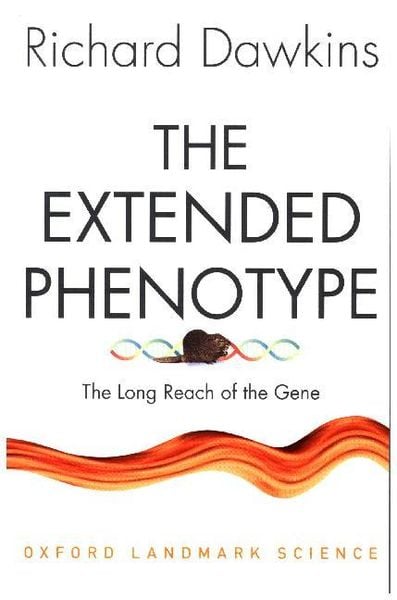
Produktbild: The Extended Phenotype

The Extended Phenotype The Long Reach of the Gene

Aus der Reihe Oxford Landmark Science

15,80 €

inkl. gesetzl. MwSt., zzgl. Versandkosten


  • Kostenlose Lieferung ab 30 € Einkaufswert
  • Versandkostenfrei für Bonuscard-Kund*innen

Beschreibung

In The Selfish Gene, Richard Dawkins crystallized the gene's eye view of evolution developed by W.D. Hamilton and others. The book provoked widespread and heated debate. Written in part as a response, The Extended Phenotype gave a deeper clarification of the central concept of the gene as the unit of...

Beschreibung

In The Selfish Gene, Richard Dawkins crystallized the gene's eye view of evolution developed by W.D. Hamilton and others. The book provoked widespread and heated debate. Written in part as a response, The Extended Phenotype gave a deeper clarification of the central concept of the gene as the unit of selection; but it did much more besides. In it, Dawkins extended the gene's eye view to argue that the genes that sit within an organism have an influence that reaches out beyond the visible traits in that body - the phenotype - to the wider environment, which can include other individuals. So, for instance, the genes of the beaver drive it to gather twigs to produce the substantial physical structure of a dam; and the genes of the cuckoo chick produce effects that manipulate the behaviour of the host bird, making it nurture the intruder as one of its own. This notion of the extended phenotype has proved to be highly influential in the way we understand evolution and the natural world. It represents a key scientific contribution to evolutionary biology, and it continues to play an important role in research in the life sciences.
The Extended Phenotype is a conceptually deep book that forms important reading for biologists and students. But Dawkins' clear exposition is accessible to all who are prepared to put in a little effort.
Oxford Landmark Science books are 'must-read' classics of modern science writing which have crystallized big ideas, and shaped the way we think.

Produktdetails

Einband

Taschenbuch

Erscheinungsdatum

22.09.2016

Verlag Oxford University Press
Seitenzahl

468

Produktdetails

Einband

Taschenbuch

Erscheinungsdatum

22.09.2016

Verlag Oxford University Press
Seitenzahl

468

Maße (L/B/H)

19,8/13,1/5 cm

Gewicht

452 g

Farbe

Wollweiß / Terracotta

Sprache

Englisch

ISBN

978-0-19-878891-1

Herstelleradresse

Libri GmbH
Europaallee 1
36244 Bad Hersfeld
DE

Email: gpsr@libri.de

Noch keine Bewertungen vorhanden

Verfassen Sie die erste Bewertung zu diesem Artikel

Helfen Sie anderen Kundinnen und Kunden durch Ihre Meinung.

Kundinnen und Kunden meinen

Bewertungen (0)

Die Leseprobe wird geladen.
  • Produktbild: The Extended Phenotype
    • 1: Necker Cubes and Buffaloes
    • 2: Genetic Determinism and Gene Selectionism
    • 3: Constraints on Perfection
    • 4: Arms Races and Manipulation
    • 5: The Active Germ-Line Replicator
    • 6: Organisms, Groups and Memes: Replicators or Vehiclesa
    • 7: Selfish Wasp or Selfish Strategya
    • 8: Outlaws and Modifiers
    • 9: Selfish DNA, Jumping Genes, and a Lamarckian Scare
    • 10: An Agony in Five Fits
    • 11: The Genetic Evolution of Animal Artefacts
    • 12: Host Phenotypes of Parasite Genes
    • 13: Action at a Distance
    • 14: Rediscovering the Organism; References
    • Afterword by Daniel Dennett
    • Glossary
    • Author Index
    •  Subject Index