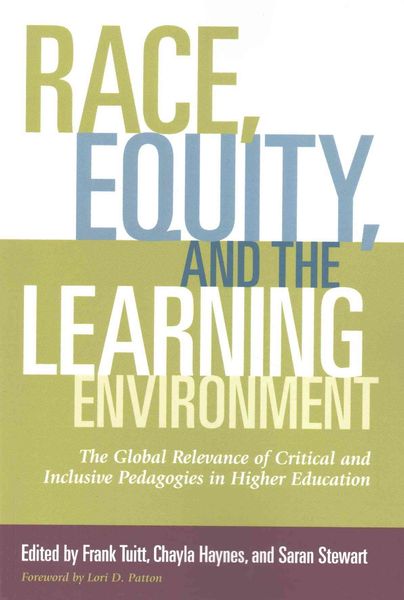
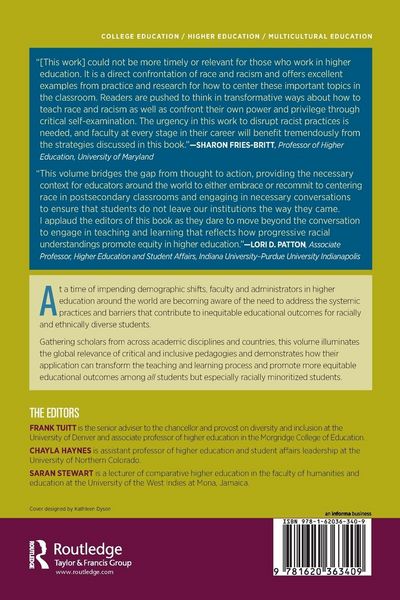
Foreword—Lori D. Patton Acknowledgements Introduction. Critical and Inclusive Pedagogy. Why the Classroom Is All It’s Cracked Up to Be—Chayla HaynesPart One. How We Think About Our Work 1. Advancing a Critical and Inclusive Praxis. Pedagogical and Curriculum Innovations for Social Change in the Caribbean—Saran Stewart 2.Pursuing Equity Through Diversity. Perspectives and Propositions for Teaching and Learning in Higher Education—Liza Ann Bolitzer, Milagros Castillo-Montoya, and Leslie A. Williams 3. A Democratic Pedagogy for a Democratic Society. Education for Social and Political Change (T-128)—Eileen de los Reyes, Hal Smith, Tarajean Yazzie-Mintz, Yamila Hussein, and Frank Tuitt With José Moreno, Anthony De Jesús, Dianne Morales, and Sarah Napier Part Two. How We Engage In Our Work 4. Radical Honesty. Truth-Telling as Pedagogy for Working Through Shame in Academic Spaces—Bianca C. Williams 5. Using the Barnga Card Game Simulation to Develop Cross-Cultural Thinking and Empathy—David S. Goldstein 6. Campus Racial Climate and Experiences of Students of Color in a Midwestern College—Kako Koshino 7. Humanizing Pedagogy for Examinations of Race and Culture in Teacher Education—Dorinda J. Carter Andrews and Bernadette Castillo Part Three. Measuring the Impact of Our Work 8. Dehumanizing and Humanizing Pedagogies. Lessons From U.S. Latin@ and Undocumented Youth Through the P-16 Pipeline—Lisa Martinez, Maria del Carmen Salazar, and Debora M. Ortega 9. De-Racializing Japaneseness. A Collaborative Approach to Shifting Interpretation and Representation of “Culture” at a University in Japan—Ioannis Gaitanidis and Satoko Shao-Kobayashi 10. Unsung Heroes. Impact of Diverse Administrators on the Creation of Transformative, Affirming, and Equitable Learning Environments—Stella L. Smith 11. Critical Pedagogy and Intersectional Sexuality. Exploring Our Oppressions and Privileges Through Reflexivity, Responsibility, and Resistance—Haneen S. Ghabra, Sergio F. Juarez, Shanna K. Kattari, Miranda Olzman, and Bernadette Marie Calafell Conclusion. Inclusive Pedagogy 2.0. Implications for Race, Equity, and Higher Education in a Global Context—Frank Tuitt The Editors and Contributors