Gutscheinbedingungen

**Gültig nur für Bestellungen an die Wunsch-Poststation bis 10.06.2026 auf Spielzeug, Schreibwaren, Filme, Geschenke & Trends, Musik, tolino eReader & Zubehör, Hörbücher und Hörbuch-Downloads (außer Abo), nicht preisgebundene Bücher und Kalender online auf thalia.at und in der Thalia App. Einzelne Artikel können ausgeschlossen sein. Aufgrund der Buchpreisbindung sind deutschsprachige Bücher und eBooks ausgenommen. Zusätzlich ausgenommen sind preisgebundene Artikel, Abos & Flatrates, eBooks, Games, Geschenkkarten/-boxen, Shelfies, Software, Zeitschriften sowie einzelne Artikel von tonies®. Pro Einkauf einmal einlösbar. Kein Click & Collect möglich. Keine Barauszahlung. Nicht kombinierbar mit anderen Aktionen und Gutscheinen. Gutschein wird auf max. 500€ Bestellwert angerechnet. Nicht gültig für Versandkosten und Services.

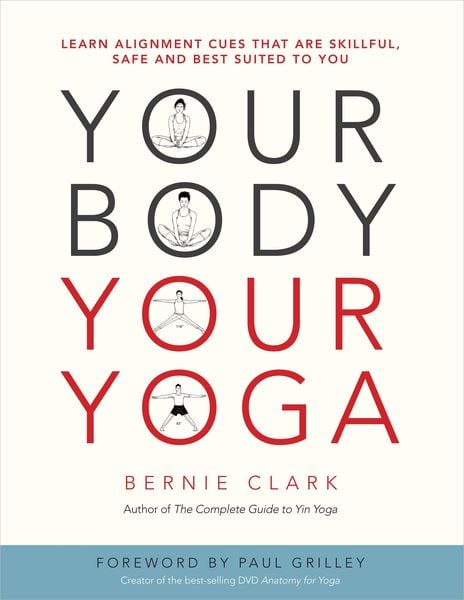
Produktbild: Your Body, Your Yoga

Your Body, Your Yoga Foreword by Paul Grilley

24,99 €

inkl. gesetzl. MwSt., zzgl. Versandkosten


  • Kostenlose Lieferung ab 30 € Einkaufswert
  • Versandkostenfrei für Bonuscard-Kund*innen

Beschreibung

Produktdetails

Verkaufsrang

2894

Einband

Taschenbuch

Erscheinungsdatum

12.04.2016

Abbildungen

15 color photos, 490 color illustrations, 17 charts, 27 tables

Illustriert von

Morgan Jeske

Herausgeber

Dania Sheldon

Verlag

Ingram Publisher Services

Seitenzahl

301

Maße (L/B/H)

27,9/21,5/1,7 cm

Gewicht

915 g

Sprache

Englisch

ISBN

978-0-9687665-3-8

Beschreibung

Rezension

Compulsory reading for those teaching and studying yoga! The best therapeutic exercise has a defined technique and dosage, but these are different for every person. Bernie Clark masterfully guides readers through an understanding of their unique bodies. Nothing else compares to the value and knowledge gained. With this, readers can create the most rigorous, evidence-based and effective yoga practice, finding what works best for them.- Professor Stuart McGill, PhD, University of Waterloo; Canada

You will not need another book on the mechanics of yoga. Bernie has written many wonderful books on yoga, but the one in your hands is his opus. I will be recommending this one to everyone!- Sarah Powers, co-founder of Insight Yoga Institute and author of Insight Yoga; U.S.A.

Finally, a book that dares to combine yoga with state-of-the art critical thinking and scientific reflection! To my knowledge, the most accurate and anatomically-knowledgeable book in this field. I knew that Bernie Clark would contribute something remarkable. But this book goes way beyond even the highest expectations. A truly groundbreaking contribution to the field of science-inspired yoga.- Professor Robert Schleip, PhD, Ulm University; Germany

Your Body, Your Yoga is a fascinating, provocative, and scientifically-informed look at the inner workings of the body as it affects the practice of asana. Bernie Clark challenges much dogma in the modern postural yoga world, including a few heretofore sacrosanct principles of alignment, to demonstrate that a healthy and effective yoga practice should be adapted to each individual's unique needs, abilities and anatomy. Required reading for yoga teachers and yoga therapists, and highly recommended for avid practitioners.- Timothy McCall, MD, author of Yoga As Medicine; U.S.A.

An exceptionally well-informed and interesting way of approaching the human enterprise of doing yoga. Full of beautiful and stimulating pictures and analogies, awakening a deep thirst to know more and think more yet.- Loren M. Fishman, MD, B. Phil.(oxon.), author of Healing Yoga and many other books; U.S.A.

If you want to buy only one book on yoga and anatomy, buy this one. It fills a gap that urgently needed filling, and makes our work as yoga teachers and educators immensely easier. This will be a textbook for our future yoga teacher trainings.- Anat Geiger, co-owner of YogaGarden; Netherlands

This book will revolutionize the practicing and teaching of yoga. It is going to be the next yoga bible! It is an incredible treasure, and it will help everybody to truly understand the essence of physical yoga practice. - Stefanie Arend, author of Yin Yoga, Detox Yoga, and Fascia Massage; Germany

Your Body, Your Yoga is an essential book for all serious yoga practitioners. Through skillful marshaling of evidence, Bernie Clark decisively illustrates the importance of individuality in yoga practice.- Norman Blair, Yoga teacher, author and trainer; United Kingdom

A must-read for yoga teachers and practitioners. This book will reframe the way you think about body movements. - Jo Phee, senior yoga teacher trainer; Singapore

I am so amazed: Your Body, Your Yoga is more than a great book-it is like participating in a training at home. I could not stop myself from finishing it.- Devrim Akkaya, senior yoga teacher trainer; Turkey

This is an instant classic. Your Body, Your Yoga demystifies and reveals the limitations in one's yoga practice in a very clear and in-depth manner.- Sebastian & Murielle, senior yoga teacher trainers; Indonesia

Teachers will benefit greatly from understanding all that this book has to offer, and advancing students will enjoy and benefit all the more because of it. Bernie Clark's book is a terrific contribution to the field of yoga, which until recently has been overly "posture-centric." Bernie gives a readable, clear account of individual differences-how to recognize them, their consequences for asana practice, and how to sense when you are going too far. There is a wealth of information on the deeper mechanics of muscles and fascia, and an extensive treatment of the specifics of the joints.- Doug Keller, author of Yoga As Therapy and associate professor in the Maryland University of Integrative Health Master's Degree Program in Yoga Therapy; U.S.A.

This is a brilliant book. It is an absolutely essential research resource for anyone who teaches, hopes to teach, or wants to practice the asana component of yoga in a safe, therapeutic, and effective way. Bernie Clark's thesis that we are not all the same and therefore there are no universal alignment principles that work for everyone is a huge contribution to today's yoga literature. I couldn't agree more. It is hard to believe that anyone would say this about a book on anatomy, physiology and human movement, but once I started reading, I was so excited I couldn't put it down! - Beryl Bender Birch, author of 4 books on yoga and the founder/director of The Hard & The Soft Yoga Institute and The Give Back Yoga Foundation; U.S.A.

Produktdetails

Verkaufsrang

2894

Einband

Taschenbuch

Erscheinungsdatum

12.04.2016

Abbildungen

15 color photos, 490 color illustrations, 17 charts, 27 tables

Illustriert von

Morgan Jeske

Herausgeber

Dania Sheldon

Verlag

Ingram Publisher Services

Seitenzahl

301

Maße (L/B/H)

27,9/21,5/1,7 cm

Gewicht

915 g

Sprache

Englisch

ISBN

978-0-9687665-3-8

Herstelleradresse

Libri GmbH
Europaallee 1
36244 Bad Hersfeld
DE

Email: gpsr@libri.de

Kundinnen und Kunden meinen

0 Bewertungen

Informationen zu Bewertungen

Zur Abgabe einer Bewertung ist eine Anmeldung im Konto notwendig. Die Authentizität der Bewertungen wird von uns nicht überprüft. Wir behalten uns vor, Bewertungstexte, die unseren Richtlinien widersprechen, entsprechend zu kürzen oder zu löschen.

Die Bewertungen sind nach Format, Anzahl Sterne und Datum sortiert.

Verfassen Sie die erste Bewertung zu diesem Artikel

Helfen Sie anderen Kund*innen durch Ihre Meinung

Kundinnen und Kunden meinen

0 Bewertungen filtern

Die Leseprobe wird geladen.
  • Produktbild: Your Body, Your Yoga
  • Acknowledgements
    How to Read this Book
    Foreword: The History of Teaching Alignment in America

    Table of Contents for Volume 1: What Stops Me? Sources of Tension and Compression
    Intentions

    Chapter 1: You Are Unique—So Is Your Yoga
    Range of Human Variations
    Examples of Human Variations

    Chapter 2: What Stops Me?
    Tension
    Compression
    Sensing Tension and Compression
    Functional Yoga versus Aesthetic Yoga

    Chapter 3: The Value of Stress

    Chapter 4: The Physiology of Our Tissues
    Sources of Tension
    Muscles
    Myofascia
    Tendons
    Fascia
    Ligaments
    The Nervous System
    The Immune System
    The Wonder of Water
    Sources of Compression
    Bones
    Joints and Cartilage

    Volume 1 Summary
    Appendix A: The Forms of Stress
    Appendix B: Muscle Shapes and Functions
    Appendix C: The Myofascial Meridians
    Appendix D: Facts About Osteoporosis
    Appendix E: The Types of Joints
    Appendix F: The Biomechanics of Joint Motion
    Volume 1 Endnotes

    Table of Contents for Volume 2: The Lower Body

    Intentions
    1. The Bare Bones of Yoga
    The Planes of the Body

    2. The Joint Segments of the Lower Body
    The Hip Joint
    Form
    The Architecture of the Hip Joint
    The Bones of the Hip Joint
    The Joint Capsule and Ligaments
    Muscles of the Hip
    The Types and Ranges of Variations
    Function-Application in Yoga Postures
    Normal Ranges of Motion
    Sources of Tension
    Sources of Compression
    Variation in Ranges of Motion
    Hip Joint Summary

    3. The Knee Joint
    Form
    The Architecture of the Knee
    The Bones of the Knee
    The Knee-Joint Capsule and Ligaments
    Muscles of the Knee
    The Types and Ranges of Variations
    Function-Application in Yoga Postures
    Normal Ranges of Motion
    Sources of Tension
    Sources of Compression
    Variation in Ranges of Motion
    Knee Joint Summary

    4. The Ankle-Foot Segment
    Form
    The Architecture of the Ankle-Foot Segment
    The Bones of the Ankle and Foot
    The Ligaments
    The Muscles and Tendons
    The Types and Ranges of Variations
    Function-Application in Yoga Postures
    Normal Ranges of Motion
    Sources of Tension
    Sources of Compression
    Variation in Ranges of Motion
    Ankle-Foot Segment Summary

    5 Volume 2 Summary

    Appendices
    A. List of Anatomical Directions
    B. Variations in the Female Pelvis
    C. Mechanical Advantage-Pulleys and Levers
    D. Flexion-Caused Impingement at the Hip Joint
    E. The Dangers and Benefits of Valgum or Varum Knee Orientation
    F. The Movements of the Foot and Ankle

    Sidebars
    It’s Important: Beware of studies
    It’s Important: Who is flying the airplane
    It’s Important: Playing your edge
    It’s Important: Injuries caused by yoga
    It’s Important: Antifragility (or no strain—no gain!)
    It’s Important: The value of compression
    It’s Important: Millimeters versus inches
    It’s Important: Safely stressing joints
    It’s Important: The value of alignment
    It’s Important: Remember, compression can be good!
    It’s Important: Co-contraction
    It’s Important: Are you valgus or varus?
    It’s Important: Don’t assume it’s your ankles!

    It’s Complicated: Averages and norms
    It’s Complicated: Femoral neck-shaft-angle variations
    It’s Complicated: Stress at the cellular level
    It’s Complicated: Sarcomere contraction
    It’s Complicated: Adding sarcomeres
    Its Complicated: Our ground substance
    It’s Complicated: Other parts of our joints
    It’s Complicated: Which muscles cause which movement can vary
    It’s Complicated: Estimating available ranges of motion
    It’s Complicated: Femoral acetabular impingement syndrome
    It’s Complicated: What is a newton?
    It’s Complicated: Hyperextension of the knee
    It’s Complicated: The trochlea of the talus
    It’s Complicated: What causes plantar fasciitis?
    It’s Complicated: Arch support
    It’s Complicated: Where should the dorsiflexed foot point?

    Note to Teachers: When students can’t go further
    Note to Teachers: Stress when injured
    Note to Teachers: Should we try to stress tendons?
    Note to Teachers: Sources of compression
    Note to Teachers: Be cautious of creating alignment cues based only on
    your own experience
    Note to Teachers: Yoga is a self-selecting practice
    Note to Teachers: Explore from the core outwards
    Note to Teachers: Customizing Classes
    Note to Teachers: Do not offer a correction without knowing the cause!
    Note to Teachers: Don’t be afraid of locking the knees
    Note to Teachers: Getting grounded
    Note to Teachers: Sickling—plantarflexion with supination
    Note to Teachers: Aligning the feet in Down Dog