KI-Beratung Beta

Gutscheinbedingungen

**Gültig am 25.11.2026 auf fremdsprachige Bücher online auf thalia.at und in der Thalia App. Einzelne Artikel können ausgeschlossen sein. Ausgenommen sind preisgebundene Artikel & eBooks. Pro Einkauf einmal einlösbar. Click & Collect nur bei Onlinevorabzahlung möglich. Keine Barauszahlung. Nicht kombinierbar mit anderen Aktionen und Gutscheinen. Gutschein wird auf max. 500€ Bestellwert angerechnet. Nicht gültig für Geschenkkarten, Versandkosten und Services.

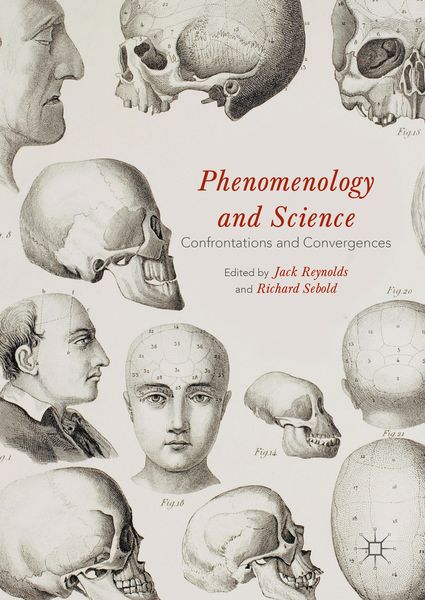
  • Produktbild: Phenomenology and Science
  • Produktbild: Phenomenology and Science

Phenomenology and Science Confrontations and Convergences

49,99 €

inkl. gesetzl. MwSt., Versandkostenfrei


Beschreibung

 This book investigates the complex, sometimes fraught relationship between phenomenology and the natural sciences. The contributors attempt to subvert and complicate the divide that has historically tended to characterize the relationship between the two fields. Phenomenology has traditionally been...

Beschreibung

 This book investigates the complex, sometimes fraught relationship between phenomenology and the natural sciences. The contributors attempt to subvert and complicate the divide that has historically tended to characterize the relationship between the two fields. Phenomenology has traditionally been understood as methodologically distinct from scientific practice, and thus removed from any claim that philosophy is strictly continuous with science. There is some substance to this thinking, which has dominated consideration of the relationship between phenomenology and science throughout the twentieth century. However, there are also emerging trends within both phenomenology and empirical science that complicate this too stark opposition, and call for more systematic consideration of the inter-relation between the two fields. These essays explore such issues, either by directly examining meta-philosophical and methodological matters, or by looking at particular topics that seem to require the resources of each, including imagination, cognition, temporality, affect, imagery, language, and perception. 

Produktdetails

Einband

Gebundene Ausgabe

Erscheinungsdatum

16.06.2016

Abbildungen

XVI, 229 p.

Herausgeber Jack Reynolds + weitere

Produktdetails

Einband

Gebundene Ausgabe

Erscheinungsdatum

16.06.2016

Abbildungen

XVI, 229 p.

Herausgeber
Verlag Palgrave Macmillan US
Seitenzahl

229

Maße (L/B/H)

21,6/15,3/1,9 cm

Gewicht

399 g

Auflage

1st ed. 2016

Sprache

Englisch

ISBN

978-1-349-94877-2

Herstelleradresse

Palgrave Macmillan
Tiergartenstr. 17
69121 Heidelberg
DE

Email: ProductSafety@springernature.com

Noch keine Bewertungen vorhanden

Verfassen Sie die erste Bewertung zu diesem Artikel

Helfen Sie anderen Kundinnen und Kunden durch Ihre Meinung.

Kundinnen und Kunden meinen

Bewertungen (0)

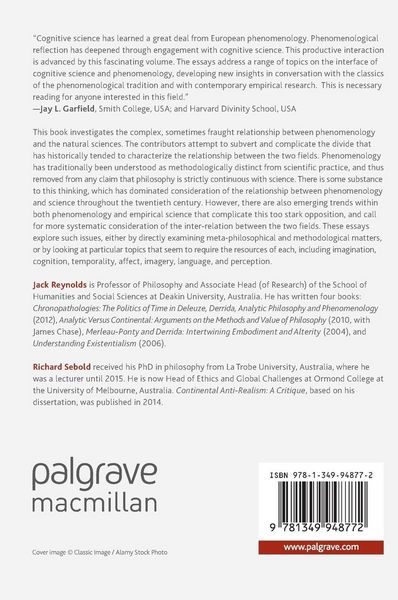
  • Produktbild: Phenomenology and Science
  • Produktbild: Phenomenology and Science
  • Preface: Phenomenology and/or Science: Confrontations and Convergences; Jack Reynolds and Richard Sebold.- 1. ‘At Arm’s Length’: The Interaction between Phenomenology and Gestalt Psychology; Aaron Harrison.- 2. “Intrinsic Time” and the Minimal Self: Reflections on the Methodological and Metaphysical Significance of Temporal Experience; Jack Reynolds.- 3. Phenomenology and the Scientific Image: Defending Naturalism from its Critics; Richard Sebold.- 4. Enacting Productive Dialogue: Addressing the Challenge that Non-human Cognition Poses to Collaborations between Enactivism and Heideggerian Phenomenology; Marilyn Stendera.- 5. The Rest is Science: What Does Phenomenology Tell Us About Cognition; Michael Wheeler.- 6. Affect as Transcendental Condition of Activity vs. Passivity—and Natural Science; David Morris.- 7. Losing Social Space: Phenomenological Disruptions of Spatiality and Embodiment in Moebius Syndrome and Schizophrenia; Joel Krueger and Amanda Taylor Aiken.- 8. Phenomenology of Language in a 4e-World; Andrew Inkpin.- 9. Intercorporeity: Enaction or simulation?; Shaun Gallagher.- 10. Multiperspectival Imagery: Sartre and Cognitive Theory on Point of View in Remembering and Imagining; Christopher Jude McCarroll and John Sutton.- 11. Imaginative Dimensions of Reality: Pretense, Knowledge, and Sociality; Michela Summa.