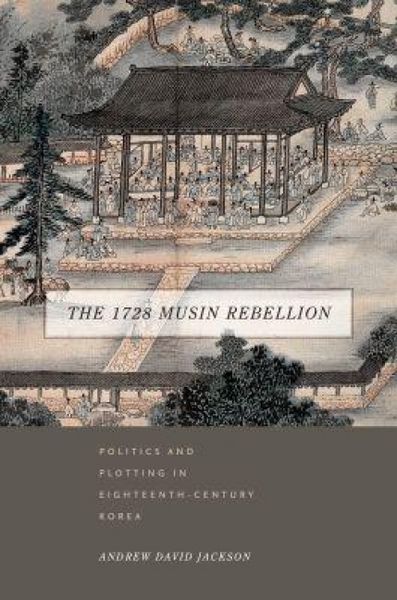
The 1728 Musin Rebellion Politics and Plotting in Eighteenth-Century Korea
-
- Englisch ausgewählt
59,99 €
inkl. gesetzl. MwSt.,
Beschreibung
Produktdetails
Einband
Gebundene Ausgabe
Erscheinungsdatum
31.01.2016
Verlag
University Of Hawaii PressSeitenzahl
216
Maße (L/B/H)
23,1/16,3/2 cm
Gewicht
476 g
Sprache
Englisch
ISBN
978-0-8248-5272-6
The 1728 Musin Rebellion: Politics and Plotting in Eighteenth-Century Korea provides the first comprehensive account in English of the Musin Rebellion, an attempt to overthrow King Y?ngjo (1694–1776; r. 1724–1776), and the largest rebellion of eighteenth-century Korea. The rebellion proved unsuccessful, but during three weeks of fighting the government lost control of over a dozen county seats and the rebels drew popular support from the inhabitants of three southern provinces. The revolt profoundly unsettled the early years of Y?ngjo's reign and had considerable influence on the subsequent course of factionalism. In this keenly reasoned study, Andrew David Jackson investigates the causes, development, suppression, legacy, and significance of the bloody Musin Rebellion.
The Musin Rebellion had its roots in the factional conflicts surrounding Y?ngjo's troubled succession to the throne. Jackson analyzes an aspect of the conflict previously neglected by researchers, namely how the rebels managed to create an armed rebellion. He argues that the rebellion should be understood in the context of other attempts on power by factional members that occurred over a hundred-year period leading up to 1728. By exploring the political and military context of the event, the book demonstrates that the Musin Rebellion was not driven by systemic breakdown, regionalism, or ideology, but was a failed attempt by political players to take control of the court. Central to the eruption of violence in 1728 was the intervention of key rebel plotters, several of whom were serving officials with access to state military resources. The book provides an in-depth view of factional politics in the Chos?n court, and the final section deals with the rebel legacy, bringing to the fore issues about managing, forming, and directing the historical memory of the rebellion.
Noch keine Bewertungen vorhanden
Verfassen Sie die erste Bewertung zu diesem Artikel
Helfen Sie anderen Kundinnen und Kunden durch Ihre Meinung.
Kurze Frage zu unserer Seite
Vielen Dank für Ihr Feedback
Wir nutzen Ihr Feedback, um unsere Produktseiten zu verbessern. Bitte haben Sie Verständnis, dass wir Ihnen keine Rückmeldung geben können. Falls Sie Kontakt mit uns aufnehmen möchten, können Sie sich aber gerne an unseren Kund*innenservice wenden.
zum Kundenservice