
Nutrigenomics
-
- Hardcover ausgewählt
- Taschenbuch
- eBook
-
Sprache:Englisch
128,99 €
inkl. gesetzl. MwSt.,
Beschreibung
Produktdetails
Einband
Gebundene Ausgabe
Erscheinungsdatum
21.06.2016
Abbildungen
XXI, 222 p. 103 illus., 101 illus. in color.
Verlag
SpringerSeitenzahl
222
Maße (L/B/H)
24,1/16/1,9 cm
Gewicht
535 g
Auflage
16001 Auflage 1st edition 2016
Sprache
Englisch
ISBN
978-3-319-30413-7
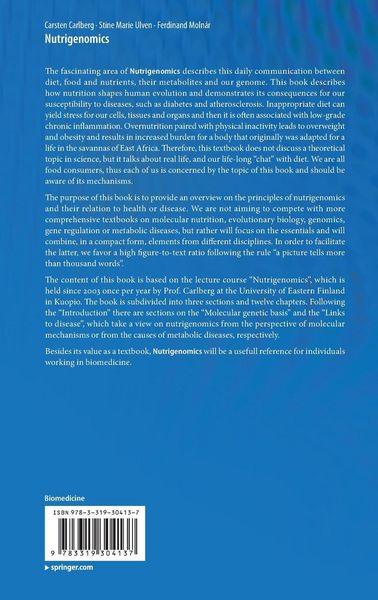
The fascinating area of Nutrigenomics describes this daily communication between diet, food and nutrients, their metabolites and our genome. This book describes how nutrition shapes human evolution and demonstrates its consequences for our susceptibility to diseases, such as diabetes and atherosclerosis. Inappropriate diet can yield stress for our cells, tissues and organs and then it is often associated with low-grade chronic inflammation. Overnutrition paired with physical inactivity leads to overweight and obesity and results in increased burden for a body that originally was adapted for a life in the savannas of East Africa. Therefore, this textbook does not discuss a theoretical topic in science, but it talks about real life, and our life-long "chat" with diet. We are all food consumers, thus each of us is concerned by the topic of this book and should be aware of its mechanisms.
The purpose of this book is to provide an overview on the principles of nutrigenomics and their relation to health or disease. We are not aiming to compete with more comprehensive textbooks on molecular nutrition, evolutionary biology, genomics, gene regulation or metabolic diseases, but rather will focus on the essentials and will combine, in a compact form, elements from different disciplines. In order to facilitate the latter, we favor a high figure-to-text ratio following the rule "a picture tells more than thousand words".
The content of this book is based on the lecture course "Nutrigenomics", which is held since 2003 once per year by Prof. Carlberg at the University of Eastern Finland in Kuopio. The book is subdivided into three sections and twelve chapters. Following the "Introduction" there are sections on the "Molecular genetic basis" and the "Links to disease", which take a view on nutrigenomics from the perspective of molecular mechanisms or from the causes of metabolic diseases, respectively.
Besidesits value as a textbook, Nutrigenomics will be a usefull reference for individuals working in biomedicine.
Noch keine Bewertungen vorhanden
Verfassen Sie die erste Bewertung zu diesem Artikel
Helfen Sie anderen Kundinnen und Kunden durch Ihre Meinung.
Kurze Frage zu unserer Seite
Vielen Dank für Ihr Feedback
Wir nutzen Ihr Feedback, um unsere Produktseiten zu verbessern. Bitte haben Sie Verständnis, dass wir Ihnen keine Rückmeldung geben können. Falls Sie Kontakt mit uns aufnehmen möchten, können Sie sich aber gerne an unseren Kund*innenservice wenden.
zum Kundenservice