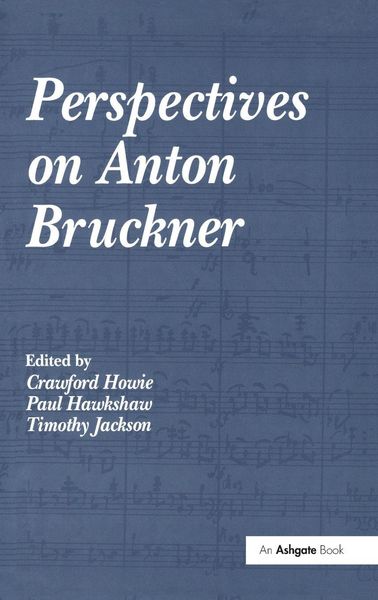
• Produktbild: Perspectives on Anton Bruckner
  • Produktbild: Perspectives on Anton Bruckner

Perspectives on Anton Bruckner

239,99 €

inkl. gesetzl. MwSt., Versandkostenfrei


Beschreibung

Produktdetails

Einband

Gebundene Ausgabe

Erscheinungsdatum

28.10.2001

Herausgeber

Howie Crawford + weitere

Verlag

Taylor and Francis

Seitenzahl

450

Maße (L/B/H)

24/16,1/2,9 cm

Gewicht

453 g

Sprache

Englisch

ISBN

978-0-7546-0110-4

Beschreibung

Produktdetails

Einband

Gebundene Ausgabe

Erscheinungsdatum

28.10.2001

Herausgeber

Verlag

Taylor and Francis

Seitenzahl

450

Maße (L/B/H)

24/16,1/2,9 cm

Gewicht

453 g

Sprache

Englisch

ISBN

978-0-7546-0110-4

Herstelleradresse

Libri GmbH
Europaallee 1
36244 Bad Hersfeld
DE

Email: gpsr@libri.de

Noch keine Bewertungen vorhanden

Verfassen Sie die erste Bewertung zu diesem Artikel

Helfen Sie anderen Kundinnen und Kunden durch Ihre Meinung.

Kundinnen und Kunden meinen

Bewertungen (0)

Die Leseprobe wird geladen.
  • Produktbild: Perspectives on Anton Bruckner
  • Produktbild: Perspectives on Anton Bruckner
  • Contents: Introduction; Theoretical Perspective and Compositional Practice: A composer learns his craft: lessons in form and orchestration, 1861-63, Paul Hawkshaw; Bruckner’s Oktaven: the problem of consecutives, doubling and orchestral voice-leading, Timothy L. Jackson; Symphonist: Analytical Considerations: The early version of the Second Symphony, William Carragan; Master and disciple united: the 1889 finale of Bruckner’s Third Symphony, Thomas Röder; Continuity in the Fourth Symphony (first movement), Edward Laufer; The expressive role of disjunction: a semiotic approach to form and meaning in the Fourth and Fifth Symphonies, Robert S. Hatten; ’Harmonic daring’ and symphonic design in the Sixth Symphony: an essay in historical musical analysis, Benjamin Marcus Korstvedt; The Adagio of the Sixth Symphony and the anticipatory tonic recapitulation in Bruckner, Brahms and Dvorák, Timothy L. Jackson; Bruckner’s free application of strict Sechterian theory with stimulation from Wagnerian sources: an assessment of the first movement of the Seventh Symphony, Graham H. Phipps; Musical time in the Eighth Symphony, Joseph C. Kraus; The facts behind a ’legend’: the Ninth Symphony and the Te Deum, John A. Phillips; Man, Musician and Reception: On unity between Bruckner’s personality and production, Constantin Floros; Bruckner - the travelling virtuoso, Crawford Howie; Students and friends as ’prophets’ and ’promoters’: the reception of Bruckner’s works in the Wiener Akademische Wagner-Verein, Andrea Harrandt; Anton Bruckner and ’German music’: Josef Schalk and the establishment of Bruckner as a national composer, Thomas Leibnitz; Siegmund von Hausegger: a Bruckner authority from the 1930s, Christa Brüstle; Ludwig Wittgenstein’s remarks on Bruckner, Peter Palmer; Richard Wetz (1875-1935): a Brucknerian composer, Erik Levi; Index.