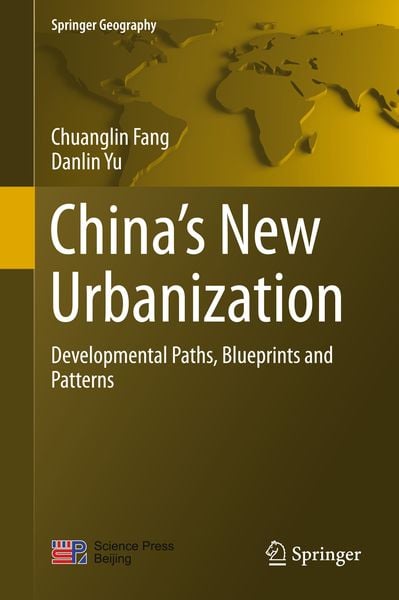
China’s New Urbanization Developmental Paths, Blueprints and Patterns
-
- Englisch ausgewählt
113,99 €
inkl. gesetzl. MwSt.,
Beschreibung
Produktdetails
Einband
Gebundene Ausgabe
Erscheinungsdatum
04.03.2016
Abbildungen
XIX, 329 p. 37 illus., 31 illus. in color.
Verlag
Springer BerlinSeitenzahl
329
Maße (L/B/H)
24,1/16/2,5 cm
Gewicht
694 g
Auflage
1st ed. 2016
Sprache
Englisch
ISBN
978-3-662-49446-2
This book answers the call for New
Urbanization, and proposes
a “5+9+6” national
spatial layout plan for the urbanization
of the 770 major cities in China. This macro pattern is based on a few
major metropolises at the center, and other cities supporting and benefitting from these
metropolises to form a pyramid-like urban hierarchical system. The book also presents a comprehensive
regionalization plan for China’s New Urbanization and strategic approaches to improving the quality of this
New Urbanization.
Currently, China is aggressively promoting a so-called
New
Urbanization, which has been regarded as one of the primary
ways to build a moderately prosperous society, to address critical issues
related to agriculture,
rural regions and farmers, to expand domestic demand and promote industrial innovation, and to realize the China Dream.
From a systematic perspective and using recently released urban data, the
authors analyze the current status of New Urbanization in China and also investigate
the various potential problems and obstacles to its concrete implementation. Based on the analyses
and investigations, the authors propose strategic directions, paths and basic
principles for China’s New Urbanization. In addition, they clearly identify the three different
modes of New Urbanization, namely, the general mode, differentiated mode, and gradual mode.
Today, many scholars argue that China’s urban regions are
experiencing a highly unsustainable mode of development. Chinese cities are
heavily burdened by the
so-called “urban diseases,”
which are characterized e.g.
by congested traffic, polluted water and air, and a lack of open and green spaces. Traditional
urbanization, which primarily focuses
on economic development, must
be fundamentally reformed. New Urbanization, which focuses on integrated economic development,
social integration and space/environmental sustainability, or simply put, on the quality of
urbanization, has been called for to provide a potential “cure” for these urban diseases. Due to the vastness of China’s
population and its rapidly growing economic, political and cultural relationships
with the rest of the world,
the book demonstrates that
the success of this New Urbanization is critical not only to the future of urban China,
but also the future of urbanization worldwide.
book offers a valuable reference
work for all researchers, graduate student and policy makers interested
in China’s urban development.
Noch keine Bewertungen vorhanden
Verfassen Sie die erste Bewertung zu diesem Artikel
Helfen Sie anderen Kundinnen und Kunden durch Ihre Meinung.
Kurze Frage zu unserer Seite
Vielen Dank für Ihr Feedback
Wir nutzen Ihr Feedback, um unsere Produktseiten zu verbessern. Bitte haben Sie Verständnis, dass wir Ihnen keine Rückmeldung geben können. Falls Sie Kontakt mit uns aufnehmen möchten, können Sie sich aber gerne an unseren Kund*innenservice wenden.
zum Kundenservice