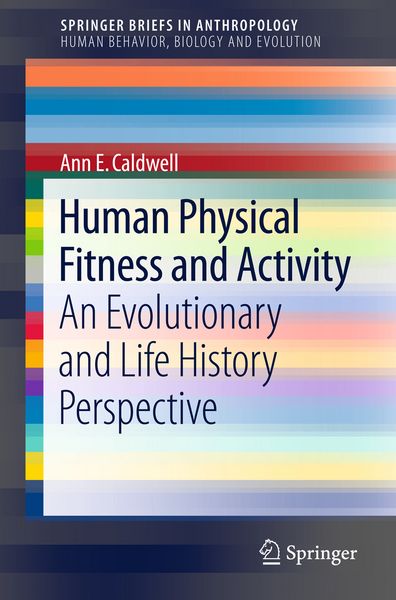
Human Physical Fitness and Activity An Evolutionary and Life History Perspective
-
- Taschenbuch ausgewählt
- eBook
-
Sprache:Englisch
51,99 €
inkl. gesetzl. MwSt.,
Beschreibung
Produktdetails
Einband
Taschenbuch
Erscheinungsdatum
06.04.2016
Abbildungen
XX, 7 illus., 2 illus. in color., farbige Illustrationen, schwarz-weiss Illustrationen
Verlag
SpringerSeitenzahl
89
Maße (L/B/H)
23,5/15,5/0,7 cm
Gewicht
184 g
Auflage
1st ed. 2016
Sprache
Englisch
ISBN
978-3-319-30407-6
for a novel theoretical framework that can integrate the ecological, genetic,
physiological and psychological factors that influence physical activity in
humans. Physical inactivity dominates most developed nations around the
world, and is among the leading causes of disease burden and death worldwide. Despite
the wide array of physical and mental health benefits, few people get the
recommended level of physical activity to achieve these benefits. Current
research on physical activity has not, as of yet, been successful for the
development of effective exercise interventions. Several researchers have
advocated a more integrative approach that takes evolutionary history into
account, but such a framework has yet to be advanced. To that aim, the first
goal of this book is to present a comprehensive evolutionary and life history
framework that highlights the domain-specific aspects of the evolved psychology
and physiology that can lead to a more integrated and complete understanding of
physical activity across the lifespan. It summarizes and extends previous work
that has been done to understand the ways natural selection has shaped physical
activity in humans in traditional and modern economies and environments.
In many ways, humans are adapted
to be physically active. Overall, however, natural selection has shaped a
flexible, but energy conscious system that responds to environmental and
individual costs and benefits of physical activity to optimally allocate a
finite energetic budget across the lifespan. This system is adapted to respond
to cues of resource scarcity and high levels of obligatory physical activity, and
conserves energy to favor allocation in ways that increase the likelihood of
reproductive success and survival. This nuanced application leads to a more
thorough understanding of the circumstances that natural selection is predicted
to favor both sedentary and active behaviors in predictable ways across the
lifespan.
The second goal of this book is to synthesize
and interpret cross-disciplinary research (from biological and evolutionary
anthropology and psychology; epidemiology; health psychology; and exercise
physiology) that can illuminate original approaches to increase physical
activity in modern, primarily sedentary contexts. This includes a breakdown of
the human lifespan to discuss the predicted costs and benefits of physical
activity at each stage of life in order to differentiate the obstacles to
physical activity and exercise that are functionally adaptive—or were in the
environments that they evolved—and identifying which factors are more
modifiable than others in order to develop interventions and environments that
are more conducive to physical activity.
Normal
0
false
false
false
EN-US
JA
X-NONE
/* Style Definitions */
table.MsoNormalTable
{mso-style-name:"Table Normal";
mso-tstyle-rowband-size:0;
mso-tstyle-colband-size:0;
mso-style-noshow:yes;
mso-style-priority:99;
mso-style-parent:"";
mso-padding-alt:0in 5.4pt 0in 5.4pt;
mso-para-margin-top:0in;
mso-para-margin-right:0in;
mso-para-margin-bottom:10.0pt;
mso-para-margin-left:0in;
line-height:115%;
mso-pagination:widow-orphan;
font-size:11.0pt;
font-family:"Calibri","sans-serif";
mso-ascii-font-family:Calibri;
mso-ascii-theme-font:minor-latin;
mso-hansi-font-family:Calibri;
mso-hansi-theme-font:minor-latin;
mso-bidi-font-family:"Times New Roman";
mso-bidi-theme-font:minor-bidi;}
Noch keine Bewertungen vorhanden
Verfassen Sie die erste Bewertung zu diesem Artikel
Helfen Sie anderen Kundinnen und Kunden durch Ihre Meinung.
Kurze Frage zu unserer Seite
Vielen Dank für Ihr Feedback
Wir nutzen Ihr Feedback, um unsere Produktseiten zu verbessern. Bitte haben Sie Verständnis, dass wir Ihnen keine Rückmeldung geben können. Falls Sie Kontakt mit uns aufnehmen möchten, können Sie sich aber gerne an unseren Kund*innenservice wenden.
zum Kundenservice