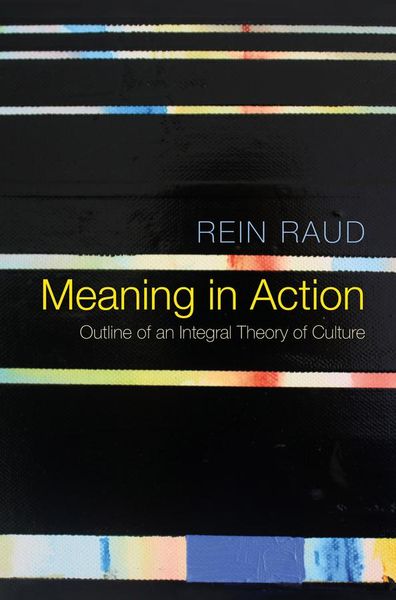
Meaning in Action Outline of an Integral Theory of Culture
-
- Hardcover ausgewählt
- Taschenbuch
-
Sprache:Englisch
82,99 €
inkl. gesetzl. MwSt.,
Beschreibung
Produktdetails
Einband
Gebundene Ausgabe
Erscheinungsdatum
29.08.2016
Verlag
John Wiley & Sons IncSeitenzahl
240
Maße (L/B/H)
23,1/15/2 cm
Gewicht
431 g
Auflage
1. Auflage
Sprache
Englisch
ISBN
978-1-5095-1124-2
In this important new book Rein Raud develops an original theory of culture understood as a loose and internally contradictory system of texts and practices that are shared by intermittent groups of people and used by them to make sense of their life-worlds. This theory views culture simultaneously in two ways: as a world of texts, tangible and shareable products of signifying acts, and as a space of practices, repeatable activities that produce, disseminate and interpret these clusters of meaning. Both approaches are developed into corresponding models of culture which, used together, are able to provide a rich understanding of any meaning in action. In developing this innovative theory, Raud draws on a wide range of disciplines, from anthropology, sociology and cultural studies to semiotics and philosophy. The theory is illustrated throughout with examples drawn from both 'high' and popular culture, and from Western and Asian traditions, dealing with both contemporary and historical topics. The book concludes with two case studies from very different contexts - one dealing with Italian poetry in the 13th century, the other dealing with the art scene in Eastern Europe in the 1990s. This timely and original work makes a major new contribution to the theory of culture and will be welcomed by students and scholars throughout the social sciences and humanities.
Noch keine Bewertungen vorhanden
Verfassen Sie die erste Bewertung zu diesem Artikel
Helfen Sie anderen Kundinnen und Kunden durch Ihre Meinung.
Kurze Frage zu unserer Seite
Vielen Dank für Ihr Feedback
Wir nutzen Ihr Feedback, um unsere Produktseiten zu verbessern. Bitte haben Sie Verständnis, dass wir Ihnen keine Rückmeldung geben können. Falls Sie Kontakt mit uns aufnehmen möchten, können Sie sich aber gerne an unseren Kund*innenservice wenden.
zum Kundenservice