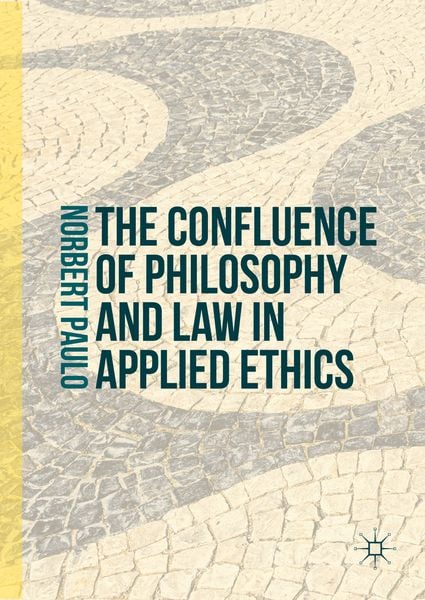
Produktbild: The Confluence of Philosophy and Law in Applied Ethics
- 17%

The Confluence of Philosophy and Law in Applied Ethics

17% sparen

81,99 € UVP 98,99 €

inkl. gesetzl. MwSt., Versandkostenfrei


Beschreibung

Produktdetails

Einband

Gebundene Ausgabe

Erscheinungsdatum

10.06.2016

Abbildungen

VIII, 3 illus., schwarz-weiss Illustrationen

Verlag

Palgrave Macmillan UK

Seitenzahl

250

Maße (L/B/H)

21,6/15,3/1,9 cm

Gewicht

430 g

Auflage

1st ed. 2016

Sprache

Englisch

ISBN

978-1-137-55733-9

Beschreibung

Produktdetails

Einband

Gebundene Ausgabe

Erscheinungsdatum

10.06.2016

Abbildungen

VIII, 3 illus., schwarz-weiss Illustrationen

Verlag

Palgrave Macmillan UK

Seitenzahl

250

Maße (L/B/H)

21,6/15,3/1,9 cm

Gewicht

430 g

Auflage

1st ed. 2016

Sprache

Englisch

ISBN

978-1-137-55733-9

Herstelleradresse

Palgrave Macmillan
Tiergartenstr. 17
69121 Heidelberg
DE

Email: ProductSafety@springernature.com

Kundinnen und Kunden meinen

0 Bewertungen

Informationen zu Bewertungen

Zur Abgabe einer Bewertung ist eine Anmeldung im Konto notwendig. Die Authentizität der Bewertungen wird von uns nicht überprüft. Wir behalten uns vor, Bewertungstexte, die unseren Richtlinien widersprechen, entsprechend zu kürzen oder zu löschen.

Die Bewertungen sind nach Format, Anzahl Sterne und Datum sortiert.

Verfassen Sie die erste Bewertung zu diesem Artikel

Helfen Sie anderen Kund*innen durch Ihre Meinung

Kundinnen und Kunden meinen

0 Bewertungen filtern

  • Produktbild: The Confluence of Philosophy and Law in Applied Ethics
  • PART I: ETHICS AND LAW.- 1 The Black-Box Problem.- METHODS.- OUTLINE.- 2 Ethics, Applied Ethics, and Law.- TERMINOLOGY: ETHICS AND MORALITY.- ETHICS, APPLIED ETHICS, BIOETHICS.- ETHICS AND LAW.- CONCLUSION.- PART II: METHODS IN LEGAL THEORY.- 3 Norms.- ABSTRACT AND GENERAL NORMS.- PRINCIPLES AND RULES.- Dworkin on Principles.- Principles as Optimization Requirements.- 4 Norm Application.- DEDUCTIVE STRUCTURE.- INTERPRETATION.- RULES OF INTERPRETATION.- Some Intricacies.- REASONING WITH PRECEDENTS.- Precedents.- What is binding?.- Strict binding force?.- ANALOGICAL REASONING.- Brewer’s Theory of Analogical Reasoning.- The sequence of processes.- CONCLUSION.- 5 Norm Development.- EXPANSIONS.- Supplementation.- Conflict of principles: proportionality test.- The four steps.- Critique.- Gap-Filling.- Distinguishing.- REVISIONS.- Overruling.- Correction of Mistakes.- NEW LEGISLATION.- CONCLUSION.- PART III: METHODS IN CONTEMPORARY ETHICAL THEORIES.- 6 Principlism.- THE STRUCTURE OF PRINCIPLISM.- Clusters of Principles and the Common Morality.- Principles and Rules.- Ideals, Virtues, and Rights.- PRINCIPLISM’s NORMATIVE CONTENT.- Respect for Autonomy.- Nonmaleficence.- Beneficence, Impartiality, and Moral Status.- Justice.- Relationship.- THEORY OF JUSTIFICATION.- METHODS.- Specification.- The importance of revisions and expansions.- Richardson’s definition.- Interpretation.- Abandoning specification.- Balancing.- The constraining conditions and proportionality.- Critique and alternatives.- CONCLUSION.- 7 Casuistry.- THE BASICS.- THE STRUCTURE OF CASUISTRY.- Morphology.- Taxonomy.- Kinetics.- CRITIQUE.- Cases do not speak for themselves.- What rules the case?.- Importance of the Taxonomy.- The Role of Paradigms.- Arbitrary Kinetics.- Casuistry’s Conventionality.- A BETTER STRUCTURE FOR CAUSISTRY.- Rules: Maxims and Paradigms.- Application of Paradigms.- Overruling and Distinguishing Paradigms.- Analogical Reasoning.- CONCLUSION.- 8 Consequentialism.- PETER SINGER’s PREFERENCE UTILITARIANISM.- The Practice of Singer’s Theory.- BRAD HOOKER’s RULE-CONSEQUENTIALISM.- The Basic Theory.- Structure.- Impartiality, Reflective Equilibrium, and Pluralism.- Prima Facie Rules, Interpretation, and Conflicts.- Hooker on Euthanasia.- CONCLUSION.- 9 The Morisprudence Model for Applied Ethics.- DEDUCTIVE NORM APPLICATION.- APPLICATION AND DEVELOPMENT.- WHY THE MORISPRIDENCE MODEL?.- Notes.- Bibliography.- Index