Gutscheinbedingungen

**Gültig am 28.06.2026 auf Spielzeug, Schreibwaren, Filme, Geschenke & Trends, Musik, tolino eReader & Zubehör, Hörbücher und Hörbuch-Downloads (außer Abo), nicht preisgebundene Bücher und Kalender online auf thalia.at und in der Thalia App. Einzelne Artikel können ausgeschlossen sein. Aufgrund der Buchpreisbindung sind deutschsprachige Bücher und eBooks ausgenommen. Zusätzlich ausgenommen sind preisgebundene Artikel, Abos & Flatrates, eBooks, Games, Geschenkkarten/-boxen, Shelfies, Software, Zeitschriften sowie einzelne Artikel von tonies®. Pro Einkauf einmal einlösbar. Click & Collect nur bei Onlinevorabzahlung möglich. Keine Barauszahlung. Nicht kombinierbar mit anderen Aktionen und Gutscheinen. Gutschein wird auf max. 500€ Bestellwert angerechnet. Nicht gültig für Versandkosten und Services.

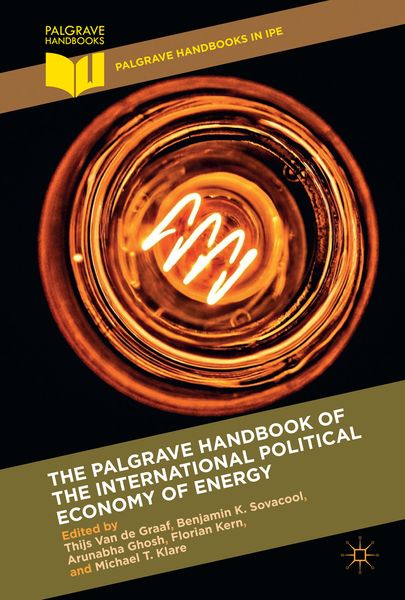
Produktbild: The Palgrave Handbook of the International Political Economy of Energy
- 12%

The Palgrave Handbook of the International Political Economy of Energy

12% sparen

289,99 € UVP 329,99 €

inkl. gesetzl. MwSt., Versandkostenfrei


Beschreibung

Produktdetails

Einband

Gebundene Ausgabe

Erscheinungsdatum

17.08.2016

Abbildungen

XXIII, 46 illus., 22 illus. in color., schwarz-weiss Illustrationen, farbige Illustrationen

Herausgeber

Thijs Van de Graaf + weitere

Verlag

Palgrave Macmillan UK

Seitenzahl

743

Maße (L/B/H)

24,1/16/4,7 cm

Gewicht

1324 g

Auflage

1st ed. 2016

Sprache

Englisch

ISBN

978-1-137-55630-1

Beschreibung

Rezension

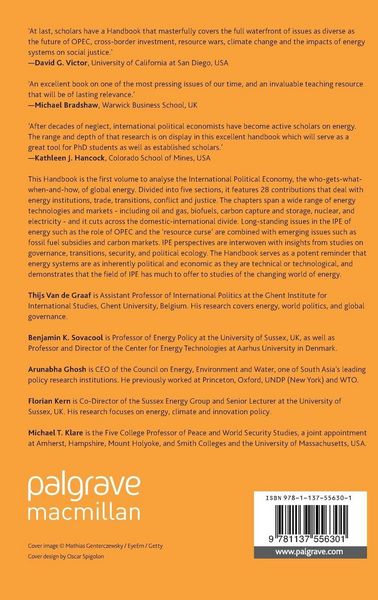
“Besides filling a gap in the IPE literature, it also provides potential readers, especially scholars, young researchers, policymakers and the interested public, with an assemblage of compelling state-of-the-art reviews of many traditional IPE energy- policy and politics-related themes. Moreover, it provides thoughtful readings on a recently growing literature covering emerging global energy issues that constitute a major global – and still, national – concern of our time.” (Rosana Icassatti Corazza and Paulo Sérgio Fracalanza, Contexto Internacional, Vol. 42 (1), 2020)

“The Palgrave Handbook of the International Political Economy of Energy stands out from the pack. … this book represents an important contribution to the study of global energy policy. … it will prove an invaluable reference not only for scholars of energy seeking greater theoretical rigor, but also for policymakerswho are often left grappling in the dark for the best way to manage energy at the global level given the lack of existing theories and concepts to turn to.” (Christian Downie, global Policy, globalpolicyjournal.com, February, 2018)

Produktdetails

Einband

Gebundene Ausgabe

Erscheinungsdatum

17.08.2016

Abbildungen

XXIII, 46 illus., 22 illus. in color., schwarz-weiss Illustrationen, farbige Illustrationen

Herausgeber

Verlag

Palgrave Macmillan UK

Seitenzahl

743

Maße (L/B/H)

24,1/16/4,7 cm

Gewicht

1324 g

Auflage

1st ed. 2016

Sprache

Englisch

ISBN

978-1-137-55630-1

Herstelleradresse

Palgrave Macmillan
Tiergartenstr. 17
69121 Heidelberg
DE

Email: ProductSafety@springernature.com

Kundinnen und Kunden meinen

0 Bewertungen

Informationen zu Bewertungen

Zur Abgabe einer Bewertung ist eine Anmeldung im Konto notwendig. Die Authentizität der Bewertungen wird von uns nicht überprüft. Wir behalten uns vor, Bewertungstexte, die unseren Richtlinien widersprechen, entsprechend zu kürzen oder zu löschen.

Die Bewertungen sind nach Format, Anzahl Sterne und Datum sortiert.

Verfassen Sie die erste Bewertung zu diesem Artikel

Helfen Sie anderen Kund*innen durch Ihre Meinung

Kundinnen und Kunden meinen

0 Bewertungen filtern

  • Produktbild: The Palgrave Handbook of the International Political Economy of Energy
  • Part I. Introduction.- Chapter 1: States, markets and institutions: Integrating International Political Economy and global energy politics; Thijs Van de Graaf, Benjamin K. Sovacool, Arunabha Ghosh, Florian Kern, and Michael T. Klare.- Part II: Energy actors and institutions; Primary editor: Thijs Van de Graaf.- Chapter 2: Actors, frames and institutions in global energy politics; Thijs Van de Graaf and Fariborz Zelli.- Chapter 3: The past, present and future role of OPEC; Bassam Fattouh and Anupama Sen.- Chapter 4: Corporations, civil society and disclosure: a case study of the Extractive Industries Transparency Initiative (EITI); James van Alstine and Nathan Andrews.- Chapter 5: The UN, energy, and the Sustainable Development Goals; Sylvia Karlsson-Vinkhuyzen.- Chapter 6: The World Trade Organization's role in global energy governance; Timothy Meyer.- Part III: Energy trade, finance and investment; >Primary editor: Arunabha Ghosh.- Chapter 7: Green energy trade conflicts: the political economy of a future energy system; Arunabha Ghosh; Chapter 8: The Transatlantic Trade and Investment Partnership, energy and divestment; Rafael Leal-Arcas and Constantino Grasso.- Chapter 9: The international oil and gas pricing regimes; Ustina Markus.- Chapter 10: The political economy of carbon markets; Richard Lane and Peter Newell.- Chapter 11: The politics and governance of energy subsidies; Harro van Asselt and Jakob Skovgaard.- PART IV. Energy transitions; Primary editor: Florian Kern.- Chapter 12: Energy transition studies and political economy considerations: prospects and challenges; Florian Kern and Jochen Markard.- Chapter 13: Developing and Deploying Carbon Capture and Storage Technologies: Explaining uneven progress; James Meadowcroft and James Gaede.- Chapter 14: Democracy and transitions: European experiences of policy inclusiveness and changes in the electricity industry; Mari Ratinen and Peter D. Lund.- Chapter 15: Second life or half-life? The contested future of nuclear power and its potential role in a sustainable energy transition; M.V. Ramana.- Chapter 16: The politics of biofuels.- John Alic; Part V. Energy conflict and the resource curse; Primary editor: Michael T. Klare.- Chapter 17: No blood for oil? Hydrocarbon abundance and international security; Michael T. Klare.- Chapter 18: Do countries fight over oil? Emily Meierding.- Chapter 19: Does Russia have a potent gas weapon? James Henderson.-  Chapter 20: Energy, coercive diplomacy and sanctions  Llewellyn Hughes and Eugene Gholz.- Chapter 21: The resource curse puzzle across four waves of research; William Gochberg and Victor Menaldo.- Part VI: Energy justice and political ecology; Primary editor: Benjamin K. Sovacool.- Chapter 22: The political ecology and justice of energy; Benjamin K. Sovacool.- Chapter 23: The political ecology of oil and gas in West Africa's Gulf of Guinea:  State, petroleum, and conflict in Nigeria; Michael J. Watts.- Chapter 24: Dispossession, justice and a sustainable energy future; Majia H. Nadesan and Martin Pasqualetti.- Chapter 25: Energy and global production networks; Dustin Mulvaney.- Chapter 26: Enclosure and exclusion within emerging forms of energy resource extraction: shale fuels and biofuels; Arielle Hesse, Jennifer Baka, and Kirby Calvert.- Chapter 27: The political economy of energy justice: A nuclear energy perspective; Kirsten Jenkins, Raphael Heffron, and Darren McCauley.- Chapter 28: Energy justice in theory and practice: Building a pragmatic roadmap; Mark Cooper.-