Gutscheinbedingungen

**Gültig bis 25.06.2026 auf fremdsprachige Bücher online auf thalia.at und in der Thalia App. Einzelne Artikel können ausgeschlossen sein. Ausgenommen sind preisgebundene Artikel & eBooks. Pro Einkauf einmal einlösbar. Click & Collect nur bei Onlinevorabzahlung möglich. Keine Barauszahlung. Nicht kombinierbar mit anderen Aktionen und Gutscheinen. Gutschein wird auf max. 500€ Bestellwert angerechnet. Nicht gültig für Geschenkkarten, Versandkosten und Services.

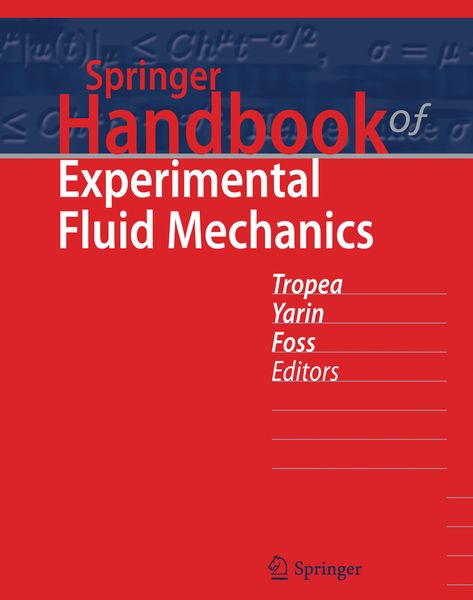
Produktbild: Springer Handbook of Experimental Fluid Mechanics
- 10%

Springer Handbook of Experimental Fluid Mechanics

Aus der Reihe Springer Handbooks
10% sparen

491,99 € UVP 549,99 €

inkl. gesetzl. MwSt., Versandkostenfrei


Beschreibung

Produktdetails

Einband

Gebundene Ausgabe

Erscheinungsdatum

18.01.2016

Abbildungen

1240 farbige Abbildungen, 1240 farbige Tabellen, Bibliographie

Herausgeber

Cameron Tropea + weitere

Verlag

Springer Berlin

Seitenzahl

1557

Maße (L/B/H)

24,9/19,7/7,1 cm

Gewicht

2988 g

Auflage

1st ed. 2007

Sprache

Englisch

ISBN

978-3-662-49162-1

Beschreibung

Rezension

From the reviews: "Handbooks are reference works for daily use by two main groups of people: on the one hand by experienced scientists, and by engineers or physicists … . And, on the other hand, by students … . due to the breadth and depth, this book serves both groups excellently. … In summary, the community of fluid mechanics today has in their hands a highly valuable and important new book, which is a major reference in our science and will soon become a standard reference." (Günter Brenn, International Journal of Heat and Mass Transfer, Vol. 51, 2008) "The stated purpose of this 1500 page handbook is to provide comprehensive information to the experimental fluid mechanics community for planning, executing, and interpreting experiments. … A DVD-ROM PDF version of the handbook accompanies the hardback book. … The book is excellent for a user who wants to obtain some information on a given topic without reading and digesting many papers. … production quality is excellenttoo. … The high-quality drawings, photos, and figures are clearly labeled and captioned." (Roger L. Simpson, American Institute of Aeronautics and Astronautics Journal, Vol. 46 (10), 2008)

Portrait

C. Tropea: Professor Tropea studied and worked in Toronto, Karlsruhe and Erlangen before taking the Chair of Fluid Mechanics and Aerodynamics at the Technical University of Darmstadt in 1997. His background is in experimental fluid mechanics and he has authored numerous book sections and journal publications on this subject. He is currently Editor of Experiments in Fluids from Springer-Verlag and was previously Editor-in-Chief of Measurement Science and Technology from IOP Publishing.

J. F. Foss 

Professor Foss received his BSME (1961), MSME (1962) and Ph.D. (1965) from Purdue University. He has been on the faculty at Michigan State University since 9/1964. He served as the NSF Program Director for Fluid Dynamics and Hydraulics (1998-2000). His research specialty is vorticity measurements. His research group addresses fundamental and applied problems in turbulent flows. The latter are primarily associated with automotive applications. He is a Fellow of ASMEand the A.V. Humboldt Stiftung and a Chartered Physicist of the IOP. He holds 7 patents involving fluid mechanics.

A. Yarin:

Alexander Yarin is currently a Professor at the Department of Mechanical and Industrial Engineering at the University of Illinois at Chicago, USA. In 1990-2005 he was a Professor at the Faculty of Mechanical Engineering at the Technion-Israel Institute of Technology. Professor Yarin is an applied physicist working in the field of fluid mechanics. He received his PhD and Habilitation degrees from the Institute for Problems in Mechanics, USSR Academy of Sciences, Moscow. His main contributions are related to the free surface flows (jets, films, fibers, threads and droplets) of Newtonian and rheologically complex liquids. He is an author of 2 monographs, 5 chapters in books and 170 research articles.  

Produktdetails

Einband

Gebundene Ausgabe

Erscheinungsdatum

18.01.2016

Abbildungen

1240 farbige Abbildungen, 1240 farbige Tabellen, Bibliographie

Herausgeber

Verlag

Springer Berlin

Seitenzahl

1557

Maße (L/B/H)

24,9/19,7/7,1 cm

Gewicht

2988 g

Auflage

1st ed. 2007

Sprache

Englisch

ISBN

978-3-662-49162-1

Herstelleradresse

Springer-Verlag GmbH
Heidelberger Platz 3
14197 Berlin
Deutschland
Email: sdc-bookservice@springer.com
Url: www.springer.com
Telephone: +49 6221 3454301
Fax: +49 30 8214091

Kundinnen und Kunden meinen

0 Bewertungen

Informationen zu Bewertungen

Zur Abgabe einer Bewertung ist eine Anmeldung im Konto notwendig. Die Authentizität der Bewertungen wird von uns nicht überprüft. Wir behalten uns vor, Bewertungstexte, die unseren Richtlinien widersprechen, entsprechend zu kürzen oder zu löschen.

Die Bewertungen sind nach Format, Anzahl Sterne und Datum sortiert.

Verfassen Sie die erste Bewertung zu diesem Artikel

Helfen Sie anderen Kund*innen durch Ihre Meinung

Kundinnen und Kunden meinen

0 Bewertungen filtern

  • Produktbild: Springer Handbook of Experimental Fluid Mechanics
  • Introduction


    The expression: "analytical work", often connotes an effort in which basic expressions are combined to analyze a given problem and to derive new information and insight from the resulting mathematical steps of the analysis. Specifically, having started with the appropriate relationships and bringing appropriate mathematical manipulations to the task, the analyst is able to create new information to address the motivating question(s).

    A central organizing theme of this handbook is that ‘experimental fluid mechanics" can be understood as a parallel activity to that described above. The motivating questions will set the context for the experiment. The experiment will be established as a boundary value problem in which the experimentalist will address all aspects of the boundary conditions that will influence the "solution." If a transient or an evolving solution is sought, the appropriate initial conditions will similarly be addressed.

    Having established these conditions, the solution to the boundary value problem will be revealed in the experimental data that will – ideally – not be contaminated by unintended or unknown perturbing effects and that will be fully converged if statistical average values are sought.

    Part A Experiments in Fluid Mechanics

    The objective of Part A is to establish the fundamental concepts and equations that undergird experimental fluid mechanics. The first chapter: addresses both the governing equations and the constitutive equations for Newtonian and non-Newtonian fluids. Chapter 2 provides the systematic bases for model testing and the scaling of experimental results. Sections 2.1 through 2.7 derive similitude parameters (Reynolds number, Froude number, etc.) from the governing equations and the boundary conditions. Dimensional analysis (Sect. 2.2) provides a rational approach for the organization and interpretation of experimental data; Sect. 2.3, self-similarity, documents known flow fields that exhibit this condition and it provides guidance on what other flows may exhibit this behavior. The encyclopedic presentation of examples will allow the reader to comprehend the universal features of both complete and incomplete self-similarity.

    Chap. 1 The Experiment as a Boundary-Value Problem

    Chap. 2 Nondimensional Representation of the Boundary-Value Problem

    Part B Measurement of  Primary Quantities

    The objective of Part B is to provide specific information to the reader on the following primary quantities: material properties (Chap. 3), flow field properties (Chap. 4 – pressure, Chap. 5 – velocity, vorticity, Mach number, Chap. 6 – spatial density variations and Chap. 7 – temperature and heat flux) and forces and moments (Chap. 8). Chapter 3 is focused on providing quantitative information for the material properties, the sources of this information and the associated confidence levels for the given data. Chapters 4 through 8 provide comprehensive guidance to the reader on: i) the objectives, ii) the available equipment, iii) the utilization techniques, and iv) the post-processing of the primitive information for the stated quantities.

    Chap. 3 Material Properties: Measurement and Data

    Chap. 4 Pressure Measurement Systems

    Chap. 5 Velocity, Vorticity and Mach Number

    Chap. 6 Spatial Density Variations

    Chap. 7 Temperature, Concentration and Heat Flux

    Chap. 8 Forces and Moments

    Part C Specific Experimental Approaches

    Building on the previous two parts of this Springer Handbook, which have dealt with the fundamental concepts and equations that undergrid experimental fluid mechanics and the measurement of primary quantities, respectively, Part C addresses experimental fluid mechanics from an application point of view. According to application, often unique and specific forms of equipment, experimental procedure, or analysis and interpretation of results have been developed. It is the purpose of Part C to elucidate a selection of such application areas, in particular measurements of non-Newtonian flows, turbulence, flow visualization, wall-bounded flows, surface topology, turbomachines, hydraulics, aerodynamics, atmospheric and oceanographic measurements, combustion diagnostics and electrohydrodynamic systems.


    Chap. 9
    Non-Newtonian Flows

    Chap. 10 Measurement of Turbulent Flows

    Chap. 11 Flow Visualization

    Chap. 12 Wall-Bounded Flows

    Chap. 13 Surface Topology

    Chap. 14 Turbomachines

    Chap. 15 Hydraulics

    Chap. 16 Aerodynamics

    Chap. 17 Atmospheric Measurements

    Chap. 18 Oceanographic Measurements

    Chap. 19 The No-Slip Boundary Condition

    Chap. 20 Combustion Diagnostics

    Chap. 21 Electrohydrodynamic Systems

    Part D Analyses and Post-Processing of Data

    This final part of the Springer Handbook is actually meant to be a reference source about single and data processing techniques commonly encountered in fluid mechanics. These topics have been complemented by a section discussing data acquisition by imaging detectors, a topic becoming increasingly important for optical measurement techniques. These are all subjects, which in their development are not naturally associated with fluid mechanics; hence Part D attempts to collect information from many diverse sources and present them conveniently to the fluid mechanic researcher. Topics covered in this part include fundamental topics of signal and data processing transforms (Fourier, Hilbert, wavelet), proper orthogonal decomposition and stochastic estimation. This is followed by a discussion of estimator expectation and variance and the influence of noise on these quantities. The Cramèr-Rao Lower Bound (CRLB) is introduced and developed for several common signal processing examples from fluid mechanics. Imaging detectors and measures of their performance are then discussed in detail before closing with a chapter on image processing and motion analysis, two topics especially relevant for the Particle Image Velocity (PIV) measurement technique.


    Chap. 22
    Review of Some Fundamentals

    Chap. 23 Fundamentals of Data Processing

    Chap. 24 Data Acquisition

    Chap. 25 Data Analyses

    About the Authors

    Subject Index