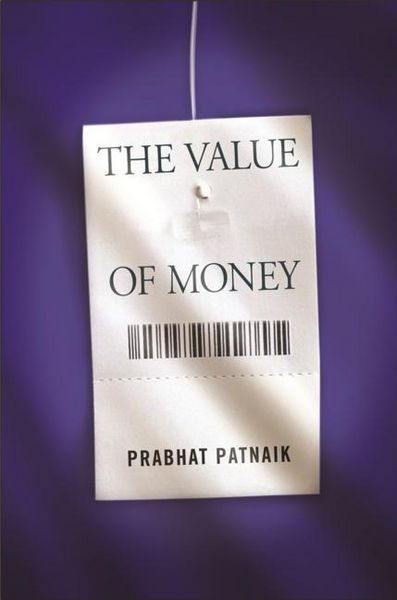
The Value of Money Value of Money
-
- Einzelkauf Download ausgewählt
-
Sprache:Englisch
56,95 €
inkl. gesetzl. MwSt.Beschreibung
Produktdetails
Format
Kopierschutz
Nein
Family Sharing
Ja
Text-to-Speech
Nein
Erscheinungsdatum
02.04.2009
Verlag
Columbia University PressSeitenzahl
280 (Printausgabe)
Dateigröße
1760 KB
Auflage
1. Auflage
Sprache
Englisch
EAN
9780231519212
Why is money more valuable than the paper on which it is printed? Monetarists link the value of money to its supply and demand, believing the latter depends on the total value of the commodities it circulates. According to Prabhat Patnaik, this logic is flawed. In his view, in any nonbarter economy, the value we assign to money is determined independently of its supply and demand.
Through an original and provocative critique of monetarism, Patnaik advances a revolutionary understanding of macroeconomics that highlights the "propertyist" position of Karl Marx and John Maynard Keynes. Unlike the usual division between "classical" economists (e.g., David Ricardo and Marx) and the "marginalists" (e.g., Carl Menger, William Stanley Jevons, and Léon Walras), Patnaik places "monetarists," including Ricardo, on one side, while grouping propertyist writers like Marx, Keynes, and Rosa Luxemburg on the other. This second group subscribes to the idea that the value of money is given from outside the realm of supply and demand, therefore making money a form in which wealth is held. The fact that money is held as wealth in turn gives rise to the possibility of deficiency of aggregate demand under capitalism.
It is no accident that this possibility was highlighted by Marx and Keynes while going largely unrecognized by Ricardo and contemporary monetarists. At the same time, Patnaik points to a weakness in the Marx-Keynes tradition¿namely, its lack of any satisfactory explanation of why the value of money, determined from outside the realm of supply and demand, remains relatively stable over long stretches of time. The answer to this question lies in the fact that capitalism is not a self-contained system but is born from a precapitalist setting with which it interacts and where it creates massive labor reserves that, in turn, impart stability to the value of money. Patnaik's theory of money, then, is also a theory of imperialism, and he concludes with a discussion of the contemporary international monetary system, which he terms the "oil-dollar" standard.
Noch keine Bewertungen vorhanden
Verfassen Sie die erste Bewertung zu diesem Artikel
Helfen Sie anderen Kundinnen und Kunden durch Ihre Meinung.
Kurze Frage zu unserer Seite
Vielen Dank für Ihr Feedback
Wir nutzen Ihr Feedback, um unsere Produktseiten zu verbessern. Bitte haben Sie Verständnis, dass wir Ihnen keine Rückmeldung geben können. Falls Sie Kontakt mit uns aufnehmen möchten, können Sie sich aber gerne an unseren Kund*innenservice wenden.
zum Kundenservice