KI-Beratung Beta

Gutscheinbedingungen

**Gültig bis 18.11.2026 auf englischsprachige Klassiker (klassiker-32728) online auf thalia.at und in der Thalia App. Einzelne Artikel können ausgeschlossen sein. Ausgenommen sind preisgebundene Artikel & eBooks. Pro Einkauf einmal einlösbar. Click & Collect nur bei Onlinevorabzahlung möglich. Keine Barauszahlung. Nicht kombinierbar mit anderen Aktionen und Gutscheinen. Gutschein wird auf max. 500€ Bestellwert angerechnet. Nicht gültig für Geschenkkarten, Versandkosten und Services.

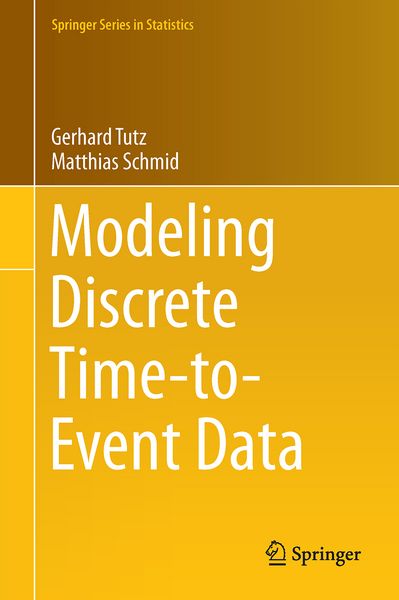
  • Produktbild: Modeling Discrete Time-to-Event Data
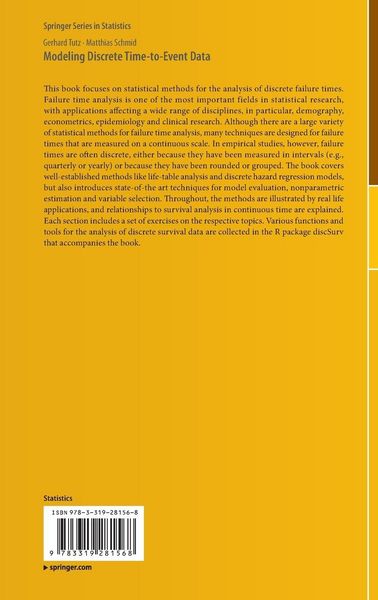
  • Produktbild: Modeling Discrete Time-to-Event Data
- 17%

Modeling Discrete Time-to-Event Data

17% sparen

99,99 € UVP 120,99 €

inkl. gesetzl. MwSt., Versandkostenfrei


Beschreibung

This book focuses on statistical methods for the analysis of discrete failure times. Failure time analysis is one of the most important fields in statistical research, with applications affecting a wide range of disciplines, in particular, demography, econometrics, epidemiology and clinical research....

Beschreibung

This book focuses on statistical methods for the analysis of discrete failure times. Failure time analysis is one of the most important fields in statistical research, with applications affecting a wide range of disciplines, in particular, demography, econometrics, epidemiology and clinical research. Although there are a large variety of statistical methods for failure time analysis, many techniques are designed for failure times that are measured on a continuous scale. In empirical studies, however, failure times are often discrete, either because they have been measured in intervals (e.g., quarterly or yearly) or because they have been rounded or grouped. The book covers well-established methods like life-table analysis and discrete hazard regression models, but also introduces state-of-the art techniques for model evaluation, nonparametric estimation and variable selection. Throughout, the methods are illustrated by real life applications, and relationships to survival analysis in continuous time are explained. Each section includes a set of exercises on the respective topics. Various functions and tools for the analysis of discrete survival data are collected in the R package discSurv that accompanies the book. 

Rezension

“Modeling Discrete Time-to-Event Data provides an excellent overview of a field that is underrepresented in the literature. At what it aims to do, striking a balance between theory and practice, this book does a great job. Its readers will understand not only what to do, but also how to do it. I believe that this book can easily find a place on the shelf of statisticians who have an interest in survival analysis.” (Theodor Adrian Balan, Biometrical Journal, Vol. 61 (1), January, 2019)

Produktdetails

Einband

Gebundene Ausgabe

Erscheinungsdatum

22.06.2016

Abbildungen

X, 247 p. 58 illus., 3 illus. in color.

Verlag Springer

Produktdetails

Einband

Gebundene Ausgabe

Erscheinungsdatum

22.06.2016

Abbildungen

X, 247 p. 58 illus., 3 illus. in color.

Verlag Springer
Seitenzahl

247

Maße (L/B/H)

24,1/16/2 cm

Gewicht

507 g

Auflage

1st ed. 2016

Sprache

Englisch

ISBN

978-3-319-28156-8

Herstelleradresse

Springer-Verlag KG
Sachsenplatz 4-6
1201 Wien
AT

Email: ProductSafety@springernature.com

Noch keine Bewertungen vorhanden

Verfassen Sie die erste Bewertung zu diesem Artikel

Helfen Sie anderen Kundinnen und Kunden durch Ihre Meinung.

Kundinnen und Kunden meinen

Bewertungen (0)

  • Produktbild: Modeling Discrete Time-to-Event Data
  • Produktbild: Modeling Discrete Time-to-Event Data
  • Introduction.- The Life Table.- Basic Regression Models.- Evaluation and Model Choice.- Nonparametric Modelling and Smooth Effects.- Tree-Based Approaches.- High-Dimensional Models - Structuring and Selection of Predictors.- Competing Risks Models.- Multiple-Spell Analysis.- Frailty Models and Heterogeneity.- Multiple-Spell Analysis.- List of Examples.- Bibliography.- Subject Index.- Author Index.