• Produktbild: World Politics
  • Produktbild: World Politics

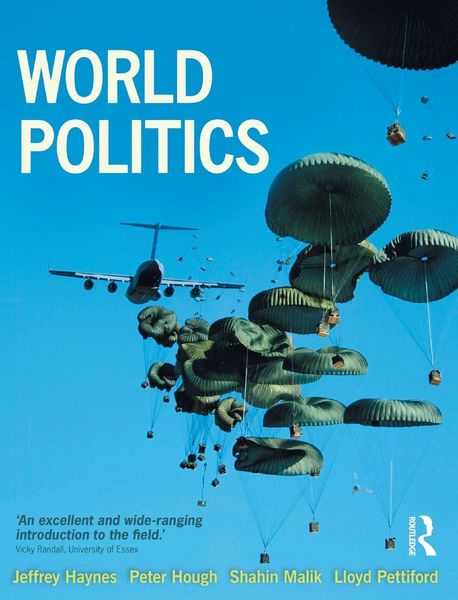
World Politics International Relations and Globalisation in the 21st Century

377,99 €

inkl. gesetzl. MwSt., Versandkostenfrei


Beschreibung

Produktdetails

Einband

Gebundene Ausgabe

Erscheinungsdatum

01.10.2015

Verlag

Taylor & Francis

Seitenzahl

832

Maße (L/B/H)

26/20,8/4,9 cm

Gewicht

1700 g

Sprache

Englisch

ISBN

978-1-138-12969-6

Beschreibung

Produktdetails

Einband

Gebundene Ausgabe

Erscheinungsdatum

01.10.2015

Verlag

Taylor & Francis

Seitenzahl

832

Maße (L/B/H)

26/20,8/4,9 cm

Gewicht

1700 g

Sprache

Englisch

ISBN

978-1-138-12969-6

Noch keine Bewertungen vorhanden

Verfassen Sie die erste Bewertung zu diesem Artikel

Helfen Sie anderen Kundinnen und Kunden durch Ihre Meinung.

Kundinnen und Kunden meinen

Bewertungen (0)

Die Leseprobe wird geladen.
  • Produktbild: World Politics
  • Produktbild: World Politics
  • Part One: International Relations and Globalisation

    1. International Relations and Globalisation in the 21st Century

    International Relations and globalisation

    Why is globalisation important for understanding International Relations?

    Technological, political, economic and cultural globalisation

    Important post-Cold War changes affecting International Relations

    Understanding globalisation

    Conclusion

    2. International Order, International Society and Globalisation

    Fundamental aspects of International Relations following the Peace of Westphalia (1648)

    International order and international society after the cold War

    Globalisation, international order and international society

    Conclusion

    Part Two: The History of Globalisation and International Relations

    3. International Relations from the early 19th Century to World War II

    European nationalism and imperialism

    World War I and International Relations

    The League of Nations: an attempt to build an international organisation to maintain collective security

    The legacy of the League of Nations

    Conclusion

    4. International Relations after World War II

    International relations after World War II

    The United Nations

    The Cold War and nuclear weapons

    The international relations of the developing countries

    Conclusion

    5. After the Cold War: International Relations in a Globalised World

    Introduction

    International relations after the Cold War: the impact of globalisation

    New World Order: more cooperation, less conflict?

    Competing norms and values in international relations after the Cold War

    Trends in post-Cold War international relations: security, ideology and development

    International Relations in the 21st century

    Conclusions

    Part Three: International Relations Theories

    6. Realism and Neo-Realism

    Context

    The ‘back-story’ to Realism

    Realism in International Relations

    Key assumptions

    Key concepts

    Conclusions and criticisms

    7. Liberalism

    Context

    The ‘back-story’ to Liberalism

    Liberalism in contemporary International Relations

    Key assumptions

    Key concepts

    Conclusions and criticisms

    8. Marxism and Neo-Marxism

    Context

    The ideas of Marx

    The ideas of Lenin

    Dependency Theory

    World Systems Theory

    Key concepts

    Conclusions and criticisms

    9. Critical Theory

    Context

    Contemporary critical theory and IR

    Key concepts

    Conclusions

    10. Alternative Approaches

    Theoretical context

    Postmodernism

    Feminism

    Green theory

    Conclusions

    11. Social Constructivism

    Social Constructivism as a bridge between the traditional theories

    Agency and culture in IR

    A Social Constructivist reappraisal of IR’s key concepts

    The empiricists strike back? Critiques of Social Constructivism

    Conclusion

    Part Four: International and Regional Actors

    12. Intergovernmental Organisations

    What is an intergovernmental organisation?

    The evolution and diversity of IGOs

    IR theory and IGOs

    Conclusions

    13. Global Multi-Purpose IGOs: The United Nations and the Organisation of the Islamic Conference

    Intergovernmental organisations and globalisation

    The United Nations and international law

    The UN Charter

    The five permanent members of the UN Security Council: permanent privileges

    Organisation of the Islamic Conference (OIC)

    The OIC: history and development

    Conclusion: comparing the UN and the OIC

    14. Regional Organisations and Regionalisation: Theory and Practice

    Introduction

    Regional cooperation and globalisation

    Old regionalisation and new regionalisation

    The North American Free Trade Agreement

    Asia Pacific Economic Cooperation

    Conclusion

    15. The European Union and the African Union

    Introduction

    The European Union

    The African Union

    Conclusion

    Part Five: Current Global Issues

    16. International Political Economy, Part I: Theory and History

    What is IPE?

    A short history of IPE

    Approaches to IPE

    The contemporary trading system

    The contemporary international monetary system

    Conclusions

    17. International Political Economy, Part II: Key Actors and Controversies

    The IMF and World Bank

    International trade organisations

    Multi-national corporations (MNCs)

    Theoretical perspectives on the actors of IPE

    Conclusions

    18. Development, Poverty and Inequality

    The persistence of global poverty

    Approaches to development

    The evolution of development policy

    Conclusions

    19. Gender

    Context

    Gender approaches to IR

    Gender and security

    Gender and international development

    Future developments

    Conclusions

    20. Identity and Identities

    Forms of identity

    Theorising identity

    Conclusions

    21. Democratisation

    What is democracy?

    The three waves of democratisation

    What can make democracy permanent?

    Democratisation by force – ‘nation building’

    Is democratisation important for international relations?

    Conclusions

    22. Human Rights

    The evolution of the idea of human rights

    The United Nations and the codification of human rights

    Implementing human rights

    Are human rights ‘right’?

    Conclusions

    23. The Natural Environment

    The emergence of political ecology

    The globalisation of political ecology

    Global environmental policy and human security

    Threats to a global consensus on environmental policy

    Conclusions