
KI-Beratung Beta

Gutscheinbedingungen

**Gültig bis 18.11.2026 auf englischsprachige Klassiker (klassiker-32728) online auf thalia.at und in der Thalia App. Einzelne Artikel können ausgeschlossen sein. Ausgenommen sind preisgebundene Artikel & eBooks. Pro Einkauf einmal einlösbar. Click & Collect nur bei Onlinevorabzahlung möglich. Keine Barauszahlung. Nicht kombinierbar mit anderen Aktionen und Gutscheinen. Gutschein wird auf max. 500€ Bestellwert angerechnet. Nicht gültig für Geschenkkarten, Versandkosten und Services.

  • Produktbild: Hypoxia
  • Produktbild: Hypoxia
Band 903 - 13%

Hypoxia Translation in Progress

13% sparen

189,99 € UVP 219,99 €

inkl. gesetzl. MwSt., Versandkostenfrei


Beschreibung

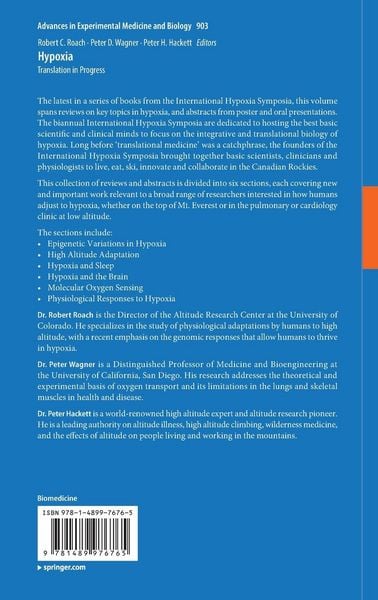
The latest in a series of books from the International Hypoxia Symposia, this volume spans reviews on key topics in hypoxia, and abstracts from poster and oral presentations. The biannual International Hypoxia Symposia are dedicated to hosting the best basic scientific and clinical minds to focus on...

Beschreibung

The latest in a series of books from the International Hypoxia Symposia, this volume spans reviews on key topics in hypoxia, and abstracts from poster and oral presentations. The biannual International Hypoxia Symposia are dedicated to hosting the best basic scientific and clinical minds to focus on the integrative and translational biology of hypoxia. Long before ‘translational medicine’ was a catchphrase, the founders of the International Hypoxia Symposia brought together basic scientists, clinicians and physiologists to live, eat, ski, innovate and collaborate in the Canadian Rockies.

This collection of reviews and abstracts is divided into six sections, each covering new and important work relevant to a broad range of researchers interested in how humans adjust to hypoxia, whether on the top of Mt. Everest or in the pulmonary or cardiology clinic at low altitude. The sections include:

  • Epigenetic Variations in Hypoxia
    High Altitude Adaptation
  • Hypoxia and Sleep
  • Hypoxia and the Brain
  • Molecular Oxygen Sensing
  • Physiological Responses to Hypoxia

Portrait

Dr. Robert Roach is the Director of the Altitude Research Center at the University of Colorado. He specializes in the study of physiological adaptations by humans to high altitude, with a recent emphasis on the genomic responses to allow humans to thrive in hypoxia. 
Dr. Peter Wagner is a Distinguished Professor of Medicine and Bioengineering at the University of California, San Diego. His research addresses the theoretical and experimental basis of oxygen transport and its limitations in the lungs and skeletal muscles in health and disease. 
Dr. Peter Hackett is a world-renowned high altitude expert and altitude research pioneer. He is a leading authority on altitude illness, high altitude climbing, wilderness medicine, and the effects of altitude on people living and working in the mountains.

Produktdetails

Einband

Gebundene Ausgabe

Erscheinungsdatum

25.06.2016

Abbildungen

XIII, 772 p. 103 illus., 14 illus. in color.

Herausgeber Robert C. Roach + weitere

Produktdetails

Einband

Gebundene Ausgabe

Erscheinungsdatum

25.06.2016

Abbildungen

XIII, 772 p. 103 illus., 14 illus. in color.

Herausgeber
Verlag Springer Us
Seitenzahl

772

Maße (L/B/H)

24,1/16/4,8 cm

Gewicht

1281 g

Sprache

Englisch

ISBN

978-1-4899-7676-5

Herstelleradresse

Springer-Verlag KG
Sachsenplatz 4-6
1201 Wien
AT

Email: ProductSafety@springernature.com

Noch keine Bewertungen vorhanden

Verfassen Sie die erste Bewertung zu diesem Artikel

Helfen Sie anderen Kundinnen und Kunden durch Ihre Meinung.

Kundinnen und Kunden meinen

Bewertungen (0)

  • Produktbild: Hypoxia
  • Produktbild: Hypoxia
  • Epigenetic Mechanisms as anInterface Between the Environment and Genome.- Developmental Origins of HypoxicPulmonary Hypertension and Systemic Vascular Dysfunction: Evidence fromHumans.- Acquired Mitochondrial Abnormalities, Including Epigenetic Inhibitionof Superoxide Dismutase 2, in Pulmonary Hypertension and Cancer: TherapeuticImplications.- Epigenetics in Cardiovascular Regulation.- Why Are High AltitudeNative So Strong at Altitude?: Maximal Oxygen Transport to the Muscle Cell inAltitude Natives.- Novel Insights into Cardiovascular Regulation in Patientswith Chronic Mountain Sickness.- Why Are High Altitude Natives So Strong atHigh Altitude?: Nature vs. Nurture.- Functional Genomic Insights intoRegulatory Mechanisms of High Altitude Adaptation.- Influence of Hypoxia onCerebral Blood Flow Regulation.- Imaging the Respiratory Effects of Opioids in theHuman Brain.- Regional Cerebrovascular Responses to Hypercapnia and Hypoxia.-Implications of Oxygen Homeostasis for Brain Tumors: Biology and Treatment.-Hyperoxia and Functional MRI.- Astrocytes and Brain Hypoxia.- BidirectionalControl of Blood Flow by Astrocytes: A Role for Tissue Oxygen and OtherMetabolic Factors.- Hypoxic Adaptation in the Nervous System: Promise for NovelTherapeutics for Acute and Chronic Neurodegeneration.- Optical Analysis ofHypoxia Inducible Factor (HIF)-1 Complex Assembly: Imaging of Cellular OxygenSensing.- Modulation of the Hypoxic Response.- Central Sleep Apnea at HighAltitude.- Multigenerational Effects of Reading Atmospheric Oxygen Level on theTracheal Dimensions and Diffusing Capacities of Pupal and Adult DrosophilaMelanogaster.- Hypoxia and Its Acid-base Consequences: From Mountains toMalignancy.- Physiological and Clinical Implications of Adrenergic Pathways atHigh Altitude.- Hemoglobin Mass and Aerobic Performance at Moderate Altitude inElite Athletes.- Does the Sympathetic Nervous System Adapt to Chronic AltitudeExposure?.- Integrative Conductance of Oxygen During Exercise at Altitude.-Modeling Variable Phanerozoic Oxygen Effects on Physiology and Evolution.-Caudwell Xtreme Everest: An Overview.- Energy Flux, Lactate Shuttling,Mitochondrial Dynamics, and Hypoxia.- Everest Physiology Pre-2008.