• Produktbild: Animal Models for Medications Screening to Treat Addiction
  • Produktbild: Animal Models for Medications Screening to Treat Addiction
Band 126

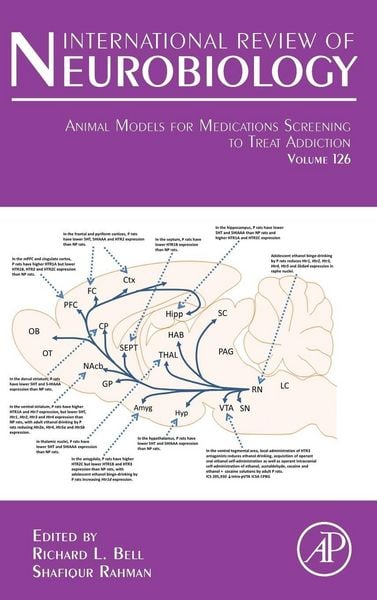
Animal Models for Medications Screening to Treat Addiction

154,99 €

inkl. gesetzl. MwSt., Versandkostenfrei


Beschreibung

Produktdetails

Einband

Gebundene Ausgabe

Erscheinungsdatum

08.04.2016

Herausgeber

Richard L. Bell + weitere

Verlag

Elsevier Science & Technology

Seitenzahl

564

Maße (L/B/H)

22,9/15,2/3,5 cm

Gewicht

994 g

Sprache

Englisch

ISBN

978-0-12-804013-3

Beschreibung

Rezension

"...an important contribution for addiction neurobiologists and those involved in drug screening/development...presents material that those in the addiction field, especially physicians, should be aware of in order to have a better understanding of addiction neurobiology and the rationales for various pharmacological interventions being used or evaluated. Score: 98 - 5 Stars!" --Doody's

Portrait

Dr. Bell received a Bachelor of Arts in General Psychology and Addiction Counseling from Minot State University (Minot, ND) and went on to receive a Master of Science and a Doctor of Philosophy in Applied Biopsychology, with a minor in Biostatistics, from the University of New Orleans (New Orleans, LA). He is presently an Associate Professor of Psychiatry at the Indiana University School of Medicine (Indianapolis, IN). He has been researching the in vivo effects of alcohol for 20 years and has maintained continuous funding from the National Institutes of Health-National Institute on Alcohol Abuse and Alcoholism for close to 15 years. His research during this time has focused on the behavioral genetics of rat lines selectively bred to consume high, vs very low, amounts of ethanol. The high ethanol-consuming rat lines display intakes corresponding with that of a 70 kg male drinking a fifth, or more, of 90-proof whiskey every day. These rat lines display many of the behavioral, physiological, neurochemical and genetic characteristics observed in clinical family history positive (FHP), for alcoholism, individuals; whereas the low ethanol-consuming rat lines serve as an animal model of family history negative (FHN) individuals. Moreover, these high ethanol-consuming rat lines meet established criteria for an animal model of alcoholism. Regarding this, he has written extensively on the genotypic as well as behavioral and neurochemical phenotypic characteristics of these and other major, international selectively bred high vs low ethanol-consuming rat lines. His more recent research has focused on three major areas: (1) innate and ethanol-induced changes in gene expression within subregions of the mesocorticolimbic and extended amygdala reward neurocircuits; (2) the acute as well as chronic behavioral and neurochemical effects of ethanol and/or nicotine exposure during adolescence and emerging adulthood; and (3) differences in the genetic, behavioral and neurochemical effects of binge-like, non-binge-like and relapse-like ethanol drinking and/or nicotine consumption. Scholastically, Dr. Bell has presented his findings to professional and lay audiences locally, nationally and internationally. He has published approximately 120 journal articles and book chapters. He serves as Associate Editor, Review Editor or Reviewer for over 50 international journals. He serves as a grant reviewer for the Veterans Affairs and the National Institutes of Health as well as multiple international academic institutions and is a member of the Research Society on Alcoholism-Animal Research and Ethics Committee.Shafiqur Rahman, Ph.D. is Professor of Pharmacology in the Department of Pharmaceutical Sciences at South Dakota State University (SDSU) in Brookings, USA. He received his Ph.D. in Neuropharmacology from the Memorial University of Newfoundland, Canada. Dr. Rahman completed his post-doctoral fellowship in the Department of Psychiatry from Indiana University School of Medicine in Indianapolis in USA. Prior to joining SDSU, he worked as research scientist and faculty at the University of Kentucky in Lexington, USA and the University of Toronto, Canada.

Dr. Rahman's research focus is drug discovery in neuropharmacology, i.e. the development of novel therapeutic candidates for the treatment of alcohol/nicotine addiction and neuropsychiatric disorders using animal models. His research resulted in over 200 publications/presentations, including peer-reviewed scientific articles, reviews, book chapters, meeting abstracts and seminar presentations. Dr. Rahman served on numerous scientific review panels and editorial boards of several scientific Journals. He has authored or edited multiple books or Journals in drug addiction and neuropharmacology field. Dr. Rahman is also affiliated with a number of professional organizations, including Society for Neuroscience and American Society for Pharmacology and Experimental Therapeutics.

Produktdetails

Einband

Gebundene Ausgabe

Erscheinungsdatum

08.04.2016

Herausgeber

Verlag

Elsevier Science & Technology

Seitenzahl

564

Maße (L/B/H)

22,9/15,2/3,5 cm

Gewicht

994 g

Sprache

Englisch

ISBN

978-0-12-804013-3

EU-Ansprechpartner

Kolibri 360 GmbH
Ettore-Bugatti-Straße 6-14
51149 Köln
DE
produktsicherheit@kolibri360.de

Herstelleradresse

Elsevier Science & Technology
125 London Wall
EC2Y 5AS London
GB
tradeorders@elsevier.com

Noch keine Bewertungen vorhanden

Verfassen Sie die erste Bewertung zu diesem Artikel

Helfen Sie anderen Kundinnen und Kunden durch Ihre Meinung.

Kundinnen und Kunden meinen

Bewertungen (0)

Die Leseprobe wird geladen.
  • Produktbild: Animal Models for Medications Screening to Treat Addiction
  • Produktbild: Animal Models for Medications Screening to Treat Addiction
  • 1. Animal models of Methamphetamine-abuse to screen pharamcotherapeutic interventions for addiction

      Arlington George Wilson

    2. Identification of treatment targets in a genetic mouse model of voluntary methamphetamine drinking

      Tamara J. Phillips

    3. Animal models for screening drugs to treat cannabis dependence: a translational perspective

      Bernard Le Foll

    4. Rodent models to screen clinically-effective smoking cessation agents

      Mohammed Shoaib

    5. An Animal Model of Alcohol Dependence to Screen Medications for Treating Alcoholism

      Howard C. Becker

    6. Variance in Ethanol Intake and Its Correlates Among Wistar Rats from Different Vendors: Its Impact on Medications Screening to Treat Alcohol Abuse and Dependence

      Ingrid Nylander

    7. Rat Lines Genetically Selected to Develop High Alcohol-Consuming Behavior and Dependence: Behavioral Correlates Paralleling Features Found in the Dually-Diagnosed Patient

      Erika Roman

    8. Screening Signature Compounds in the P and HAD Rat Animal Models of Alcoholism: A Survey of Results Focusing on Statistical Power and Effect Size

      Richard L. Bell

    9. Animal models and the development of vaccines to treat and/or prevent substance use disorders

      Colin N. Haile

    10. Genes and Excessive Alcohol Intake: Using Mutant Mice to Pinpoint Molecular Systems as Drugable Targets to Treat Alcohol Use Disorders

      Robert Adron Harris

    11. Gene Targeting Studies of Physical and Affective States of Alcohol Withdrawal in Rodents

      Gian D. Greenberg

    12. Abstinence Conflict Model: Toward an Optimal Animal Model for Human Drug Abstinence

      Joshua Alan Peck

    13. Prairie vole as a model to screen medications for the treatment of alcoholism and addictions: A Mini-Review

      Andrey E. Ryabinin

    14. Animal Models for Medication Development and Application to Treat Fetal Alcohol Effects

      Susan Barron

    15. Using In Vitro Electrophysiological Approaches to Screen for Novel Drug Targets: Accumbal Plasticity as an Engram of Alcohol Dependence

      Richard Morrisett

    16. C. elegans: A Behavioral Model System to Screen Medications for the Treatment of Addiction

      Eric A. Engleman

    17. Animal Models for Medications Screening Targeting the Treatment of Addiction: Caveats and Future Directions

      Shafiqur Rahman