KI-Beratung Beta

Gutscheinbedingungen

**Gültig bis 11.11.2026 auf Spielzeug, Schreibwaren, Filme, Geschenke & Trends, Musik, tolino eReader & Zubehör, Hörbücher und Hörbuch-Downloads, nicht preisgebundene Bücher und Kalender online auf thalia.at und in der Thalia App. Einzelne Artikel können ausgeschlossen sein. Aufgrund der Buchpreisbindung sind deutschsprachige Bücher und eBooks ausgenommen. Zusätzlich ausgenommen sind Abos & Flatrates, Games, Geschenkkarten/-boxen, Shelfies, Software, Zeitschriften sowie einzelne Artikel von tonies®. Pro Einkauf einmal einlösbar. Click & Collect nur bei Onlinevorabzahlung möglich. Keine Barauszahlung. Nicht kombinierbar mit anderen Aktionen und Gutscheinen. Gutschein wird auf max. 500€ Bestellwert angerechnet. Nicht gültig für Versandkosten und Services.

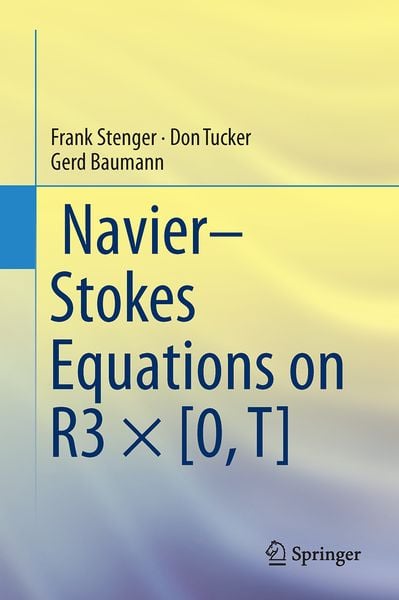
Produktbild: Navier–Stokes Equations on R3 × [0, T]
- 10%

Navier–Stokes Equations on R3 × [0, T]

10% sparen

98,99 € UVP 109,99 €

inkl. gesetzl. MwSt., Versandkostenfrei


Beschreibung

In this monograph, leading researchers in the world of numerical analysis, partial differential equations, and hard computational problems study the properties of solutions of the Navier–Stokes partial differential equations on (x, y, z, t) ∈ ℝ 3 × [0, T ]. Initially converting the PDE to a system of...

Beschreibung

In this monograph, leading researchers in the world of
numerical analysis, partial differential equations, and hard computational
problems study the properties of solutions of the Navier–Stokes

partial differential equations on (x, y, z,
t) ∈ ℝ
3
× [0,
T
]. Initially converting the PDE to a
system of integral equations, the authors then describe spaces
A
of analytic functions that house
solutions of this equation, and show that these spaces of analytic functions
are dense in the spaces
S
of rapidly
decreasing and infinitely differentiable functions. This method benefits from
the following advantages:


  • The functions of S are
    nearly always conceptual rather than explicit

  • Initial and boundary
    conditions of solutions of PDE are usually drawn from the applied sciences,
    and as such, they are nearly always piece-wise analytic, and in this case,
    the solutions have the same properties


  • When methods of
    approximation are applied to functions of
    A
    they converge at an exponential rate, whereas methods of
    approximation applied to the functions of
    S
    converge only at a polynomial rate

  • Enables sharper bounds on
    the solution enabling easier existence proofs, and a more accurate and
    more efficient method of solution, including accurate error bounds


Following the proofs of denseness, the authors prove the
existence of a solution of the integral equations in the space of functions
A
∩ ℝ
3
× [0,
T
], and provide an explicit novel
algorithm based on Sinc approximation and Picard–like iteration for computing
the solution. Additionally, the authors include appendices that provide a
custom Mathematica program for computing solutions based on the explicit
algorithmic approximation procedure, and which supply explicit illustrations of
these computed solutions.

Produktdetails

Einband

Gebundene Ausgabe

Erscheinungsdatum

04.10.2016

Abbildungen

X, 226 p. 25 illus. in color.

Verlag Springer

Produktdetails

Einband

Gebundene Ausgabe

Erscheinungsdatum

04.10.2016

Abbildungen

X, 226 p. 25 illus. in color.

Verlag Springer
Seitenzahl

226

Maße (L/B/H)

24,1/16/1,9 cm

Gewicht

472 g

Auflage

1st ed. 2016

Sprache

Englisch

ISBN

978-3-319-27524-6

Herstelleradresse

Springer-Verlag KG
Sachsenplatz 4-6
1201 Wien
AT

Email: ProductSafety@springernature.com

Noch keine Bewertungen vorhanden

Verfassen Sie die erste Bewertung zu diesem Artikel

Helfen Sie anderen Kundinnen und Kunden durch Ihre Meinung.

Kundinnen und Kunden meinen

Bewertungen (0)

  • Produktbild: Navier–Stokes Equations on R3 × [0, T]
  • Preface.- Introduction, PDE, and IE Formulations.- Spaces of Analytic Functions.- Spaces of Solution of the N–S Equations.- Proof of Convergence of Iteration 1.6.3.- Numerical Methods for Solving N–S Equations.- Sinc Convolution Examples.- Implementation Notes.- Result Notes.